
Threadworks: Anonymity and the Needle in Early Modern Italy
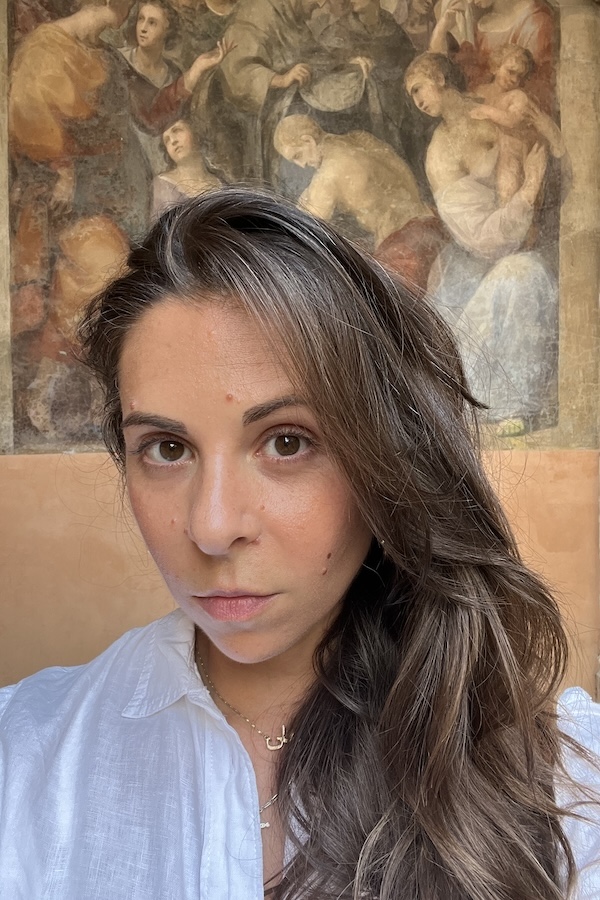
Meagan Khoury
Solmsen Fellow (2026–2027)
Stanford University (Ph.D. 2025)
Threadworks develops a bold argument: that threadwork (not painting or sculpture) should be considered a major medium of the early modern period. Specifically, I am concerned with the creation of luxury textiles in sixteenth-century Italy, such as silk, embroidery, and lace. From simple stitches bordering a linen tablecloth to the complex geometry of lace cuffs, such textiles were omnipresent in every home, convent, and court across Italy, produced by thousands of anonymous female makers. The sheer ubiquity of these threadworks and the obscurity of their makers have made these artworks unattractive objects of inquiry to art historians. The pieces that do come down to us often do so without names, dates, or precise places of origin. I seek to untangle the maligned history of women’s “ornamentation” with the needle – a history that can illuminate the origins of women’s labor practices and networks.
Threadworks sits at the nexus of art history and environmental humanities by focusing on the confluence of the sixteenth-century’s exploding interest in silk-making and its rich print culture. Through print, we can trace the trajectory from the earliest botanical studies of the mulberry tree; entomological treatises on silkworms; sericulture manuals; embroidery pattern books; and finally, to the finished needle arts themselves. Ultimately, the book addresses questions of colonization within labor networks, the politics of ornament, and the ways in which humans and nonhumans collaborate to produce cultural capital.
Dr. Meagan Khoury investigates art historical questions of gender in later medieval and early modern Europe. Her research and teaching interests lie at the intersection of ecofeminism, anonymous labor, and global luxury trade networks.
Khoury has previously published on the journey narratives of Eleanor Rykener, a trans woman from fourteenth-century London; and on St. Catherine of Siena’s metaphysical connection between the heart and breast. She co-edited the volume Medieval Mobilities: Gendered Bodies, Spaces, and Movements (Palgrave McMillan, 2023). Her doctoral research, “Brush, Needle, Knife: Women’s Creative Labor in Northern Italy, 1525-1650” was awarded the Christopher Meyer Prize in Art History at Stanford University. Khoury’s work has been supported by Fulbright, the Gladys Krieble Delmas Foundation, Bard Graduate Center, and the Folger Shakespeare Institute.
*Events currently open only to 2026-27 fellows due to space concerns; please contact IRH at info@irh.wisc.edu to be added to a cancellation list for in-person events.*