
Selected Fellow Books
IRH Fellowships have provided the research, community, and time in which book projects take shape. A selection of books and articles developed during IRH Fellowships is posted below, with most recent publications first.

Modernist Women and the Greek Chorus
McClure, L. Modernist Women and the Greek Chorus. New York: Oxford University Press, 2026.
IRH Fellow: Laura McClure (Senior Fellow, 2019–2023)
Synopsis: The disappearance of the chorus after antiquity—along with its association with female marginality, lyricism, and ritual authority in the Athenian drama that preserved it—rendered it an enigmatic vestige of the Greek past that invited innovative receptions by women from the early twentieth century onward. This book traces a feminine, and feminist, genealogy of the chorus from archaic Greece to the 1930s, focusing on three anglophone women whose work was profoundly shaped by it: the classicist Jane Harrison (1850–1928), the novelist Virginia Woolf (1882–1941), and the poet Hilda Doolittle (1886–1961), known as H.D. All three women were drawn to the chorus as the most elusive and unknowable aspect of Greek drama, envisioning it as fundamentally feminine in origin and identifying with its marginality, lyric power, and ritual authority.
As a literary anomaly with no modern parallel, the chorus, with its detachment from dramatic action, distinctive metrical form, and indeterminate language, offered an abstract medium through which to explore narrative fragmentation, temporal disjunctions, and polyphonic voice. Their pathbreaking work in the fields of classical scholarship, modernist fiction, and verse emerged in the wake of the nineteenth century, a period critical for the transmission and reception of Greek tragedy in Britain and the United States. Modernist Women and the Greek Chorus argues that these women not only reimagined the chorus from a feminist perspective, but in turn were themselves critical agents of its modernist reception, radically reshaping how their readers understood the Greek past. Their innovative scholarly and literary work further challenged traditional male academic Hellenism, which they viewed with skepticism, if not outright disdain, and opened the way for imaginative, feminist readings of Greek texts that ultimately expanded the field of classics beyond philology.
Fear of the False: Forensic Science and the Law of Crime in Colonial South Asia
IRH Fellow: Mitra Sharafi (Resident Fellow, 2016–2017)
Synopsis: Fear of the False uncovers colonial South Asia’s critical role in the development of forensic science. Around 1900, the government of British India created a web of institutions for the scientific detection of crime. Driven by anxieties about “native mendacity,” newly minted forensic analysts focused on uncovering faked evidence planted by South Asians. These experts, joining toxicologists known as “chemical examiners,” were supposed to extract objective, scientific truth in the service of British justice. But in trying to counteract the presumed tendency of colonized peoples to lie, the system enabled widespread misconduct by state experts, increasing the risk of wrongful convictions of South Asian defendants.
Through scrupulously documented legal cases, Mitra Sharafi reveals that colonial dynamics put special pressure on the relationship between truth and justice. Examining falsity on both sides of the law through the use of testing to (mis)identify poisons, blood, and spermatozoa, as well as debates over adversarialism and inquisitorialism in the colonial courtroom, Fear of the False explores advances in forensic science and shortcuts in criminal procedure against the backdrop of colonial mistrust.
Thanks to generous funding from the University of Wisconsin Law School, the ebook editions of this book are available as open access volumes through the Cornell Open initiative.
Anatomophilia: The Liberation of the Body
Das, D. Anatomophilia: The Liberation of the Body. Albany: SUNY Press, 2026.
IRH Fellow: Devaleena Das (Honorary Fellow, 2016–2017)
Synopsis: Drawing from South Asian, Indigenous, feminist, and queer philosophies of Kālī’s body, at once beautiful and abominable, wounded and regenerative, violated and resistant, Anatomophilia develops the theory of anatomophilia as a radical love and reverence for diverse anatomies. Moving across medical education and clinical encounters, embodied histories of migration, dance and performance, protest in the streets, visual art, and everyday bodily rituals, Devaleena Das argues that Global South bodies do not merely illustrate theory; they think, resist, and generate knowledge through touch, affect, grief, and resilience. Challenging disembodied and technocratic models of justice and care, she offers an ethically demanding framework for teaching, learning, and practicing medicine and care differently. Essential reading for scholars in health humanities and social sciences, clinicians, and students of feminist, queer, and justice studies, Anatomophilia speaks to urgent questions about embodiment, care, and what it means to live and love through the body.

Pastoral’s End: Art, Ecology, and Catastrophe in Renaissance Italy
IRH Fellow: James Pilgrim (Solmsen Fellow, 2021–2022)
Synopsis: In the sixteenth century, Italian artist Jacopo Bassano painted pictures of herdsmen and animals moving through dark and muddy landscapes. But he also participated in the agricultural development of the region in which he lived, producing topographical maps of local mountains and forests, inventing new methods of drainage and irrigation, and studying the latest techniques of crop rotation and fertilization. The relationship between Bassano’s rustic art and his participation in environmental transformation has, however, never been explored. One of the first studies of Italian Renaissance art to grapple with the connections between visual culture and the environment, Pastoral’s End explores this crucial, formative relationship. James Pilgrim looks at Bassano’s career holistically, demonstrating how his involvement in a world marked by agricultural expansion, industrialization, resource extraction, environmental degradation, social transformation, and radical philosophical development informed his paintings of country life. Introducing new archival and visual evidence of Bassano’s knowledge of hydrology, agronomy, husbandry, and architecture, Pastoral’s End argues that he transformed the more placid rustic imagery of previous Renaissance artists into visions of dangerous ecological instability.
Beer Ghosts: In Search of Lost Hops and the Women Who Grew Them
IRH Fellow: Jennifer Jordan (UW System Fellow, 2022–2023)
Synopsis: Water, malt, yeast, and hops: these are essential ingredients of beer. Hops, specifically, play an outsized role in determining its flavor and aroma. In Beer Ghosts, Jennifer Jordan takes us back to a brief but pivotal moment in the nineteenth century when Wisconsin produced much of the hops grown in the United States. Yet those long-ago hops are not the only ghosts in Jordan’s story. Haunting the pages of this book are the young women whose work at harvest time was key to the rise of the American beer industry. Until the early twentieth century, the work of picking hops was a time-consuming process that could only be done by hand, one cone at a time. In nineteenth-century Wisconsin, that work was performed almost exclusively by women and girls, who traveled to hop farms in droves as summer came to a close and the harvest began. At the height of the hop boom in the 1860s, farmers and their families laid out beds and prepared food for tens of thousands of seasonal laborers, and hosted parties and dances well into the night. Despite the scale of Wisconsin’s hop boom (and subsequent crash), the industry left behind little trace aside from local records and archives. And it is that barely discernible trace that lures Jordan to dig deeper. Jordan’s vivid prose takes us back to this era by drawing on a rich trove of archival sources, from the thousands of hop farmers in the agricultural census to the extraordinary diary of a single hop picker, a young woman named Ella. The history of beer is incomplete without the history of Ella and the others who labored in the hop fields and in the houses that hosted them. In this book, Jordan gives life and voice to these beer ghosts who call to us from the past, showing the rich connections between a nation’s beer and the lives that made it possible.
A World of Piety: The Aims of Castilian Kabbalah
IRH Fellow: Jeremy Phillip Brown (Kingdon Fellow, 2023–2024)
Synopsis: What were the aims of the celebrated works of rabbinic wisdom fashioned during the reigns of Alfonso X and Sancho IV of Castile, including the formative Book of the Zohar? In pursuit of this question, Judaica scholar Jeremy Phillip Brown turns to the Hebrew and Aramaic writings composed by Todros ben Joseph ha-Levi Abulafia of Toledo, Joseph Gikatilla of Medinaceli, and especially Moses de León of Guadalajara. These writings set out to disseminate the secret patrimony of ancients: a knowledge of divinity comprised of essentially Jewish attributes as a basis for human emulation. According to these texts, God models a pious form of life—not merely a life of Torah and the commandments, but a program exceeding the norms of religious obligation. Midnight vigils for prayer and study, guarding the eyes and tongue, sexual austerity, spiritual poverty and concern for the materially poor—the texts affirm that God exemplifies these and other modes of piety, prompting their imitation as a penitential means of individual and even social transformation. By means of their writings, the Castilian authors sought to form penitents as “other people” created anew in the Judeomorphic image of God. A World of Piety sheds light on the core motivations of a discourse that would emerge as a major domain of religion and thought by reconstructing the socio-historical ambitions of a little-known cadre of medieval rabbis active in a Christian milieu.
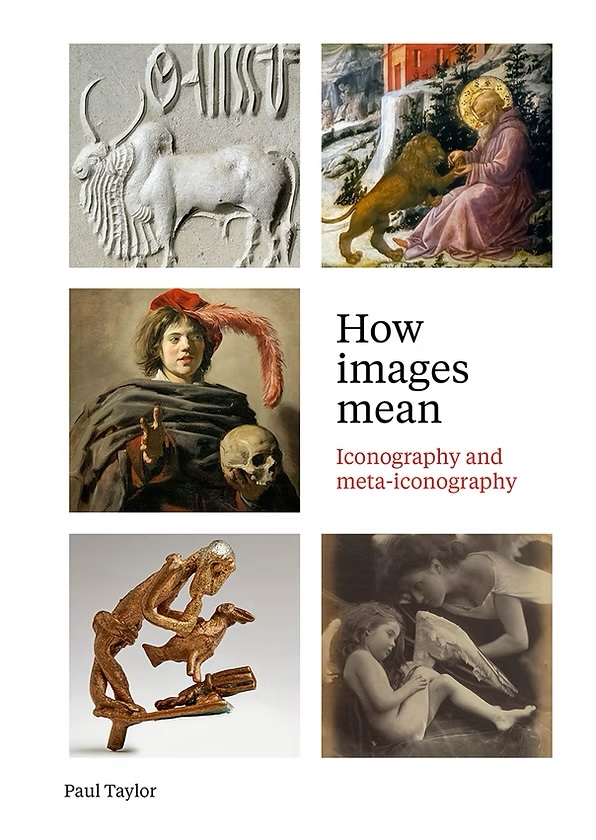
How Images Mean: Iconography and Meta-iconography
IRH Fellow: Paul Taylor (Solmsen Fellow, 2020–2021) Synopsis: This groundbreaking study interrogates a rich and diverse repertoire of images from all over the world to answer the fundamental question: how are the meanings of images assigned, conveyed and recognized? Combining art history, anthropology, philosophy and linguistics, the book expands the field of traditional iconography, which explains what images mean, by introducing new, useful categories that enable us to understand how images mean (meta-iconography). In his study of iconography from a century ago Erwin Panofsky famously discussed what an “Australian bushman” might make of Leonardo’s Last Supper: though unaware of the religious story, the Aboriginal viewer would have known it was a picture of humans eating a meal together. Paul Taylor’s book argues that this gets the question the wrong way round. We only know the painting depicts people at supper if we know it represents a supper. It is through knowing the cultural context that we can interpret the contents of an image. Universal in scope and profoundly topical at a time when artificial intelligence is redefining our visual horizon, this book represents a resource for scholars in a variety of fields and a thought-provoking read for all those interested in art.
Queer Lasting: Ecologies of Care for a Dying World
Ensor, S. Queer Lasting: Ecologies of Care for a Dying World. New York: NYU Press, 2025.
IRH Fellow: Sarah Ensor (Resident Fellow, 2023–2024) Synopsis: What does it mean to live at the end of life, the end of a family line, the end of a species, or the end of the future itself? When faced with unfurling catastrophes, environmentalists often limit the conversation by focusing on the future. Activists work for the welfare of future generations, while scientists labor over projections of future outcomes. In Queer Lasting, Sarah Ensor asks what this emphasis on the future makes unthinkable. She looks to queer scenes of futurelessness to consider what ecocriticism can learn from queer theory, which imagines and inhabits the immanent ethical possibilities of a terminal present. While living “at the last” is often a terrifying prospect, queer culture reminds us that “to last” is itself also one way to go on. Defining queerness as a mode of collective life in which these paradigms of lasting—ending and persisting—are constitutively intertwined, Ensor turns to two periods of queer extinction for models of care, continuance, and collective action predicated on futurelessness: the 1890s, in which existing forms of erotic affiliation were extinguished through the binary of homo/heterosexuality, and the 1980s, in which the spread of the AIDS epidemic threatened the total loss of gay lives and of specific erotic ways of life. Through readings that trace unexpected formal resonances across the works of Sarah Orne Jewett, Willa Cather, Melvin Dixon, Essex Hemphill, Allen Barnett, and Samuel Delany, Queer Lasting maintains that queer writing, in its intimacy with death and loss, offers a rich archive for imagining new ways of thinking through environmental collapse. Whether confronting the epidemic contours of the AIDS crisis, theorizing the temporary encounters of cruising, or reckoning with the lives of non-reproductive subjects, this book about futurelessness is also a book about persistence. It demonstrates how, far from giving up in the face of the terminal paradigms that environmentalism fears, queer culture has instead predicated its living—and its lasting—upon them.
The Unruly Tongue: Speech and Violence in Medieval Italy
IRH Fellow: Melissa Vise (Solmsen Fellow, 2017–2018) Synopsis: The Unruly Tongue, a cultural history of speech in medieval Italy, offers a new account of how the power of words changed in Western thought. Despite the association of freedom of speech with the political revolutions of the eighteenth century that ushered in the era of modern democracies, historian Melissa Vise locates the history of the repression of speech not in Europe’s monarchies but rather in Italy’s republics. Exploring the cultural process through which science and medicine, politics, law, literature, and theology together informed a new political ethics of speech, Vise uncovers the formation of a moral code where the regulation of the tongue became an integral component of republican values in medieval Europe. The medieval citizens of Italy’s republics understood themselves to be wholly subject to the power of words not because they lived in an age of persecution or doctrinal rigidity, but because words had furnished the grounds for their political freedom. Speech-making was the means for speaking the republic itself into existence against the opposition of aristocracy, empire, and papacy. But because words had power, they could also be deployed as weapons. Speech contained the potential for violence and presented a threat to political and social order, and thus needed to be controlled. Vise shows how the laws that governed and curtailed speech in medieval Italy represented broader cultural understandings of human susceptibility to speech. Tracing anthropologies of speech from religious to political discourse, from civic courts to ecclesiastical courts, from medical texts to the works of Dante and Boccaccio, The Unruly Tongue demonstrates that the thirteenth century marked a major shift in how people perceived the power, and the threat, of speech: a change in thinking about “what words do.”
Banished Citizens A History of the Mexican American Women Who Endured Repatriation
IRH Fellow: Marla A. Ramírez (Race, Ethnicity, and Indigeneity Fellow, 2023–2024) Synopsis: From 1921 to 1944, approximately one million ethnic Mexicans living in the United States were removed across the border to Mexico. What officials called “repatriation” was in fact banishment: 60 percent of those expelled were US citizens, mainly working-class women and children whose husbands and fathers were Mexican immigrants. Drawing on oral histories, transnational archival sources, and private collections, Marla A. Ramírez illuminates the lasting effects of coerced mass removal on three generations of ethnic Mexicans. Ramírez argues that banishment served interests on both sides of the border. In the United States, the government accused ethnic Mexicans of dependence on social services in order to justify removal, thereby scapegoating them for post–World War I and Depression-era economic woes. In Mexico, meanwhile, officials welcomed returnees for their potential to bolster the labor force. In the process, all Mexicans in the United States—citizens and undocumented immigrants alike—were cast as financially burdensome and culturally foreign. Shedding particular light on the experiences of banished women, Ramírez depicts the courage and resilience of their efforts to reclaim US citizenship and return home. Nevertheless, banishment often interrupted their ability to pass on US citizenship to their children, robbed their families of generational wealth, and drastically slowed upward mobility. Today, their descendants continue to confront and resist the impact of these injustices—and are breaking the silence to ensure that this history is not forgotten. A wrenching account of expulsion and its afterlives, Banished Citizens illuminates the continuing social, legal, and economic consequences of a removal campaign still barely acknowledged in either Mexico or the United States.
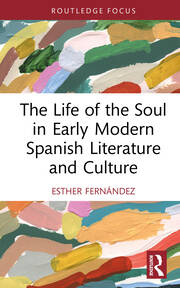
The Life of the Soul in Early Modern Spanish Literature and Culture
IRH Fellow: Ester Fernández (Biruté Ciplijauskaité Postdoctoral Fellow, 2023–2025) Synopsis: Understanding the soul’s essence is an elusive pursuit, rendering any attempt to write about it akin to grasping at a mirage. As a sublime subject, the soul has captivated human thought for centuries. How do we approach it? How can we define its boundaries? This exploration offers an experimental investigation into the soul’s complexities during one of Spain’s most turbulent periods—the dawn of modernity. Set against the spiritual backdrop of the 17th century, these reflections examine how materiality ensnared individuals in artifice, often neglecting expansionism’s social and political consequences. The Twelve Years’ Truce (1609) and the Thirty Years’ War (1618–1648) marked critical moments of instability, further compounded by economic depression and social turmoil. In this landscape of despair, the Spanish soul sought refuge inwardly and through indulgence in worldly pleasures. Through metaphysical inquiry, emotional depth, and the role of animated matter in art and theater, this book reflects on existence amid the illusions of early modern Spain.
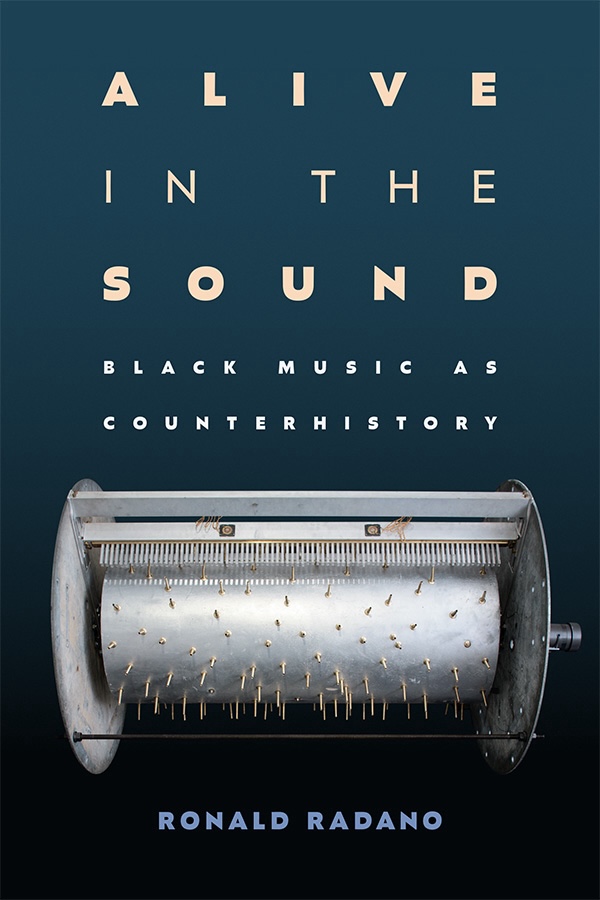
Alive in the Sound: Black Music as Counterhistory
IRH Fellow: Ronald Radano (Senior Fellow, 2013–2017) Synopsis: In Alive in the Sound, Ronald Radano proposes a new understanding of US Black music by focusing on the key matter of value, manifested musically in its seemingly embodied qualities—spirit, soul, and groove. While acknowledging these qualities are always embedded in Black music, Radano shows they developed not simply from performance but from musicians’ status as laborers inhabiting an enduring racial-economic contradiction: Black music originated publicly as an exchangeable property owned by people whose subhuman status granted them—as “natural” musicians—indelible properties of sound. As a contradiction of the rules of ownership, wherein enslaved property was forbidden the right to own, modern Black music emerges after emancipation as a primary possession, moving dialectically into commercial markets and counterhistorically back into Black worlds. Slavery’s seminal contests of ownership underlie modern musical sensations of aliveness, which become the chief measure of value in popular music. By reconceiving US Black music history as a history of value, Radano rethinks the music’s place in US and global culture.
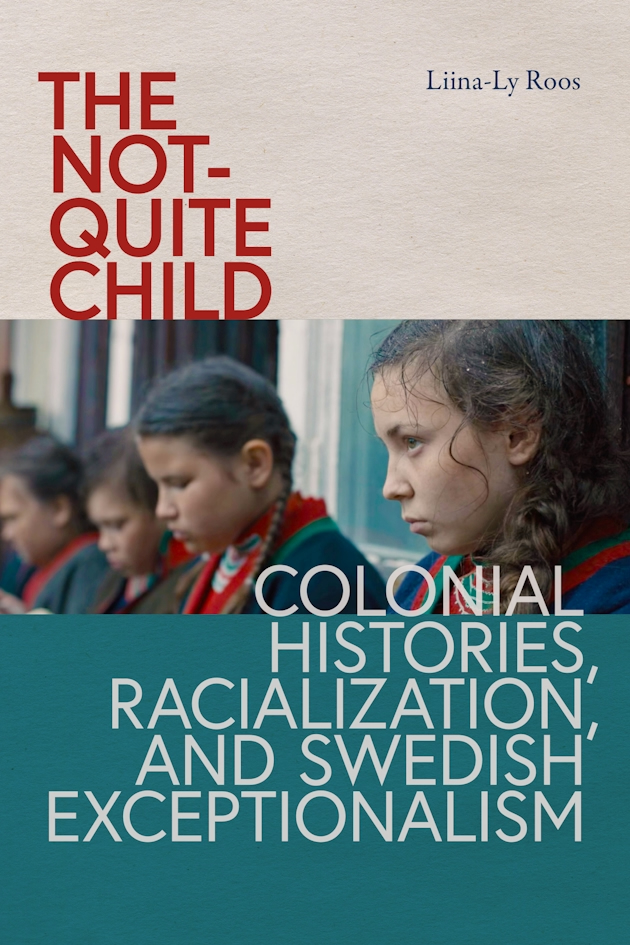
The Not-Quite Child: Colonial Histories, Racialization, and Swedish Exceptionalism
IRH Fellow: Liina-Ly Roos (open-topic Resident Fellow, 2024–2025) Synopsis: Figures like Pippi Longstocking and Greta Thunberg exemplify an ideal mainstream Swedish childhood: they are autonomous, competent, and the voices of moral truths. In this innovative work, Liina-Ly Roos analyzes the figure of the “not-quite child”—children who, while appearing white, have been marginalized due to historical racialization and colonialism—to challenge this established ideal. Through analyses of films and literature that portray Indigenous Sámi, Tornedalian, and Finnish-speaking children, The Not-Quite Child reveals how these figures disrupt the normative understanding of growing up in Sweden. These cultural texts are filled with tensions of assimilation, invisibility, and the struggle to grow in a society that demands conformity to a specific “Swedishness.” The children in these stories are both minoritized and, at the same time, have the privilege of passing, and share a long cultural history with and within the dominant culture. Through nuanced attention to these important narratives, The Not-Quite Child contributes to dialogue on the complexities of identity, race, and the hidden colonial legacies that continue to shape understandings of childhood in Sweden.
More Than Words: How Talking Sharpens the Mind and Shapes Our World
IRH Fellow: Maryellen MacDonald (SHRF Fellow, 2019) Synopsis: Humans are the only species that can transform internal ideas into talk, whether through speech, writing, or sign language. But why do we have this almost magical, special talent? It turns out that while talking allows us to share ideas and connect with one another, it isn’t just for communication. Other benefits of talking stem from the fact that it is hard work: we can understand speech up to 50 percent faster than we can create it ourselves. The complex processes in the brain that allow us to talk spill over and impact other areas of our lives in surprising ways. In this groundbreaking book, Maryellen MacDonald, a researcher and psycholinguist, explores the marvel and mental task of talking and offers an eye-opening look at how it shapes everything from our attention, memory, and the way we learn to how we regulate our emotions and our cognitive health as we age. Filled with fascinating insights, More Than Words reveals: • how languages all over the world bend to the demands of talking • how talking helps us set goals and acts as a learning engine • the link between speech patterns and mental illness • why conversations in classrooms are crucial • how talking can amplify the talker’s political polarization • how talking can slow cognitive decline as we age Engaging and illuminating, More Than Words has lessons that have the power to transform education policy, parenting, psychology, and more. It is a sweeping and provocative look at a fundamental human behavior we take for granted.
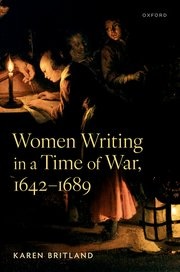
Women Writing in a Time of War, 1642–1689
Britland, K. Women Writing in a Time of War, 1642–1689. New York: Oxford University Press, 2025.
IRH Fellow: Karen Britland (Resident Fellow, 2013–2014) Synopsis: Women Writing in a Time of War, 1642-1689 explores the stereotype of the apolitical woman who was nevertheless valuable as a messenger or secret agent during the English civil wars, not least because her imagined lack of political acumen obscured her partisan behaviour. It examines the interconnections between early modern men and women’s cultural production, analyzing the secret writing and communication strategies employed by agents and spies during the wars and arguing that an attention to clandestine modes of writing provides new insights into women’s literary production during the conflict. Encouraging us to understand such literary production differently, Britland offers a new history of early modern political writing, one deeply imbricated in-but by no means exclusively focused on-the literary work and experiences of women, the non-elite, and the racially marginalized in early modern England and its colonial trade networks. An attentiveness to the narrative strategies deployed by women writers during the English civil wars also helps us to think about the long histories subtending our own reading and writing practices. Not only does the relative invisibility of female agents in our own historiography reveal a persistent tendency in contemporary criticism to overlook women’s contributions to major historical events, but, the book argues, the early modern instrumentalization of women’s bodies-particularly the bodies of women from non-elite backgrounds who acted as couriers within elite communication networks-acts as a caution against adopting contemporary methods of reading (particularly computer-aided reading) that can downplay or ignore the contributions of women and non-elite people. This book makes a case for not separating our discussions of women from those of men, nor for privileging analyses of the rich over those of the poor, at the same time as it remains deeply embedded in the literary, material, and merchant cultures of later seventeenth-century England.
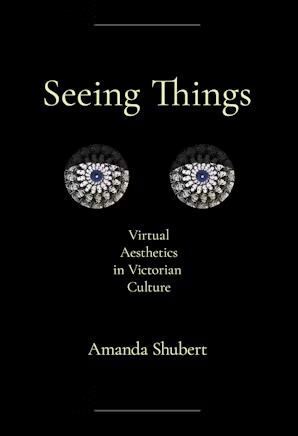
Seeing Things Virtual Aesthetics in Victorian Culture
IRH Fellow: Amanda Shubert (ACLS Resident Fellow, 2023–2024) Synopsis: A cultural history of nineteenth-century media imaginaries, Seeing Things tells the story of how Victorians experienced the virtual images created by modern optical technologies—magic lanterns, stereoscopes, phenakistoscopes, museum displays, and illusionistic stage magic. Amanda Shubert argues that interactions with these devices gave rise to a new virtual aesthetics—an understanding of visual and perceptual encounters with things that are not really there. The popularization of Victorian optical media redefined visuality as a rational mode of spectatorship that taught audiences to distinguish illusion from reality. As an aesthetic expression of a civilizational ideal that defined the capacity to see but not believe, to be entertained without being deceived, it became a sign of western supremacy. By tracing the development of virtual aesthetics through nineteenth-century writings, from the novels of George Eliot and Charles Dickens to popular science writing and imperial travelogues, Seeing Things recovers a formative period of technological and literary innovation to explain how optical media not only anticipated cinema but became a paradigmatic media aesthetic of western modernity.
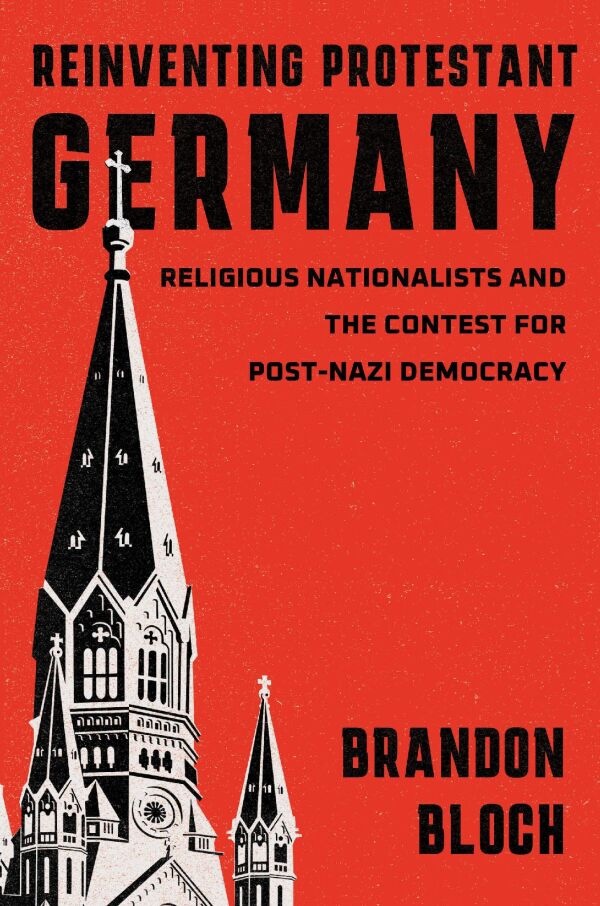
Reinventing Protestant Germany: Religious Nationalists and the Contest for Post-Nazi Democracy
IRH Fellow: Brandon Bloch (Resident Fellow, 2023–2024) Synopsis: Germany’s Protestant churches, longtime strongholds of nationalism and militarism, largely backed the Nazi dictatorship that took power in 1933. For many Protestant leaders, pastors, and activists, national and religious revival were one and the same. Even those who opposed the regime tended toward antidemocratic attitudes. By the 1950s, however, Church leaders in West Germany had repositioned themselves as prominent advocates for constitutional democracy and human rights. Brandon Bloch reveals how this remarkable ideological shift came to pass, following the cohort of theologians, pastors, and lay intellectuals who spearheaded the postwar transformation of their church. Born around the turn of the twentieth century, these individuals came of age amid the turbulence of the Weimar Republic and were easily swayed to complicity with the Third Reich. They accommodated the state in hopes of protecting the Church’s independence from it, but they also embraced the Nazi regime’s antisemitic and anticommunist platform. After the war, under the pressures of Allied occupation, these Protestant intellectuals and their heirs creatively reimagined their tradition as a fount of democratic and humanitarian values. But while they campaigned for family law reform, conscientious objection to military service, and the protection of basic rights, they also promoted a narrative of Christian anti-Nazi resistance that whitewashed the Church’s complicity in dictatorship and genocide. Examining the sources and limits of democratic transformation, Reinventing Protestant Germany sheds new light on the development of postwar European politics and the power of national myths.
Law, Visual Culture, and the Show Trial
Fijalkowski, A. Law, Visual Culture, and the Show Trial. Oxfordshire, UK: Routledge, 2024.
IRH Fellow: Agata Fijalkowski (Honorary Fellow, 2022-2023) Synopsis: Addressing the relationship between law and the visual, this book examines the importance of photography in Central, East, and Southeast European show trials. The dispensation of justice during communist rule in Albania, East Germany, and Poland was reliant on legal propaganda, making the visual a fundamental part of the legitimacy of the law. Analysing photographs of trials, this book examines how this message was conveyed to audiences watching and participating in the spectacle of show trials. The book traces how this use of the visual was exported from the Soviet Union and imposed upon its satellite states in the immediate aftermath of the Second World War. It shows how the legal actors and political authorities embraced new photographic technologies to advance their legal propaganda and legal photography. Drawing on contemporary theoretical work in the area, the book then challenges straightforward accounts of the relationship between law and the visual, critically engaging entrenched legal historical narratives, in relation to three different protagonists, to offer the possibility of reclaiming and rewriting past accounts. As its analysis demonstrates, the power of images can also be subversive; and, as such, the cases it addresses contribute to the discourse on visual epistemology and open onto contemporary questions about law and its inherent performativity. This original and insightful engagement with the relationship between law and the visual will appeal to legal and cultural theorists, as well as those with more specific interests in Stalinism, and in Central, East, and Southeast European history.
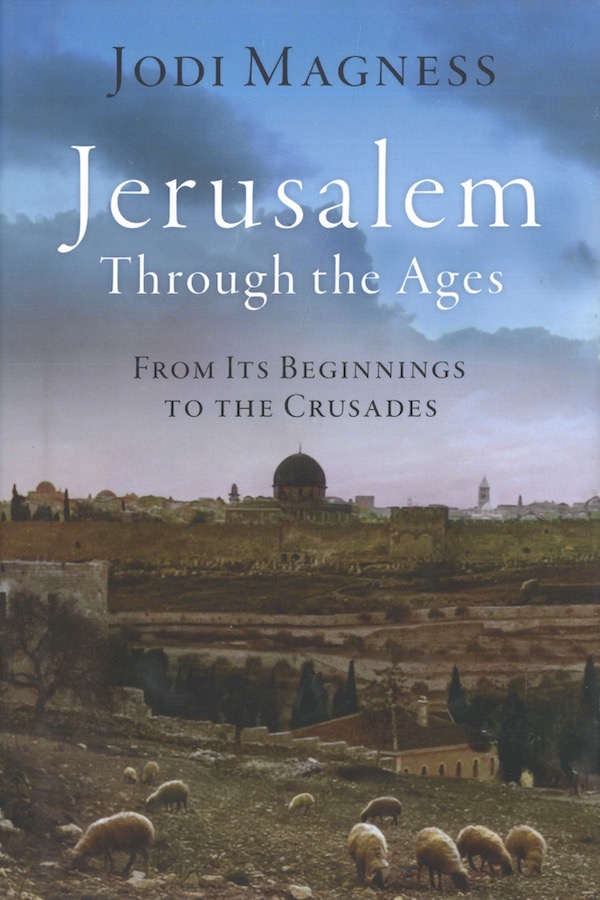
Jerusalem Through the Ages
Magness, J. Jerusalem Through the Ages. Oxford, UK: Oxford University Press, 2024.
IRH Fellow: Jodi Magness (Kingdon Fellow, 2021-2022) Synopsis: A major new history of one of the world’s holiest of cities, based on the most recent archaeological discoveries First settled five thousand years ago by a mountain spring between the Mediterranean and Dead Sea, Jerusalem was named for the god (Shalem) that was worshipped there. When David reportedly conquered the city, ca. 1000 BCE, he transferred the Ark of the Covenant–and with it, the presence of the God of Israel–to this rocky outcrop. Here, David’s son Solomon built a permanent house for the God of Israel called the first temple, and since then this spot has been known as the Temple Mount. After Babylonians destroyed Solomon’s temple in 586 BCE, it was replaced by the second temple, which is the setting for many of the events described in the Gospel accounts. In 70 CE, the Romans destroyed Jerusalem, leaving the Temple Mount in ruins. Two hundred and fifty years later, the emperor Constantine constructed the Church of the Holy Sepulcher around the spots where Jesus is believed to have been crucified and buried, and the church is now considered Jerusalem’s holiest site by many Christians worldwide. In the late seventh century CE the focus shifted back to the Temple Mount, when an early Islamic ruler named Abd al-Malek enshrined the rocky outcrop in a monument that is still iconic of the city today: the Dome of the Rock. In 1099 Crusaders conquered Jerusalem, and although their rule was brief rule they left a deep impact on the city. Today, much of the old city retains its medieval appearance. For followers of the three Abrahamic faiths, Jerusalem is the place where the presence of the God of Israel dwells–the meeting point of heaven and earth and the locus of divine and human interaction. Jerusalem through the Ages by Jodi Magness explores how these beliefs came to be associated with the city by introducing readers to its complex and layered history, providing a broad yet detailed account, including the most recent archaeological discoveries. Each chapter focuses on a key moment of transition from Jerusalem’s beginnings to the Crusades of the medieval period, enabling readers to experience the city’s many transformations as it changed hands and populations-Jebusites, Israelites, Judahites, Persians, Greeks, Romans, Jews, Christians, and Muslims. The book also includes a walking guide for visitors who wish to experience the city’s many archaeological sites firsthand.
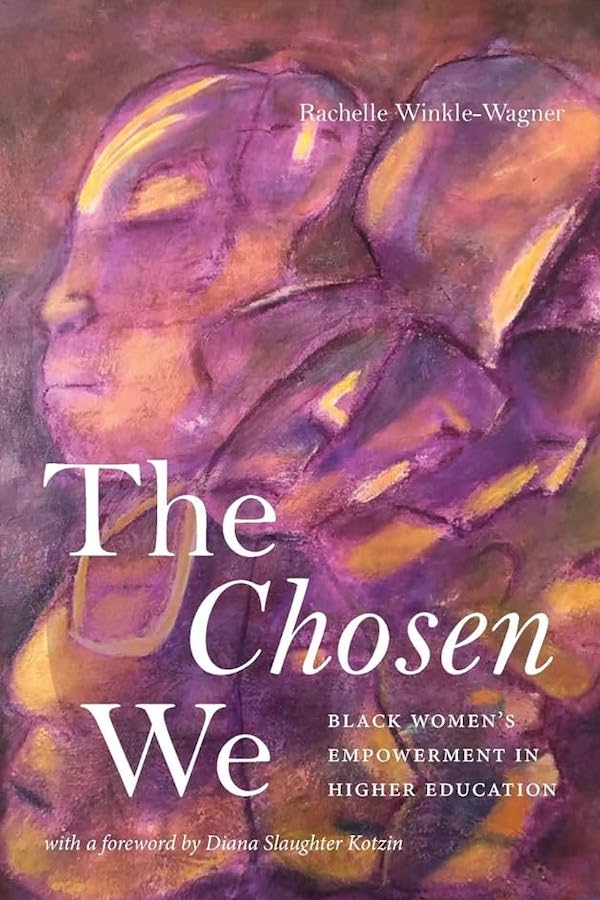
The Chosen We: Black Women’s Empowerment in Higher Education
IRH Fellow: Rachelle Winkle-Wagner (Race, Ethnicity, and Indigeneity Fellow, 2018-2019) Synopsis: The Chosen We elevates the oral histories of 105 accomplished, college-educated Black women who earned success despite experiencing reprehensible racist and sexist barriers. The central argument is that these women succeeded in and beyond college by developing a Chosen We—a community with one another. The book builds on their words and insights to offer a powerful rethinking of educational success that moves away from individualistic and competitive models and instead imagines success as a result of recognizing what people owe to one another. It also uncovers the importance of the type of institutions that students attend for higher education, comparing Black women’s experiences not only by region and era but also by whether they attended a predominantly White institution (PWI) or a historically Black college or university (HBCU). The Chosen We features theoretical and methodological exemplars for how to conduct research across lines of difference. The Black women’s oral histories shared here manifest the wisdom from which many groups in the United States might benefit—that liberation is only found through community.
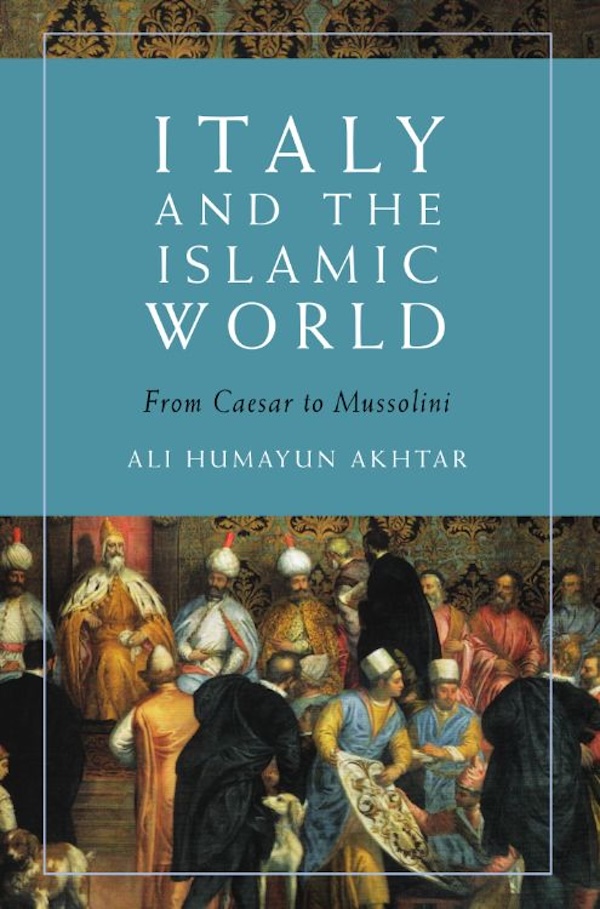
Italy and the Islamic World: From Caesar to Mussolini
IRH Fellow: Ali Humayun Akhtar (Kingdon Fellow, 2015-2016) Synopsis: Italy and the Islamic World tells the story of how Italian cities have been centres of international exchange for centuries, linking Europe with the most storied marketplaces of the Middle East and North Africa. From the Ancient Roman period and the Renaissance to the rise of the Italian Republic, Italy has been a global crossroads for more than two millennia. In Ali Humayun Akhtar’s new picture of European history, Italy’s debates about trade with its southern neighbours evoke an earlier era of encounters – one that sheds light on where the EU is heading today. Beginning with the fall of Ancient Rome and the rise of the Papal State, Ali Humayun Akhtar traces the stories of merchants and diplomats among the peninsula’s Pisans, Genoese, Venetians, Florentines and Livornans as they navigated cultural difference in pursuit of commerce and adventure. Their stories offer a colourful picture of the connections between the peninsula and the Islamic world that survived the turmoil of Napoleon’s conquests and two World Wars. By the 20th century, following the Italian Unification (Risorgimento), Livorno and Cairo became cultural centres of Italian-speaking Roman Catholic, Greek and Jewish communities who navigated democratic revolutions and new discourses around nationhood.
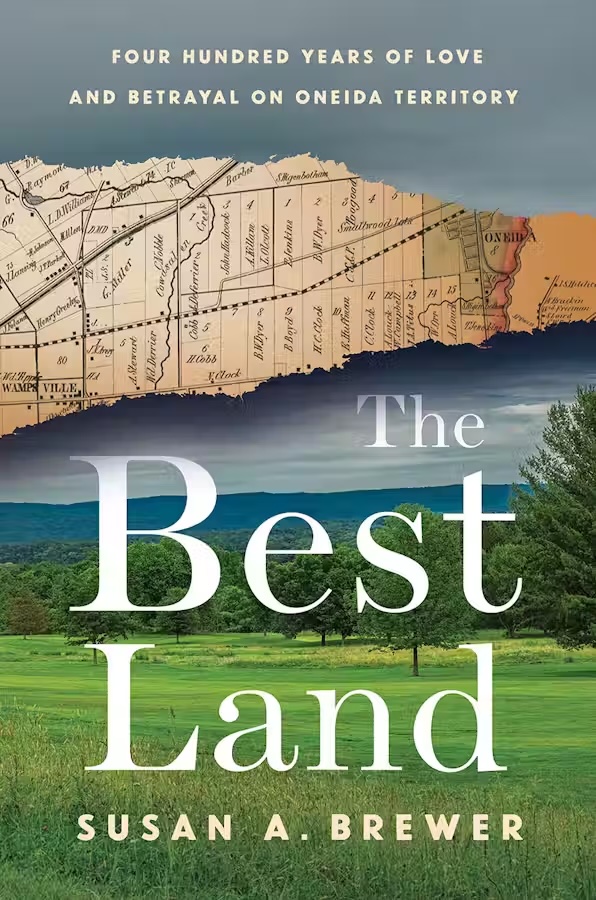
The Best Land
Brewer, S. A. The Best Land. Ithaca, NY: Cornell University Press, 2024.
IRH Fellow: Susan A. Brewer (UW System Fellow, 2014–2015) Synopsis: In Susan A. Brewer’s fascinating The Best Land, she recounts the story of the parcel of central New York land on which she grew up. Brewer and her family had worked and lived on this land for generations when the Oneida Indians claimed that it rightfully belonged to them. Why, she wondered, did she not know what had happened to this place her grandfather called the best land. Here, she tells its story, tracing over the past four hundred years the two families—her own European settler family and the Oneida/Mohawk family of Polly Denny—who called the best land home. Situated on the passageway to the west, the ancestral land of the Oneidas was coveted by European colonizers and the founders of the Empire State. The Brewer and Denny families took part in imperial wars, the American Revolution, broken treaties, the building of the Erie Canal, Native removal, the rise and decline of family farms, bitter land claims controversies, and the revival of the Oneida Indian Nation. As Brewer makes clear in The Best Land, through centuries of violence, bravery, greed, generosity, racism, and love, the lives of the Brewer and Denny families were profoundly intertwined. The story of this homeland, she discovers, unsettles the history she thought she knew. With clear determination to tell history as it was, without sugarcoating or ignoring the pain and suffering of both families, Brewer navigates the interconnected stories with grace, humility, and a deep love for the land. The Best Land is a beautiful homage to the people, the place, and the environment itself.
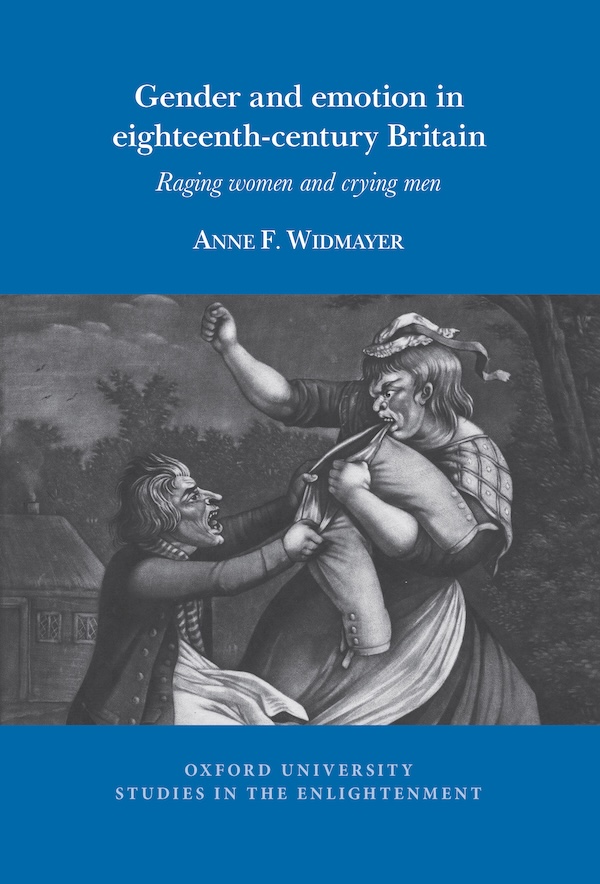
Gender and Emotion in Eighteenth-Century Britain: Raging Women and Crying Men
IRH Fellow: Anne F. Widmayer (UW System Fellow, 2021–2022) Synopsis: Gender and Emotion in Eighteenth-Century Britain: Raging Women and Crying Men investigates emotional excess from the perspectives of performance studies, gender studies, and cultural studies. For the seventeenth and eighteenth centuries in Britain, “raging women” and “crying men” illustrate how gender affects an audience’s willingness to accept emotional performances. Female rage and male despair were both associated with the stage where their excessiveness was singularly allowed—if often also criticized. When these emotions appeared in prose works, they were often portrayed as exaggerated, manipulative performances. In this monograph, Anne F. Widmayer argues that female rage and male despair are both precipitated by power inequities. Female rage defies gender inequality, whereas male weeping reinforces gender ranking. Women’s rage assumes men’s power; men’s grief reveals their feminine weakness. Angry women and grieving men were thus viewed as equally monstrous because they upset contemporary gender roles. Employing the figures of Medea, Odysseus, and Achilles, Widmayer surprisingly delineates how stoicism and sentimentalism coexisted for much of the eighteenth century. As the far more taboo emotion, women’s rage had to be suppressed in order to maintain a distinction between masculinity and femininity. To sometimes cry like women did not significantly lessen men’s privilege, but to allow angry women to act like men risked endangering the gendered power structure of the eighteenth century.
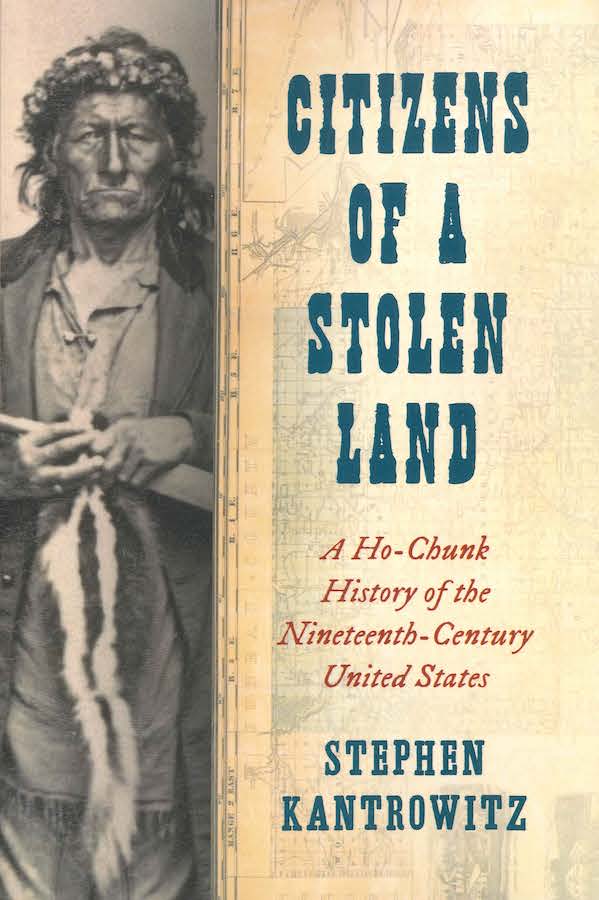
Citizens of a Stolen Land: A Ho-Chunk History of the Nineteenth-Century United States
IRH Fellow: Stephen Kantrowitz, Senior Fellow (2017-2021) Synopsis: This concise and revealing history reconsiders the Civil War era by centering one Native American tribe’s encounter with citizenship. In 1837, eleven years before Wisconsin’s admission as a state, representatives of the Ho-Chunk people yielded under immense duress and signed a treaty that ceded their remaining ancestral lands to the U.S. government. Over the four decades that followed, as “free soil” settlement repeatedly demanded their further expulsion, many Ho-Chunk people lived under the U.S. government’s policies of “civilization,” allotment, and citizenship. Others lived as outlaws, evading military campaigns to expel them and adapting their ways of life to new circumstances. After the Civil War, as Reconstruction’s vision of nonracial, national, birthright citizenship excluded most Native Americans, the Ho-Chunk who remained in their Wisconsin homeland understood and exploited this contradiction. Professing eagerness to participate in the postwar nation, they gained the right to remain in Wisconsin as landowners and voters while retaining their language, culture, and identity as a people. This history of Ho-Chunk sovereignty and citizenship offer a bracing new perspective on citizenship’s perils and promises, the way the broader nineteenth-century conflict between “free soil” and slaveholding expansion shaped Indigenous life, and the continuing impact of Native people’s struggles and claims on U.S. politics and society.
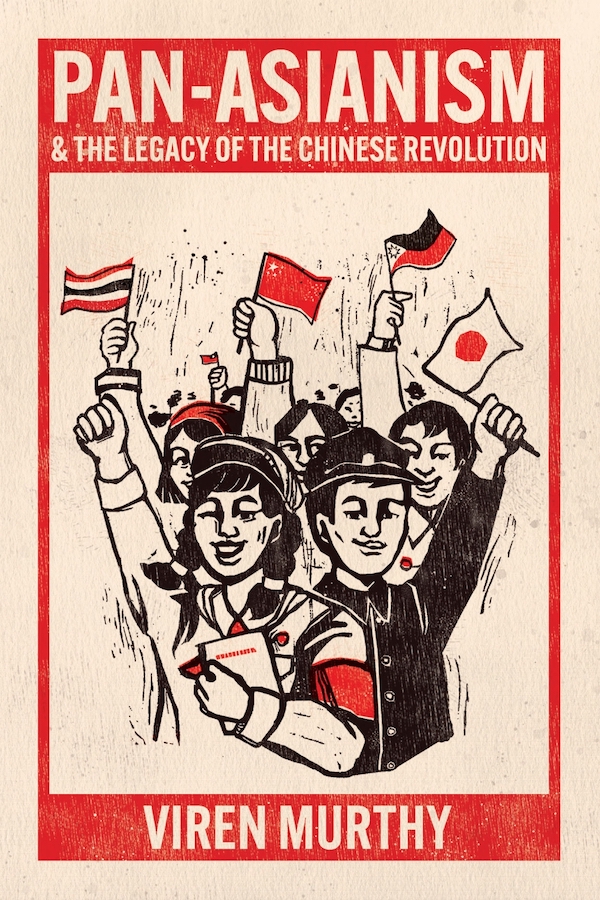
Pan-Asianism and the Legacy of the Chinese Revolution
IRH Fellow: Viren Murthy, (Resident Fellow 2021-2022) Synopsis: Recent proposals to revive the ancient Silk Road for the contemporary era and ongoing Western interest in China’s growth and development have led to increased attention to the concept of pan-Asianism. Most of that discussion, however, lacks any historical grounding in the thought of influential twentieth-century pan-Asianists. In this book, Viren Murthy offers an intellectual history of the writings of theorists, intellectuals, and activists—spanning leftist, conservative, and right-wing thinkers—who proposed new ways of thinking about Asia in their own historical and political contexts. Tracing pan-Asianist discourse across the twentieth century, Murthy reveals a stronger tradition of resistance and alternative visions than the contemporary discourse on pan-Asianism would suggest. At the heart of pan-Asianist thinking, Murthy shows, were the notions of a unity of Asian nations, of weak nations becoming powerful, and of the Third World confronting the “advanced world” on equal terms—an idea that grew to include non-Asian countries into the global community of Asian nations. But pan-Asianists also had larger aims, imagining a future beyond both imperialism and capitalism. The fact that the resurgence of pan-Asianist discourse has emerged alongside the dominance of capitalism, Murthy argues, signals a profound misunderstanding of its roots, history, and potential.
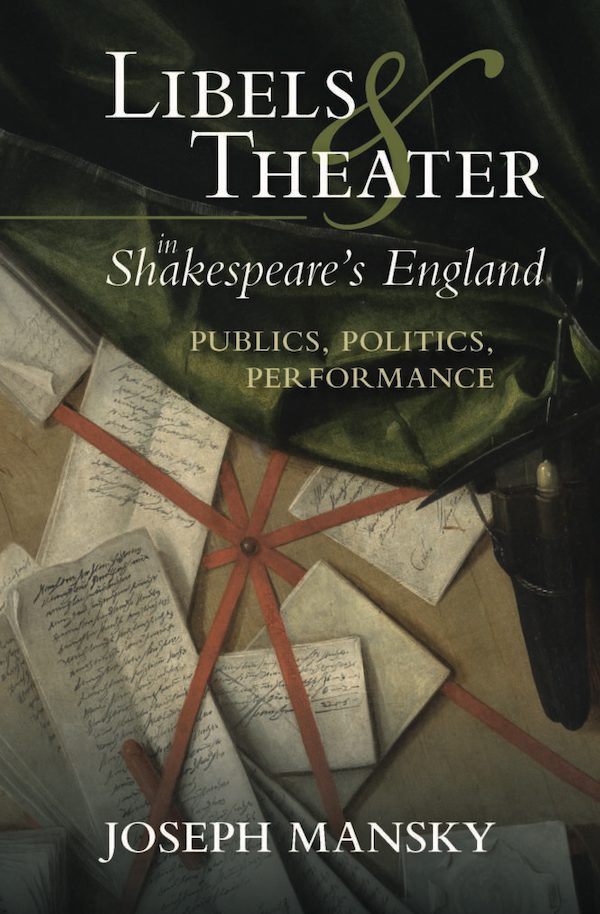
Libels and Theater in Shakespeare’s England: Publics, Politics, Performance
IRH Fellow: Joseph Mansky, (Solmsen Fellow, 2019-2020) Synopsis: In the first comprehensive history of libels in Elizabethan England, Joseph Mansky traces the crime across law, literature, and culture, outlining a viral and often virulent media ecosystem. During the 1590s, a series of crises – simmering xenophobia, years of dearth and hunger, surges of religious persecution – sparked an extraordinary explosion of libeling. The same years also saw the first appearances of libels on London stages. Defamatory, seditious texts were launched into the sky, cast in windows, recited in court, read from pulpits, and seized by informers. Avatars of sedition, libels nonetheless empowered ordinary people to pass judgment on the most controversial issues and persons of the day. They were marked by mobility, swirling across the early modern media and across class, confessional, and geographical lines. Ranging from Shakespearean drama to provincial pageantry, this book charts a public sphere poised between debate and defamation, between free speech and fake news.
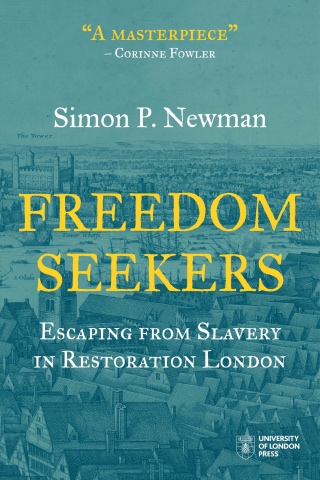
Freedom Seekers: Escaping from Slavery in Restoration London
IRH Fellow: Simon P. Newman, (Honorary Fellow, 2020-2022) Synopsis: Freedom Seekers: Escaping from Slavery in Restoration London reveals the hidden stories of enslaved and bound people who attempted to escape from captivity in England’s capital. In 1655 White Londoners began advertising in the English-speaking world’s first newspapers for enslaved people who had escaped. Based on the advertisements placed in these newspapers by masters and enslavers offering rewards for so-called runaways, this book brings to light for the first time the history of slavery in England as revealed in the stories of resistance by enslaved workers. Featuring a series of case-studies of individual “freedom-seekers”, this book explores the nature and significance of escape attempts as well as detailing the likely routes and networks they would take to gain their freedom. The book demonstrates that not only were enslaved people present in Restoration London but that White Londoners of this era were intimately involved in the construction of the system of racial slavery, a process that traditionally has been regarded as happening in the colonies rather than the British Isles. An unmissable and important book that seeks to delve into Britain’s colonial past.
“Con esta carga nacemos las mujeres”: discursos sobre el cuerpo femenino en la España de Cervantes
IRH Fellow: Mercedes Alcalá-Galán (Honorary Fellow, 2019-2020) Synopsis: This is a book about women that deals with the lives of that half of the population that had a completely different experience from the other half in the 16th and 17th centuries. Its chapters explore a story that has hardly been told and that literary fiction almost always eludes: that of how women lived the experience of inhabiting their own bodies in a strongly normative era with respect to the female subject. Woman was largely defined in relation to her body and more specifically to her sexuality. The scientific, medical, moral, economic, religious and legal discourses about it will form a corpus of practices and knowledge that will constitute a series of unquestionable ‘truths’ about its nature. Spanish Synopsis: Este es un libro sobre mujeres que se refiere a las vidas de esa mitad de la población que tuvo una experiencia completamente diferente de la otra mitad en los siglos XVI y XVII. Sus capítulos exploran una historia que no ha sido apenas contada y que la ficción literaria casi siempre elude: la de cómo las mujeres vivieron la experiencia de habitar sus propios cuerpos en una época fuertemente normativa con respecto al sujeto femenino. La mujer fue, en gran parte, definida en relación con su cuerpo y más específicamente con su sexualidad. Los discursos científicos, médicos, morales, económicos, religiosos y legales sobre ella formarán un corpus de prácticas y saberes que constituirán una serie de ‘verdades’ incuestionables sobre su naturaleza. El título de este estudio se refiere específicamente a Cervantes, puesto que la recreación de la subjetividad femenina presente en su obra ofrece la posibilidad de examinar desde otro ángulo, el de las mujeres, temas como la violencia sexual, el acoso reproductor, la maternidad y la crianza.
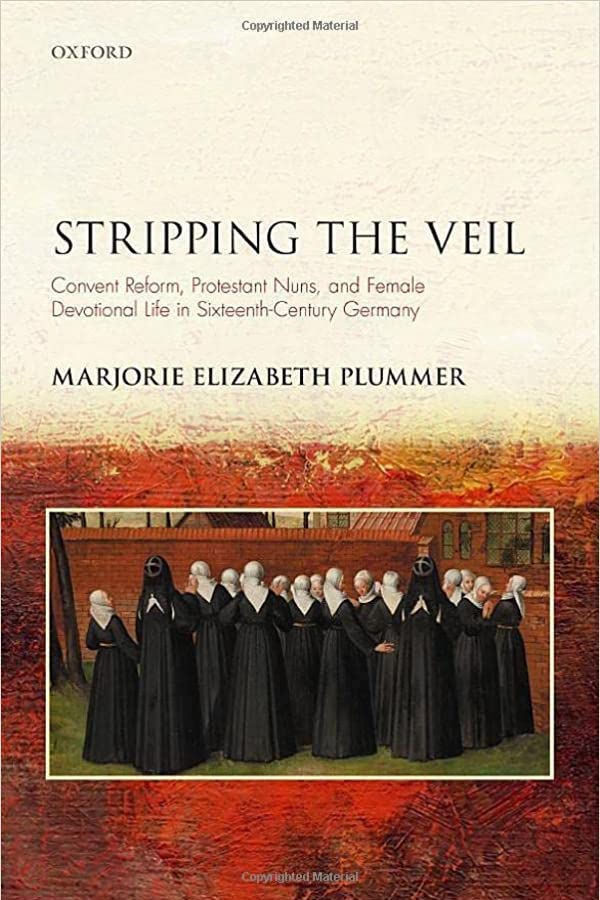
Stripping the Veil: Convent Reform, Protestant Nuns, and Female Devotional Life in Sixteenth Century Germany
IRH Fellow: Marjorie Elizabeth Plummer (Solmsen Fellow, 2016-2017) Synopsis: Protestant nuns and mixed-confessional convents are an unexpected anomaly in early modern Germany. According to sixteenth-century evangelical reformers’ theological positions outlined in their publications and reform-minded rulers’ institutional efforts, monastic life in Protestant regions should have ended by the mid-sixteenth century. Instead, many convent congregations exhibiting elements of traditional and evangelical practices in Protestant regions survived into the seventeenth century and beyond. How did these convents survive? What is a Protestant nun? How many convent congregations came to house nuns with diverse belief systems and devotional practices, and how did they live and worship together? These questions lead to surprising answers. Stripping the Veil explores the daily existence, ritual practices, and individual actions of nuns in surviving convents over time against the backdrop of changing political and confessional circumstances in Protestant regions. It also demonstrates how incremental shifts in practice and belief led to the emergence of a complex, often locally constructed, devotional life. This continued presence of nuns and the survival of convents in Protestant cities and territories of the German-speaking parts of the Holy Roman Empire is evidence of a more complex lived experience of religious reform, devotional practice, and confessional accommodation than traditional histories of early modern Christianity would indicate. The internal differences and the emerging confessional hybridity, blending, and fluidity also serve as a caution about designating a nun or groups of nuns as Lutheran, Catholic, or Reformed, or even more broadly as Protestant or Catholic during the sixteenth century.
Queer Forms
Fawaz, R. Queer Forms. New York, NY: NYU Press, 2022.
IRH Fellow: Ramzi Ramaz (Resident Fellow, 2017-2018) Synopsis: In Queer Forms, Ramzi Fawaz explores how the central values of 1970s movements for women’s and gay liberation—including consciousness-raising, separatism, and coming out of the closet—were translated into a range of American popular culture forms. Throughout this period, feminist and gay activists fought social and political battles to expand, transform, or wholly explode definitions of so-called “normal” gender and sexuality. In doing so, they inspired artists, writers, and filmmakers to invent new ways of formally representing, or giving shape to, non-normative genders and sexualities. This included placing women, queers, and gender outlaws of all stripes into exhilarating new environments—from the streets of an increasingly gay San Francisco to a post-apocalyptic commune, from an Upper East Side New York City apartment to an all-female version of Earth—and finding new ways to formally render queer genders and sexualities by articulating them to figures, outlines, or icons that could be imagined in the mind’s eye and interpreted by diverse publics. Surprisingly, such creative attempts to represent queer gender and sexuality often appeared in a range of traditional, or seemingly generic, popular forms, including the sequential format of comic strip serials, the stock figures or character-types of science fiction genre, the narrative conventions of film melodrama, and the serialized rhythm of installment fiction. Through studies of queer and feminist film, literature, and visual culture including Mart Crowley’s The Boys in the Band (1970), Armistead Maupin’s Tales of the City (1976–1983), Lizzy Borden’s Born in Flames (1983), and Tony Kushner’s Angels in America (1989–1991), Fawaz shows how artists innovated in many popular mediums and genres to make the experience of gender and sexual non-conformity recognizable to mass audiences in the modern United States. Against the ideal of ceaseless gender and sexual fluidity and attachments to rigidly defined identities, Queer Forms argues for the value of shapeshifting as the imaginative transformation of genders and sexualities across time. By taking many shapes of gender and sexual divergence we can grant one another the opportunity to appear and be perceived as an evolving form, not only to claim our visibility, but to be better understood in all our dimensions.
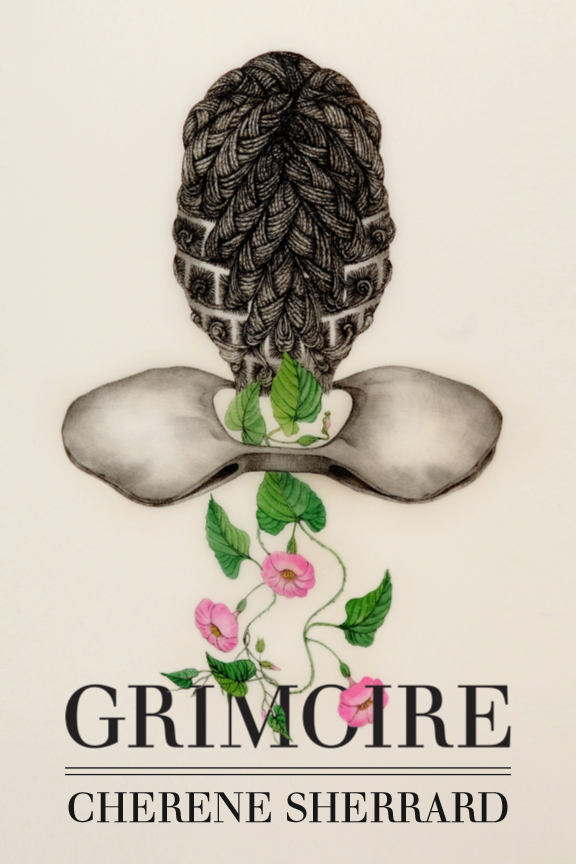
Grimoire
Sherrard, C. Grimoire. Pittsburgh, PA: Autumn House Press, 2021.
IRH Fellow: Cherene Sherrard (Senior Race, Ethnicity, and Indigeneity Fellow, 2017-2021) Synopsis: Named after a magical textbook, Cherene Sherrard’s Grimoire is a poetry collection centered on the recovery and preservation of ancestral knowledge and on the exploration of black motherhood. Incorporating experiences of food preparation, childrearing, and childbearing, the book begins with a section of poems that re-imagine recipes from one of the earliest cookbooks by an African-American woman: Mrs. Malinda Russell’s A Domestic Cookbook. Mrs. Russell’s voice as a nineteenth-century chef is joined in conversation with a contemporary amateur cook in poetic recipes that take the form of soft and formal sonnets, introspective and historical lyric, and found poems. In the second section, the poet explores black maternal death and the harrowing circumstances surrounding birth for women of color in the United States. Throughout Grimoire, Sherrard explores the precarity of black mothering over the last two centuries and the creative and ingenious modes of human survival.
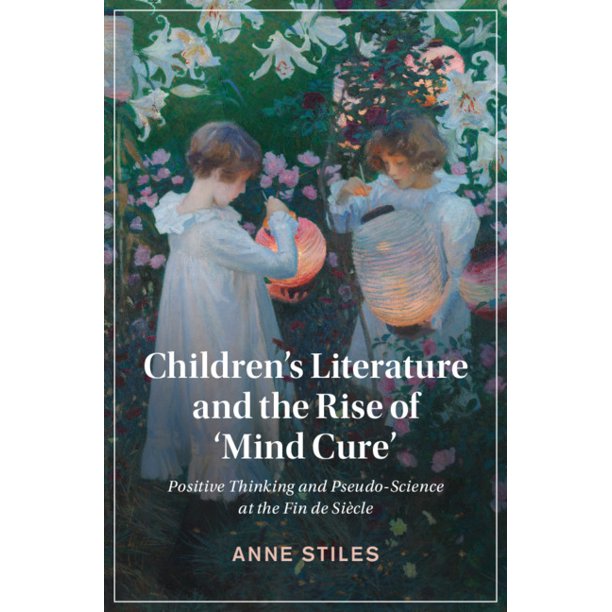
Children’s Literature and the Rise of ‘Mind Culture’
Stiles, A. Children’S Literature and the Rise of ‘Mind Culture’. Cambridge, UK: Cambridge University Press , 2021.
IRH Fellow: Ann Stiles (Kingdon Fellow, 2016-2017) Synopsis: Positive thinking is good for you. You can become healthy, wealthy, and influential by using the power of your mind to attract what you desire. These kooky but commonplace ideas stem from a nineteenth-century new religious movement known as ‘mind cure’ or New Thought. Related to Mary Baker Eddy’s Christian Science, New Thought was once a popular religious movement with hundreds of thousands of followers, and has since migrated into secular contexts such as contemporary psychotherapy, corporate culture, and entertainment. New Thought also pervades nineteenth- and early twentieth-century children’s literature, including classics such as The Secret Garden, Anne of Green Gables, and A Little Princess. In this first book-length treatment of New Thought in Anglophone fiction, Anne Stiles explains how children’s literature encouraged readers to accept New Thought ideas – especially psychological concepts such as the inner child – thereby ensuring the movement’s survival into the present day.
Les Remontrances: Textes et commentaires
IRH Fellow: Ulrich Langer (Interim Director, 2017-2018; Senior Fellow, 2000-2005) Paul-Alexis Mellet (Solmsen Fellow, 2017-2018) Synopsis: The remonstrance was an original genre of speech in Europe between the sixteenth and eighteenth centuries. This book brings together contributions from specialists from history, literature, rhetoric, law, and linguistics. Eighteen texts are transcribed and commented on.
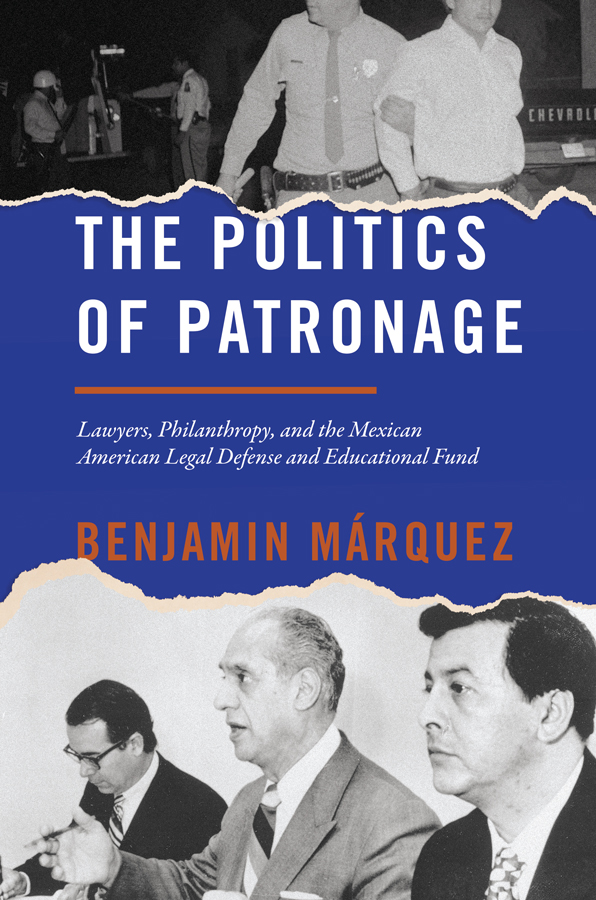
The Politics of Patronage
Márquez, B. The Politics of Patronage. Austin, TX: University of Texas Press, 2021.
IRH Fellow: Benjamin Márquez (REI Fellow, 2018-2019) Synopsis: The first book about the Mexican American Legal Defense and Educational Fund, the influential work it has done for the Latina/o community, and the issues stemming from its dependence on large philanthropic organizations. Founded in 1968, the Mexican American Legal Defense and Educational Fund (MALDEF) is the Latino equivalent to the NAACP: a source of legal defense for the Latina/o community in cases centered on education, state immigration laws, redistricting, employment discrimination, and immigrant rights. Unlike the NAACP, however, MALDEF was founded by Mexican American activists in conjunction with the larger philanthropic structure of the Ford Foundation—a relationship that has opened it up to controversy and criticism. In the first book to examine this little-known but highly influential organization, Benjamin Márquez explores MALDEF’s history and shows how it has thrived and served as a voice for the Latina/o community throughout its six decades of operation. But he also looks closely at large-scale investments of the Ford Foundation, Rockefeller Foundation, and others, considering how their ties to MALDEF have influenced Mexican American and Latinx politics. Its story crafted from copious research into MALDEF and its benefactors, this book brings to light the influence of outside funding on the articulation of minority identities and the problems that come with creating change through institutional means.
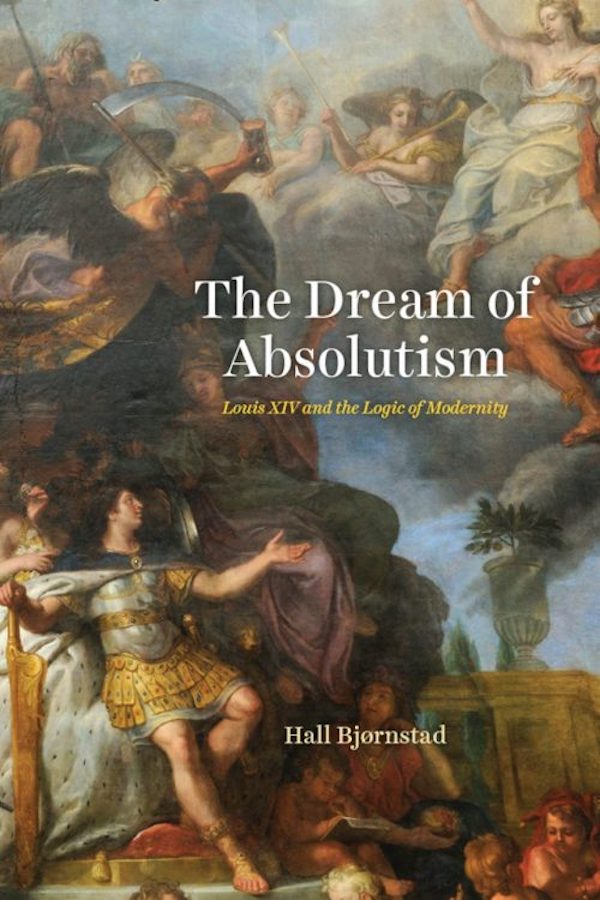
The Dream of Absolutism Louis XIV and the Logic of Modernity
IRH Fellow: Hall Bjórnstad (Honorary Fellow, 2018-2019) Synopsis: The Dream of Absolutism examines the political aesthetics of power under Louis XIV. What was absolutism, and how did it work? What was the function of the ostentatious display surrounding Louis XIV at Versailles? What is gained—and what is lost—by approaching such expressions of absolutism as propaganda, as present-day scholars tend to do? In this sweeping reconsideration of absolutist culture, Hall Bjørnstad argues that the exuberance of Louis XIV’s reign was not top-down propaganda in any modern sense, but rather a dream dreamt collectively, by king, court, image-makers, and nation alike. Bjørnstad explores this dream through a sustained close analysis of a corpus of absolutist artifacts, ranging from Charles Le Brun’s famous paintings in the Hall of Mirrors at Versailles via the king’s secret Mémoires to two little-known particularly extravagant verbal and textual celebrations of the king. The dream of absolutism, Bjørnstad concludes, lives at the intersection of politics and aesthetics. It is the carrier of a force that emerges as a glorious image; a participatory emotional reality that requires reality to conform to it. It is a dream, finally, that still shapes our collective political imaginary today.
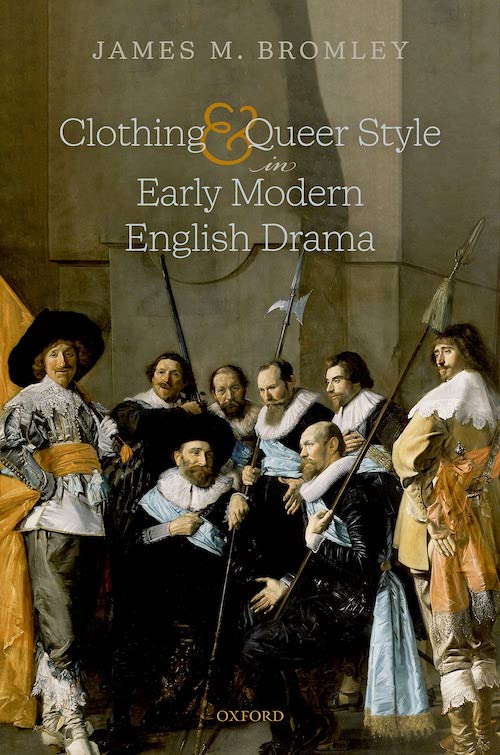
Clothing and Queer Style in Early Modern English Drama
IRH Fellow: James M. Bromley (Solmsen Fellow, 2014-2015) Synopsis: This book examines ‘queer style’ or forms of masculinity grounded in superficiality, inauthenticity, affectation, and the display of the extravagantly clothed body in early modern English city comedies. Queer style destabilizes distinctions between able-bodied and disabled, human and nonhuman, and the past and the present—distinctions that have structured normative ways of thinking about sexuality. Glimpsing the worldmaking potential of queer style, plays by Ben Jonson, George Chapman, Thomas Middleton, and Thomas Dekker imagine alternatives to the prevailing modes of subjectivity, sociability, and eroticism in early modern London. While the characters associated with queer style are situated in a hostile generic and historical context, this book draws on recent work on disability, materiality, and queer temporality to rethink their relationship to those contexts so as to access the utopian possibilities of early modern queer style. These theoretical frameworks also help bring into relief how the attachments and pleasures of early modern sartorial extravagance can estrange us from the epistemologies of sexuality that narrow current thinking about sexuality and its relationship to authenticity, pedagogy, interiority, and privacy.
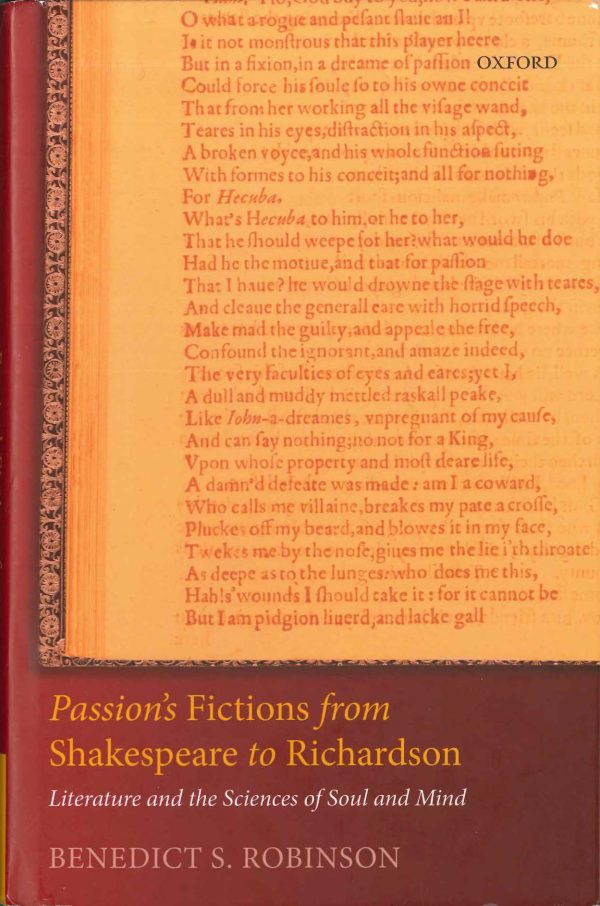
Passion’s Fictions from Shakespeare to Richardson
IRH Fellow: Benedict D. Robinson (Solmsen Fellow, 2013-2014) Synopsis: Passion’s Fictions traces the intimate links between literature and the sciences of soul and mind from the age of Shakespeare to the rise of the novel. It chronicles the emergence of new sciences of the passions between the sixteenth and eighteenth centuries out of and in some ways against a received “science of the soul,” and it argues that this history was shaped by rhetoric, which contained the most extensively particularized discourse on the passions, offering principles for moving and affecting the passions of others in concrete social scenes. This rhetoric of the passions centered on narrative as the instrument of a non-theoretical knowledge of the passions in their particularity, predicated on an account of passion as an intimate relation between an empassioned mind and an empassioning world: rhetoric offers a kind of externalist psychology, formalized in the relation of passion to action and underwriting an account of narrative as a means of both moving passion and knowing it. This book describes the psychology of the passions before the discipline of psychology, tracing the influence of rhetoric on theories of the passions from Francis Bacon to Adam Smith and using that history to read literary works by Shakespeare, Milton, Haywood, Richardson, and others. Narrative offers a means of knowing and moving the passions by tracing them to the events and objects that generate them; the history of narrative practices is thus a key part of the history of the psychology of the passions at a critical moment in its development.
Biosemiotic Literary Criticism
Coletta, J. Biosemiotic Literary Criticism. Cham, Switzerland: Springer Nature, 2021.
IRH Fellow: W. John Coletta (UW System Fellow, 1999-2000) Synopsis: This volume is based to a large extent on the understanding of biosemiotic literary criticism as a semiotic-model-making enterprise. For Jurij Lotman and Thomas A. Sebeok, “nature writing is essentially a model of the relationship between humans and nature” (Timo Maran); biosemiotic literary criticism, itself a form of nature writing and thus itself an ecological-niche-making enterprise, will be considered to be a model of modeling, a model of nature naturing. Modes and models of analysis drawn from Thomas A. Sebeok and Marcel Danesi’s Forms of Meaning: Modeling Systems Theory and Semiotic Analysis as well as from Timo Maran’s work on “modeling the environment in literature,” Edwina Taborsky’s writing on Peircean semiosis, and, of course, Jesper Hoffmeyer’s formative work in biosemiotics are among the most important organizing elements for this volume.
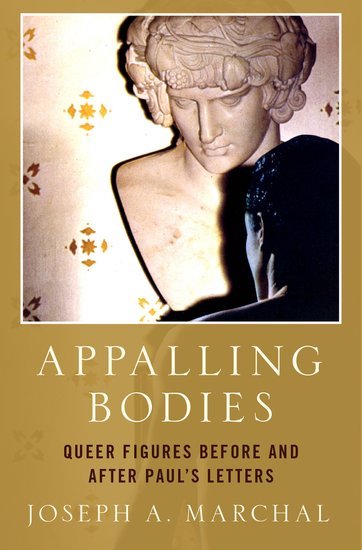
Appalling Bodies: Queer Figures Before and After Paul’s Letters
IRH Fellow: Joseph A. Marchal (Kingdon Fellow, 2013-2014) Synopsis: The letters of Paul are among the most commonly cited biblical texts in ongoing cultural and religious disputes about gender, sexuality, and embodiment. Appalling Bodies reframes these uses of the letters by reaching past Paul toward other, far more fascinating figures that appear before, after, and within the letters. The letters repeat ancient stereotypes about women, eunuchs, slaves, and barbarians–in their Roman imperial setting, each of these overlapping groups were cast as debased, dangerous, and complicated. Joseph Marchal presents new ways for us to think about these dangers and complications with the help of queer theory. Appalling Bodies juxtaposes these ancient figures against recent figures of gender and sexual variation, in order to defamiliarize and reorient what can be known about both. The connections between the marginalization and stigmatization of these figures troubles the history, ethics, and politics of biblical interpretation. Ultimately, Marchal assembles and reintroduces us to Appalling Bodies from then and now, and the study of Paul’s letters may never be the same.
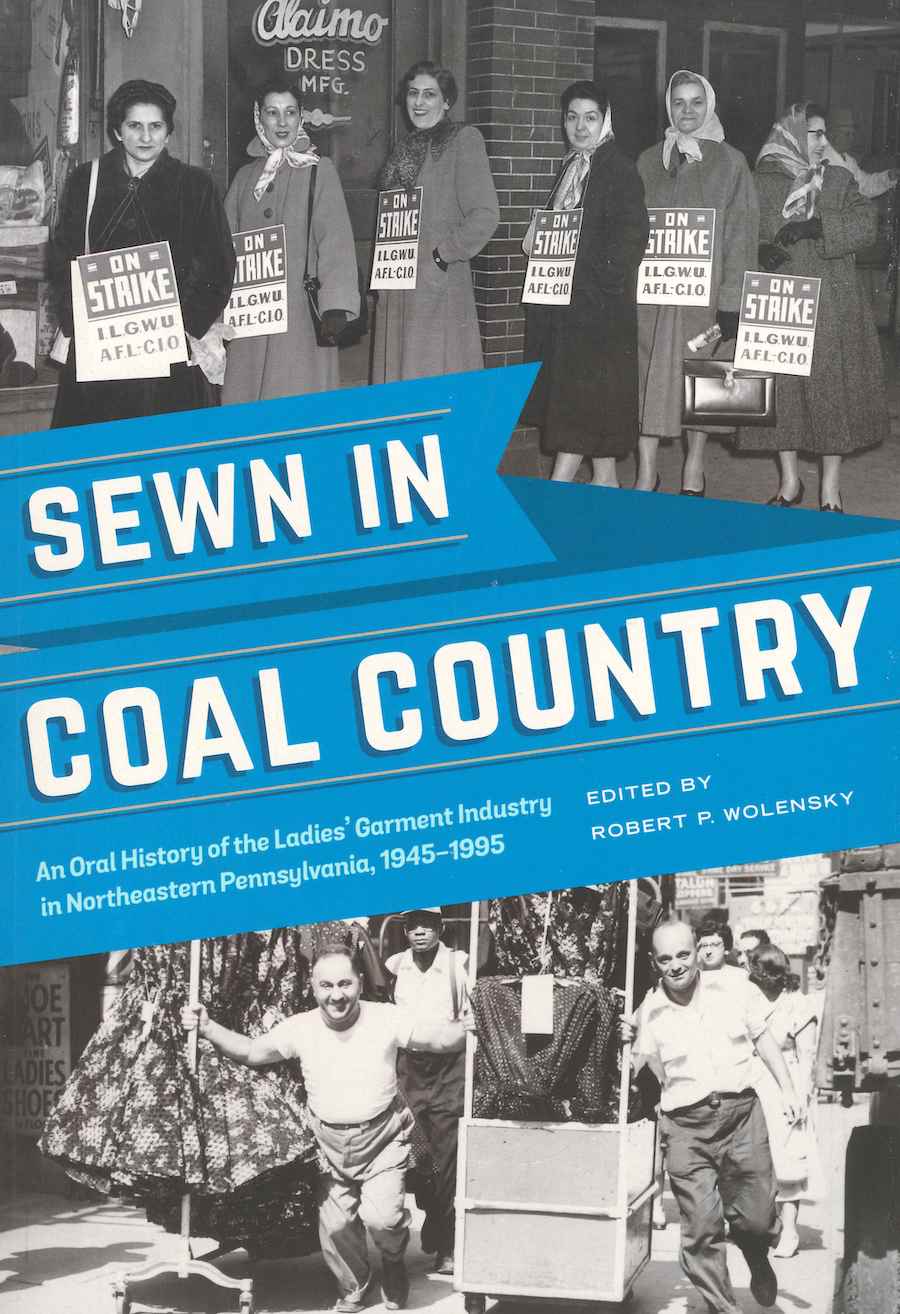
Sewn in Coal Country: An Oral History of the Ladies’ Garment Industry in Northeastern Pennsylvania, 1945–1995
IRH Fellow: Robert Wolensky (Honorary Fellow, 2014-2016) Synopsis: By the mid-1930s, Pennsylvania’s anthracite coal industry was facing a steady decline. Mining areas such as the Wyoming Valley around the cities of Wilkes-Barre and Pittston were full of willing workers (including women) who proved irresistibly attractive to New York City’s “runaway shops”—ladies’ apparel factories seeking lower labor and other costs. The International Ladies’ Garment Workers’ Union (ILGWU) soon followed, and the Valley became a thriving hub of clothing production and union activity. This volume tells the story of the area’s apparel industry through the voices of men and women who lived it. Drawing from an archive of over sixty audio-recorded interviews within the Northeastern Pennsylvania Oral and Life History Collection, Sewn in Coal Country showcases sixteen stories told by workers, shop owners, union leaders, and others. The interview subjects recount the ILGWU-led movement to organize the shops, the conflicts between the district union and the national office in New York, the solidarity unionism approach of leader Min Matheson, the role of organized crime within the business, and the failed efforts to save the industry in the 1980s and 1990s. Robert P. Wolensky places the narratives in the larger context of American clothing manufacturing during the period and highlights their broader implications for the study of labor, gender, the working class, and oral history. Highly readable and thoroughly enlightening, this significant contribution to the study of labor history and women’s history will appeal to anyone interested in the relationships among workers, unions, management, and community; the effects of economic change on an area and its residents; the role of organized crime within the industry; and Pennsylvania history—especially the social history of industrialization and deindustrialization during the twentieth century.

Genres of Rewriting in Second Temple: Judaism Scribal Composition and Transmission
IRH Fellow: Molly Zahn (Kingdon Fellow, 2013-2014) Synopsis: In this book, Molly Zahn investigates how early Jewish scribes rewrote their authoritative traditions in the course of transmitting them, from minor edits in the course of copying to whole new compositions based on prior works. Scholars have detected evidence for rewriting in a wide variety of textual contexts, but Zahn’s is the first book to map manuscripts and translations of biblical books, so-called ‘parabiblical’ compositions, and the sectarian literature from Qumran in relation to one another. She introduces a new, adaptable set of terms for talking about rewriting, using the idea of genre as a tool to compare and contrast different cases. Although rewriting has generally been understood as a vehicle for biblical interpretation, Zahn moves beyond that framework to demonstrate that rewriting was a pervasive textual strategy in the Second Temple period. Her book contributes to a powerful new model of early Jewish textuality, illuminating the rich and diverse culture out of which both rabbinic Judaism and early Christianity eventually emerged.
Think Least of Death: Spinoza on How to Live and How to Die
Director IRH: Steven Nadler (IRH Director, 2018-) Synopsis: In 1656, after being excommunicated from Amsterdam’s Portuguese-Jewish community for “abominable heresies” and “monstrous deeds,” the young Baruch Spinoza abandoned his family’s import business to dedicate his life to philosophy. He quickly became notorious across Europe for his views on God, the Bible, and miracles, as well as for his uncompromising defense of free thought. Yet the radicalism of Spinoza’s views has long obscured that his primary reason for turning to philosophy was to answer one of humanity’s most urgent questions: How can we lead a good life and enjoy happiness in a world without a providential God? In Think Least of Death, Pulitzer Prize–finalist Steven Nadler connects Spinoza’s ideas with his life and times to offer a compelling account of how the philosopher can provide a guide to living one’s best life. In the Ethics, Spinoza presents his vision of the ideal human being, the “free person” who, motivated by reason, lives a life of joy devoted to what is most important—improving oneself and others. Untroubled by passions such as hate, greed, and envy, free people treat others with benevolence, justice, and charity. Focusing on the rewards of goodness, they enjoy the pleasures of this world, but in moderation. “The free person thinks least of all of death,” Spinoza writes, “and his wisdom is a meditation not on death but on life.” An unmatched introduction to Spinoza’s moral philosophy, Think Least of Death shows how his ideas still provide valuable insights about how to live today.

On Civilization’s Edge A Polish Borderland in the Interwar World
Ciancia, K. On Civilization’s Edge A Polish Borderland in the Interwar World. Oxford, England: Oxford University Press, 2020.
IRH Fellow: Kathryn Ciancia (Resident Fellow, 2020-2021) Synopsis: As a resurgent Poland emerged at the end of World War I, an eclectic group of Polish border guards, state officials, military settlers, teachers, academics, urban planners, and health workers descended upon Volhynia, an eastern borderland province that was home to Ukrainians, Poles, and Jews. Its aim was not simply to shore up state power in a place where Poles constituted an ethnic minority, but also to launch an ambitious civilizing mission that would transform a poor Russian imperial backwater into a region that was at once civilized, modern, and Polish. Over the next two decades, these men and women recast imperial hierarchies of global civilization-in which Poles themselves were often viewed as uncivilized-within the borders of their supposedly anti-imperial nation-state. As state institutions remained fragile, long-debated questions of who should be included in the nation re-emerged with new urgency, turning Volhynia’s mainly Yiddish-speaking towns and Ukrainian-speaking villages into vital testing grounds for competing Polish national visions. By the eve of World War II, with Nazi Germany and the Soviet Union growing in strength, schemes to ensure the loyalty of Jews and Ukrainians by offering them a conditional place in the nation were replaced by increasingly aggressive calls for Jewish emigration and the assimilation of non-Polish Slavs. Drawing on research in local and national archives across four countries and utilizing a vast range of written and visual sources that bring Volhynia to life, On Civilization’s Edge offers a highly intimate story of nation-building from the ground up. We eavesdrop on peasant rumors at the Polish-Soviet border, read ethnographic descriptions of isolated marshlands, and scrutinize staged photographs of everyday life. But the book’s central questions transcend the Polish case, inviting us to consider how fears of national weakness and competitions for local power affect the treatment of national minorities, how more inclusive definitions of the nation are themselves based on exclusions, and how the very distinction between empires and nation-states is not always clear-cut.
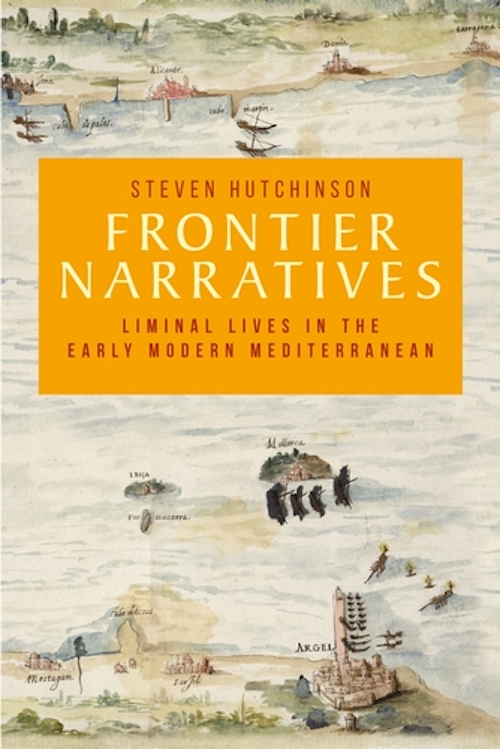
Frontier Narratives Liminal Lives in the Early Modern Mediterranean
IRH Fellow: Steven Hutchinson (Senior Fellow, 2016-2020) Synopsis: This book explores how human interaction in the frontier zones of the early modern Mediterranean was represented during the period, across genres and languages. The Muslim-Christian divide in the region produced an unusual kind of slavery, fostered a surge in conversion to Islam and offered an ideal habitat for Catholic martyrdom. The book argues that identities and alterities were multiple, that there was no war between Christianity and Islam and that commerce prevailed over ideology and dogma. Inspired by Braudel, who asserts that ‘the Mediterranean speaks with many voices; it is a sum of individual histories’, it endeavors to allow the people of the early modern Mediterranean to speak for themselves.
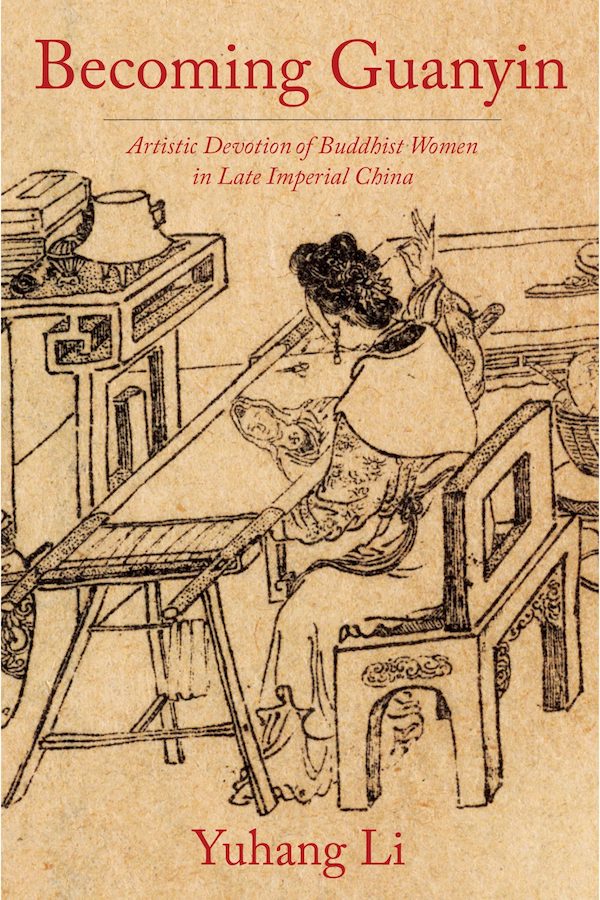
Becoming Guanyin: Artistic Devotion of Buddhist Women in Late Imperial China
Li, Y. Becoming Guanyin: Artistic Devotion of Buddhist Women in Late Imperial China. New York, NY: Columbia University Press, 2020.
IRH Fellow: Yuhang Li (Resident Fellow, 2017-2018) Synopsis: The goddess Guanyin began in India as the bodhisattva Avalokiteśvara, originally a male deity. He gradually became indigenized as a female deity in China over the span of nearly a millennium. By the Ming (1358–1644) and Qing (1644–1911) periods, Guanyin had become the most popular female deity in China. In Becoming Guanyin, Yuhang Li examines how lay Buddhist women in late imperial China forged a connection with the subject of their devotion, arguing that women used their own bodies to echo that of Guanyin. Li focuses on the power of material things to enable women to access religious experience and transcendence. In particular, she examines how secular Buddhist women expressed mimetic devotion and pursued religious salvation through creative depictions of Guanyin in different media such as painting and embroidery and through bodily portrayals of the deity using jewelry and dance. These material displays expressed a worldview that differed from yet fit within the Confucian patriarchal system. Attending to the fabrication and use of “women’s things” by secular women, Li offers new insight into the relationships between worshipped and worshipper in Buddhist practice. Combining empirical research with theoretical insights from both art history and Buddhist studies, Becoming Guanyin is a field-changing analysis that reveals the interplay between material culture, religion, and their gendered transformations.
A is for Asylum Seeker: Words for People on the Move/A de Asilo: Palabras para Personas en Movimiento
IRH Fellow: Rachel Ida Buff, (UW System Fellow, 2019-2020)) Synopsis: A clear and concise A-to-Z of keywords that echo our current human rights crisis As millions are forced to leave their nations of origin as a result of political, economic, and environmental peril, rising racism and xenophobia have led to increasingly harsh policies. A mass-mediated political circus obscures both histories of migration and longstanding definitions of words for people on the move, fomenting widespread linguistic confusion. Under this circus tent, there is no regard for history, legal advocacy, or jurisprudence. Yet in a world where the differences between “undocumented migrant” and “asylum seeker” can mean life or death, words have weighty consequences. A timely antidote to this circus, A is for Asylum Seeker reframes key words that describe people on the move. Written to correct the de-meaning of terms by rhetoric and policies based on dehumanization and profitable incarceration, this glossary provides an intersectional and historically grounded consideration of the words deployed in enflamed debate. Skipping some letters of the alphabet while repeating others, thirty terms cover everything from Asylum-seeker to Zero Tolerance Policy. Each entry begins with a contemporary or historical story for illustration and then proceeds to discuss the language politics of the word. The book balances terms affected by current political debates—such as “migrant,” “refugee,” and “illegal alien”—and terms that offer historical context to these controversies, such as “fugitive,” “unhoused,” and “vagrant.” Rendered in both English and Spanish, this book offers a unique perspective on the journeys, histories, challenges, and aspirations of people on the move. Enhancing the book’s utility as an educational and organizing resource, the author provides a list of works for further reading as well as a directory of immigration-advocacy organizations throughout the United States.
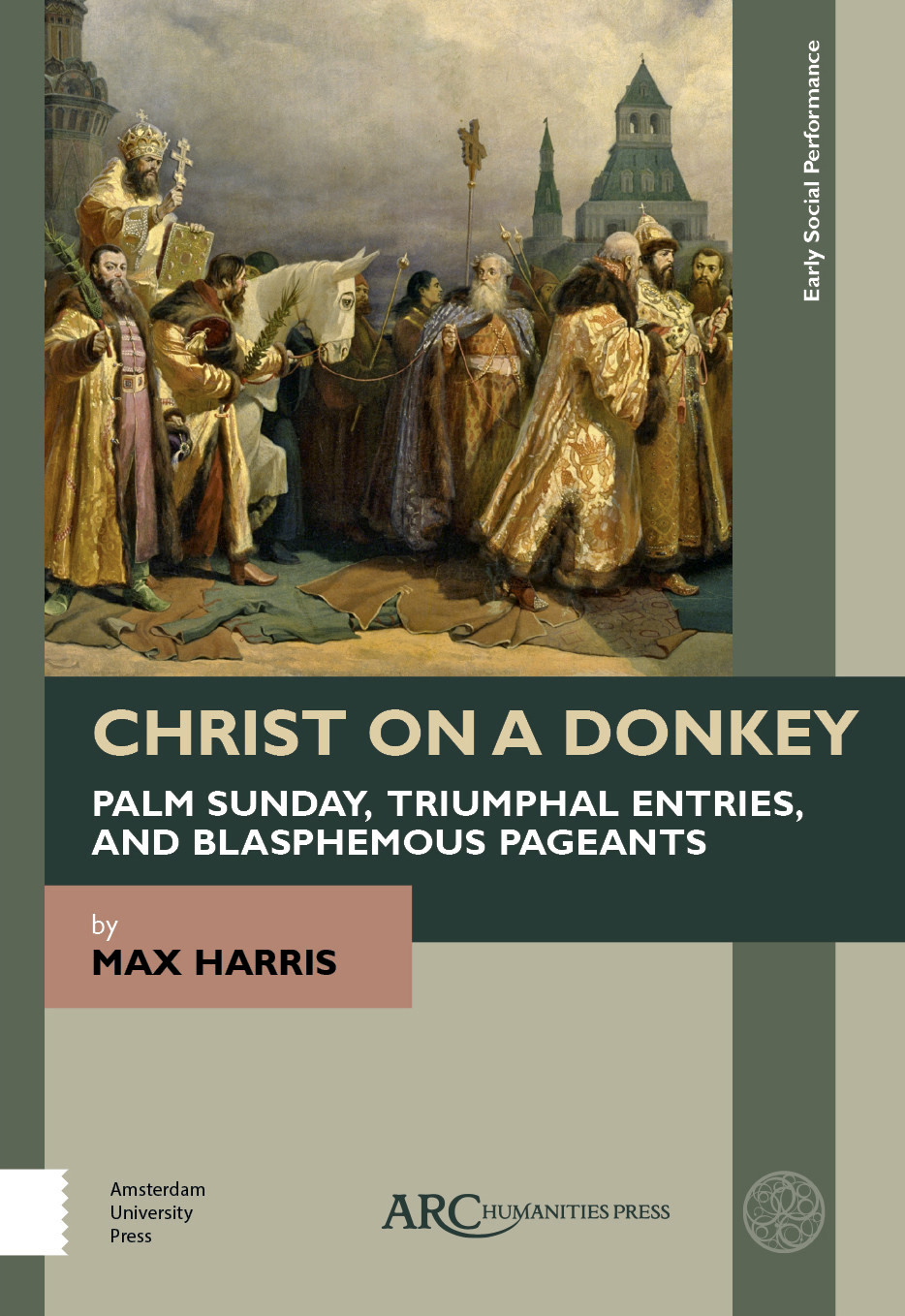
Christ on a Donkey: Palm Sunday, Triumphal Entries, and Blasphemous Pageants
IRH Fellow: Max Harris, 2018-2019 Emeritus Fellow; 2016-2017 Honorary Fellow; 2015-2016 Solmsen Fellow Synopsis: Christ on a Donkey reveals Palm Sunday processions and related royal entries as both processional theatre and highly charged interpretations of the biblical narrative. Harris’s narrative ranges from ancient Jerusalem to modern-day Bolivia, from veneration to iconoclasm, and from Christ to Ivan the Terrible. A curious theme emerges: those representations of Christ’s entry into Jerusalem that were labeled blasphemous or idolatrous by those in power were most faithful to the biblical narrative of Palm Sunday, while those that exalted power and celebrated military triumph were arguably blasphemous pageants.
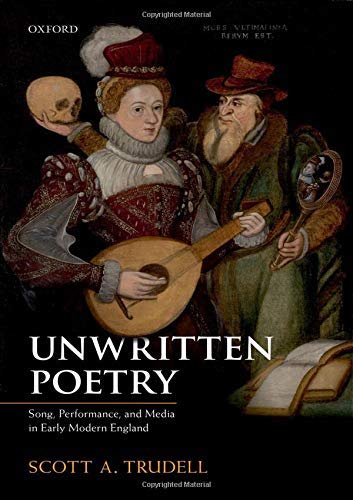
Unwritten Poetry: Song, Performance, and Media in Early Modern England
IRH Fellow: Scott Trudell, 2014-2015 Solmsen Fellow Synopsis: Vocal music was at the heart of English Renaissance poetry and drama. Virtuosic actor-singers redefined the theatrical culture of William Shakespeare and his peers. Composers including William Byrd and Henry Lawes shaped the transmission of Renaissance lyric verse. Poets from Philip Sidney to John Milton were fascinated by the disorienting influx of musical performance into their works. Musical performance was a driving force behind the period’s theatrical and poetic movements, yet its importance to literary history has long been ignored or effaced. This book reveals the impact of vocalists and composers upon the poetic culture of early modern England by studying the media through which–and by whom–its songs were made. In a literary field that was never confined to writing, media were not limited to material texts. Scott Trudell argues that the media of Renaissance poetry can be conceived as any node of transmission from singer’s larynx to actor’s body. Through his study of song, Trudell outlines a new approach to Renaissance poetry and drama that is grounded not simply in performance history or book history but in a more synthetic media history.

The Labor of Lunch: Why We Need Real Food and Real Jobs in American Public Schools
IRH Fellow: Jennifer Gaddis, 2017-2018 Resident Fellow Synopsis: There’s a problem with school lunch in America. Big Food companies have largely replaced the nation’s school cooks by supplying cafeterias with cheap, precooked hamburger patties and chicken nuggets chock-full of industrial fillers. Yet it’s no secret that meals cooked from scratch with nutritious, locally sourced ingredients are better for children, workers, and the environment. So why not empower “lunch ladies” to do more than just unbox and reheat factory-made food? And why not organize together to make healthy, ethically sourced, free school lunches a reality for all children? The Labor of Lunch aims to spark a progressive movement that will transform food in American schools, and with it the lives of thousands of low-paid cafeteria workers and the millions of children they feed. By providing a feminist history of the US National School Lunch Program, Jennifer E. Gaddis recasts the humble school lunch as an important and often overlooked form of public care. Through vivid narration and moral heft, The Labor of Lunch offers a stirring call to action and a blueprint for school lunch reforms capable of delivering a healthier, more equitable, caring, and sustainable future.

Forgotten Healers: Women and the Pursuit of Health in Late Renaissance Italy
Strocchia, S. T. Forgotten Healers: Women and the Pursuit of Health in Late Renaissance Italy. Cambridge, MA: Harvard University Press, 2019.
IRH Fellow: Sharon T. Strocchia, 2010-2011 Solmsen Fellow Synopsis: A new history uncovers the crucial role women played in the great transformations of medical science and health care that accompanied the Italian Renaissance. In Renaissance Italy women played a more central role in providing health care than historians have thus far acknowledged. Women from all walks of life—from household caregivers and nurses to nuns working as apothecaries—drove the Italian medical economy. In convent pharmacies, pox hospitals, girls’ shelters, and homes, women were practitioners and purveyors of knowledge about health and healing, making significant contributions to early modern medicine. Sharon Strocchia offers a wealth of new evidence about how illness was diagnosed and treated, whether by noblewomen living at court or poor nurses living in hospitals. She finds that women expanded on their roles as health care providers by participating in empirical work and the development of scientific knowledge. Nuns, in particular, were among the most prominent manufacturers and vendors of pharmaceutical products. Their experiments with materials and techniques added greatly to the era’s understanding of medical care. Thanks to their excellence in medicine urban Italian women had greater access to commerce than perhaps any other women in Europe. Forgotten Healers provides a more accurate picture of the pursuit of health in Renaissance Italy. More broadly, by emphasizing that the frontlines of medical care are often found in the household and other spaces thought of as female, Strocchia encourages us to rethink the history of medicine.
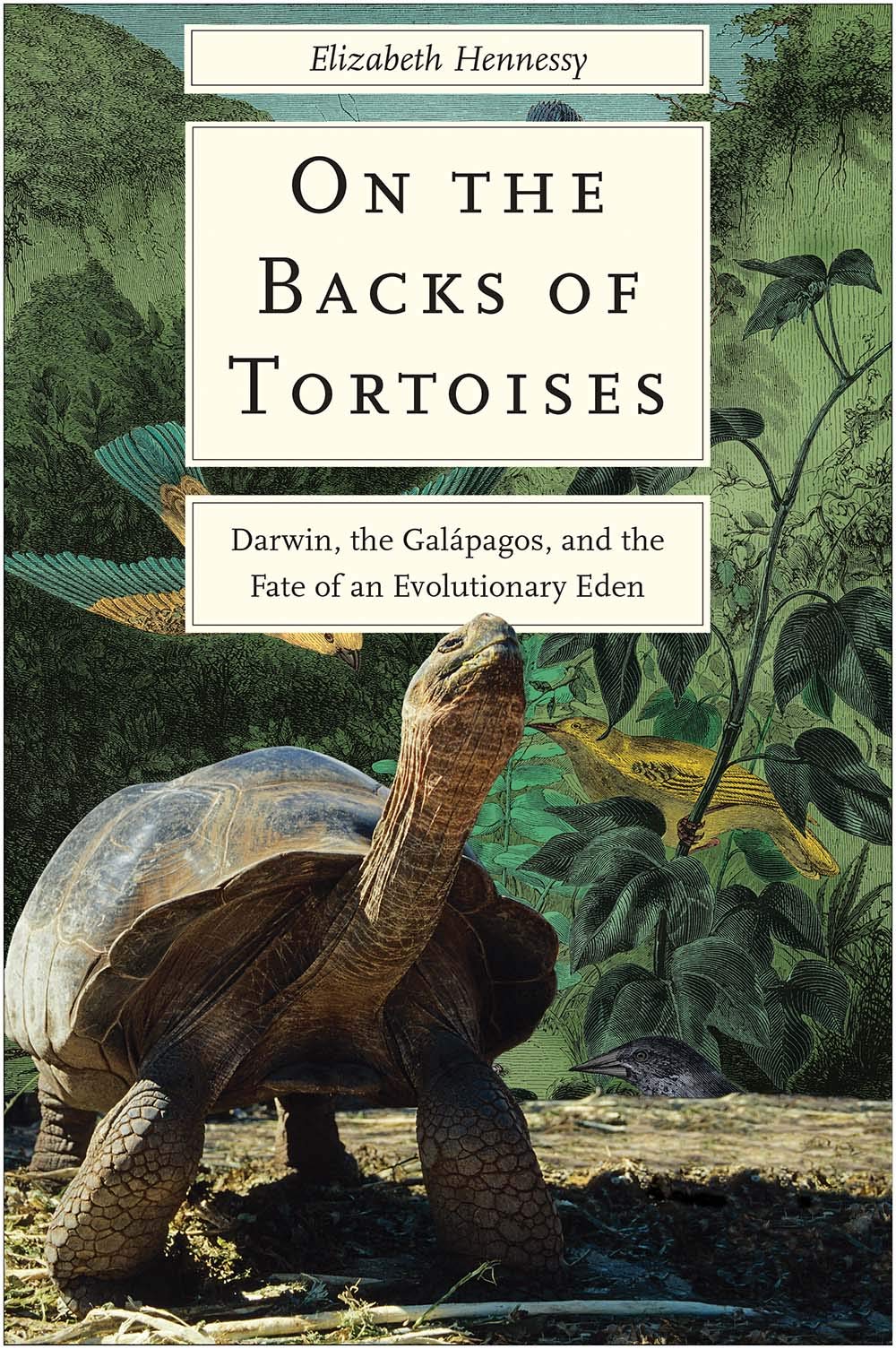
On the Backs of Tortoises: Darwin, the Galapagos, and the Fate of an Evolutionary Eden
IRH Fellow: Elizabeth Hennessy, 2017-2018 Resident Fellow Synopsis: The Galápagos archipelago is often viewed as a last foothold of pristine nature. For sixty years, conservationists have worked to restore this evolutionary Eden after centuries of exploitation at the hands of pirates, whalers, and island settlers. This book tells the story of the islands’ namesakes—the giant tortoises—as coveted food sources, objects of natural history, and famous icons of conservation and tourism. By doing so, it brings into stark relief the paradoxical, and impossible, goal of conserving species by trying to restore a past state of prehistoric evolution. The tortoises, Elizabeth Hennessy demonstrates, are not prehistoric, but rather microcosms whose stories show how deeply human and nonhuman life are entangled. In a world where evolution is thoroughly shaped by global history, Hennessy puts forward a vision for conservation based on reckoning with the past, rather than trying to erase it.
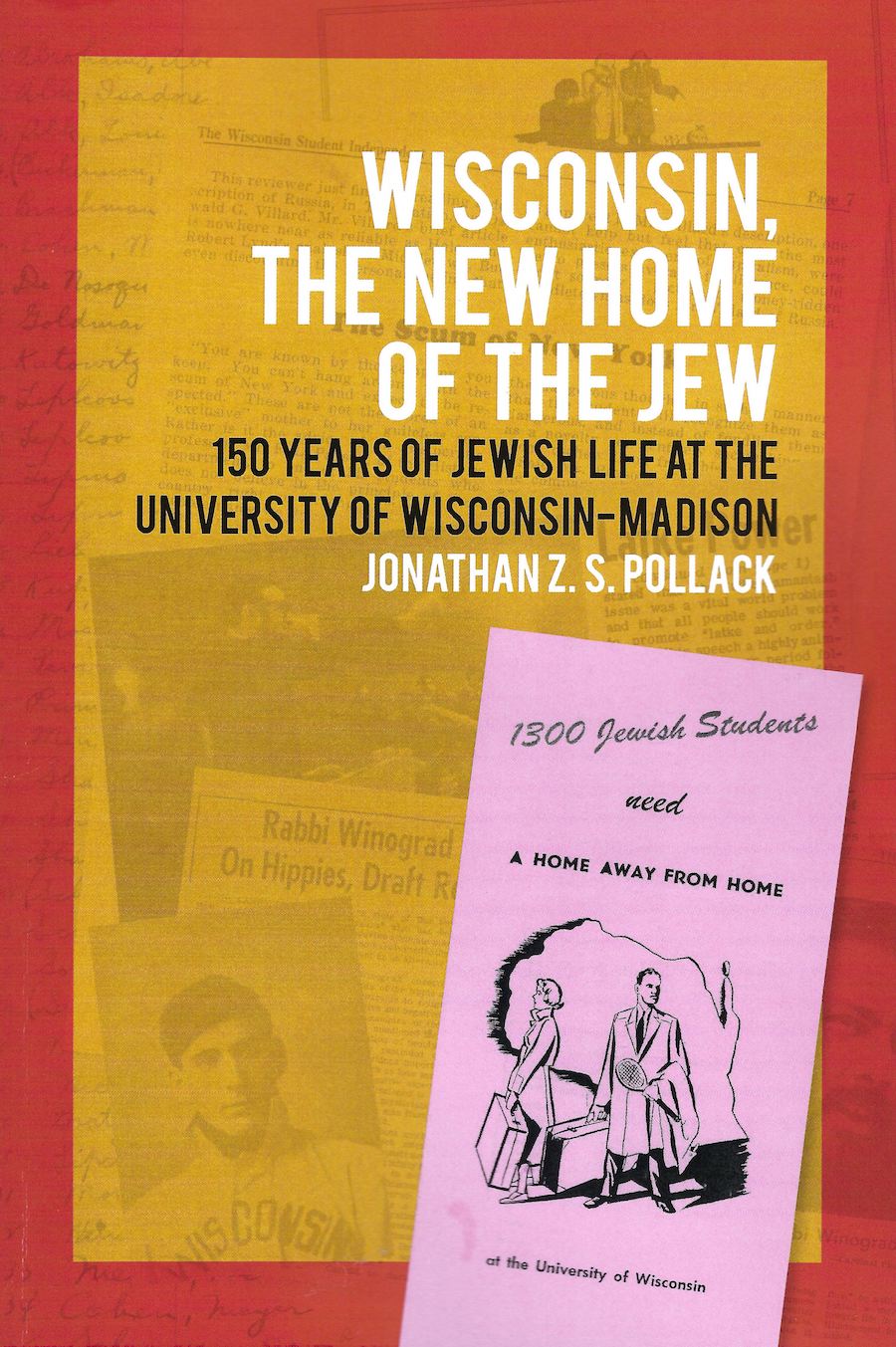
Wisconsin, The New Home of the Jew: 150 Years of Jewish Life at the University of Wisconsin–Madison
IRH Fellow: Jonathan Z.S. Pollack, 2009-2010 Madison Area Technical College Fellow Synopsis: In Wisconsin, The New Home of the Jew, Jonathan Z. S. Pollack describes the daily lives, contributions, and challenges of Jewish students, faculty, staff, and alumni at UW–Madison. The early establishment of student Zionist groups, Hillel, and fraternities and sororities at UW set examples for campuses nationwide. In the decades that followed, Madison’s Jewish faculty included a remarkable constellation of internationally renowned scholars. As Pollack shows, however, this is also a story of fluctuating reactions to the Jewish presence and recurring anti-Semitism on the part of the administration, local residents, and state government. Amid periods of acceptance and embrace, discrimination and exclusion, Jews with a stake in the University invested in their community and left a lasting imprint on UW and beyond. Full text available here.
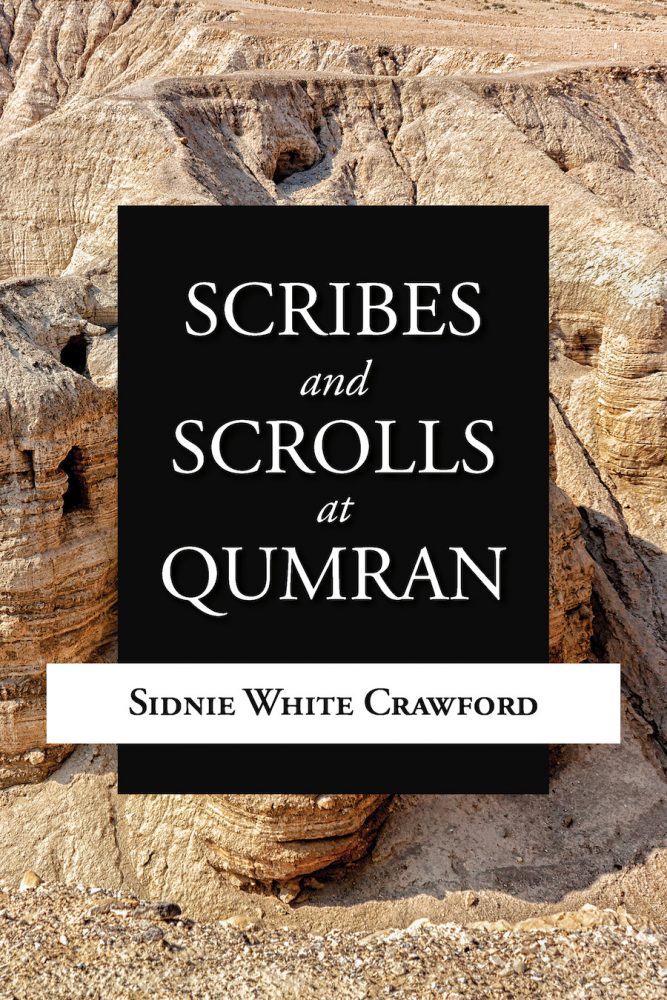
Scribes and Scrolls at Qumran
IRH Fellow: Sidnie Crawford (Kingdon Fellow, 2016-2017) Synopsis: The discovery of the Dead Sea Scrolls altered our understanding of the development of the biblical text, the history and literature of Second Temple Judaism, and the thought of the early Christian community. Questions continue to surround the relationship between the caves in which the scrolls were found and the nearby settlement at Khirbet Qumran. In Scribes and Scrolls at Qumran, Sidnie White Crawford combines the conclusions of the first generation of scrolls scholars that have withstood the test of time, new insights that have emerged since the complete publication of the scrolls corpus, and the much more complete archaeological picture that we now have of Khirbet Qumran. She creates a new synthesis of text and archaeology that yields a convincing history of and purpose for the Qumran settlement and its associated caves.
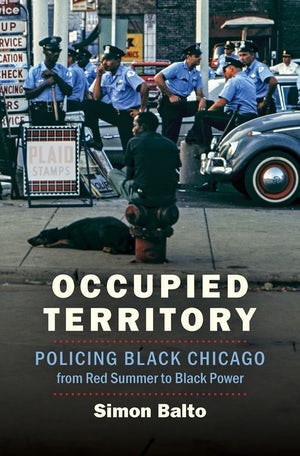
Occupied Territory Policing Black Chicago from Red Summer to Black Power
IRH Fellow: Simon Balto (ACLS Postdoctoral Fellow Resident, 2020-2021) Synopsis: In July 1919, an explosive race riot forever changed Chicago. For years, black southerners had been leaving the South as part of the Great Migration. Their arrival in Chicago drew the ire and scorn of many local whites, including members of the city’s political leadership and police department, who generally sympathized with white Chicagoans and viewed black migrants as a problem population. During Chicago’s Red Summer riot, patterns of extraordinary brutality, negligence, and discriminatory policing emerged to shocking effect. Those patterns shifted in subsequent decades, but the overall realities of a racially discriminatory police system persisted. In this history of Chicago from 1919 to the rise and fall of Black Power in the 1960s and 1970s, Simon Balto narrates the evolution of racially repressive policing in black neighborhoods as well as how black citizen-activists challenged that repression. Balto demonstrates that punitive practices by and inadequate protection from the police were central to black Chicagoans’ lives long before the late-century “wars” on crime and drugs. By exploring the deeper origins of this toxic system, Balto reveals how modern mass incarceration, built upon racialized police practices, emerged as a fully formed machine of profoundly antiblack subjugation.
Flattery and the History of Political Thought: That Glib and Oily Art
IRH Fellow: Daniel J. Kapust, 2015-2016 Resident Fellow Synopsis: Flattery is an often overlooked political phenomenon, even though it has interested thinkers from classical Athens to eighteenth-century America. Drawing a distinction between moralistic and strategic flattery, this book offers new interpretations of a range of texts from the history of political thought. Discussing Cicero, Pliny, Castiglione, Machiavelli, Hobbes, Mandeville, Smith, and the Federalist/Anti-Federalist debates, the book engages and enriches contemporary political theory debates about rhetoric, republicanism, and democratic theory, among other topics. Flattery and the History of Political Thought shows both the historical importance and continued relevance of flattery for political theory. Additionally, the study is interdisciplinary in both subject and approach, engaging classics, literature, rhetoric, and history scholarship; it aims to bring a range of disciplines into conversation with each other as it explores a neglected – and yet important – topic.
Magic: The Basics
Bailey, M. Magic: The Basics. Abingdon, Oxon, and New York, NY: Routledge, 2018.
IRH Fellow: Michael D. Bailey, 2010-2011 Solmsen Fellow Synopsis: Magic: The Basics is a concise and engaging introduction to magic in world history and contemporary societies. Presenting magic as a global phenomenon which has manifested in all human cultures, this book takes a thematic approach which explores the historical, social, and cultural aspects of magic. Offering a global perspective of magic from antiquity through to the modern era and including a glossary of key terms, suggestions for further reading and case studies throughout, Magic: The Basics is essential reading for anyone seeking to learn more about the academic study of magic.
Models from the Past in Roman Culture: A World of Exempla
IRH Fellow: Matthew B. Roller, 2000-2001 Solmsen Fellow Synopsis: Historical examples played a key role in ancient Roman culture, and Matthew Roller’s book presents a coherent model for understanding the rhetorical, moral, and historiographical operations of Roman exemplarity. It examines the process of observing, evaluating, and commemorating noteworthy actors, or deeds, and then holding those performances up as norms by which to judge subsequent actors or as patterns for them to imitate. The model is fleshed out via detailed case studies of individual exemplary performers, the monuments that commemorate them, and the later contexts – the political arguments and social debates – in which these figures are invoked to support particular positions or agendas. Roller also considers the boundaries of, and ancient alternatives to, exemplary modes of argumentation, morality, and historical thinking. The book will engage anyone interested in how societies, from ancient Rome to today, invoke past performers and their deeds to address contemporary concerns and interests.
Mortal Doubt: Transnational Gangs and Social Order in Guatemala City
IRH Fellow: Anthony W. Fontes, 2015-2017 A.W. Mellon Postdoctoral Fellow Synopsis: The fear of violent crime dominates Guatemala City. In the midst of unprecedented levels of postwar violence, Guatemalans struggle to fathom the myriad forces that have made life in this city so deeply insecure. Born out of histories of state terror, migration, and US deportation, maras (transnational gangs) have become the face of this new era of violence. They are brutal organizations engaged in extortion, contract killings, and the drug trade, and yet they have also become essential to the emergence of a certain kind of social order. Drawing on years of fieldwork inside prisons, police precincts, and gang-dominated neighborhoods, Anthony W. Fontes demonstrates how gang violence has become indissoluble from contemporary social imaginaries and how these gangs provide cover for a host of other criminal actors. Ethnographically rich and unflinchingly critical, Mortal Doubt illuminates the maras’ role in making and mooring collective terror in Guatemala City while tracing the ties that bind this violence to those residing in far safer environs.
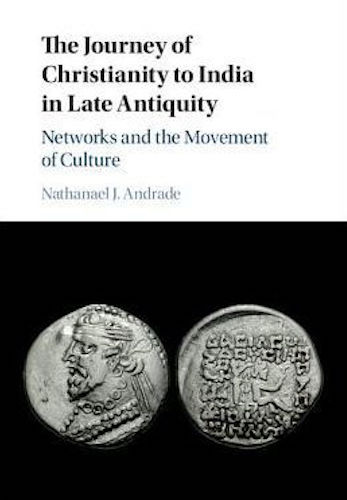
The Journey of Christianity to India in Late Antiquity: Networks and the Movement of Culture
IRH Fellow: Nathanael Andrade, 2015-2016 Solmsen Fellow Synopsis: How did Christianity make its remarkable voyage from the Roman Mediterranean to the Indian subcontinent? By examining the social networks that connected the ancient and late antique Mediterranean to the Indian Ocean, central Asia, and Iran, this book contemplates the social relations that made such movement possible. It also analyzes how the narrative tradition regarding the apostle Judas Thomas, which originated in Upper Mesopotamia and accredited him with evangelizing India, traveled among the social networks of an interconnected late antique world. In this way, the book probes how the Thomas narrative shaped Mediterranean Christian beliefs regarding co-religionists in central Asia and India, impacted local Christian cultures, took shape in a variety of languages, and experienced transformation as it traveled from the Mediterranean to India, and back again.
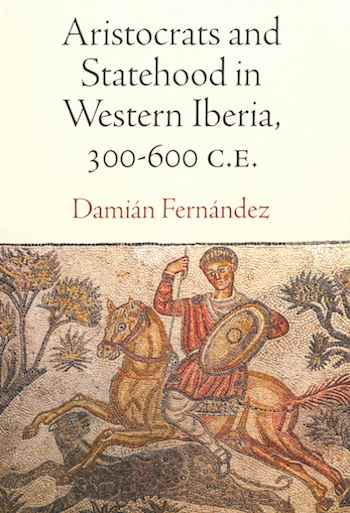
Aristocrats and Statehood in Western Iberia, 300-600 C.E.
IRH Fellow: Damián Fernández, 2012-2013 Solmsen Fellow Synopsis: In a distant corner of the late antique world, along the Atlantic river valleys of western Iberia, local elite populations lived through the ebb and flow of empire and kingdoms as historical agents with their own social strategies. Contrary to earlier historiographical accounts, these aristocrats were not oppressed by a centralized Roman empire or its successor kingdoms; nor was there an inherent conflict between central states and local elites. Instead, Damián Fernández argues, there was an interdependency of state and local aristocracies. The upper classes embraced state projects to assert their ascendancy within their communities. By doing so, they enacted statehood at the local level, bringing state presence to the remotest corners of Iberia, both under Roman rule and during the later Suevic and Visigothic kingdoms. Aristocrats and Statehood in Western Iberia, 300-600 C.E. combines archaeological and literary sources to reconstruct the history of late antique Iberian aristocracies, facilitating the study of a social class that has proved elusive when approached through the lens of a single type of evidence. This is the first study of Iberian elites that covers both the late Roman and the post-Roman periods in similar depth, and the chronological approach allows for a new perspective on social agency of late antique nobility. While the end of the Roman empire changed the political, economic, and social strategies of local aristocrats, the book also demonstrates a considerable degree of continuity that lasted until the late sixth century.
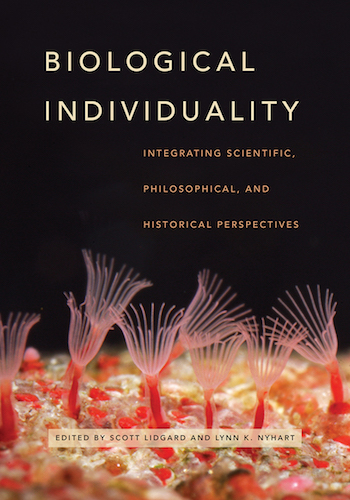
Biological Individuality: Integrating Scientific, Philosophical, and Historical Perspectives
IRH Fellow: Lynn K. Nyhart, 2014-2018 Senior Fellow Synopsis: Individuals are things that everybody knows—or thinks they do. Yet even scholars who practice or analyze the biological sciences often cannot agree on what an individual is and why. One reason for this disagreement is that the many important biological individuality concepts serve very different purposes—defining, classifying, or explaining living structure, function, interaction, persistence, or evolution. Indeed, as the contributors to Biological Individuality reveal, nature is too messy for simple definitions of this concept, organisms too quirky in the diverse ways they reproduce, function, and interact, and human ideas about individuality too fraught with philosophical and historical meaning.
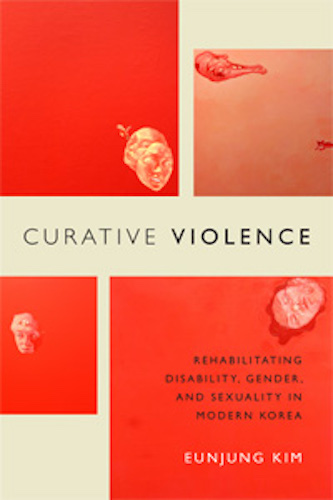
Curative Violence: Rehabilitating Disability, Gender, and Sexuality in Modern Korea
IRH Fellows: Eunjung Kim, 2013-2014 Resident Fellow Synopsis: In Curative Violence, Eunjung Kim examines what the social and material investment in curing illnesses and disabilities tells us about the relationship between disability and Korean nationalism. Kim uses the concept of curative violence to question the representation of cure as a universal good and to understand how nonmedical and medical cures come with violent effects that are not only symbolic but also physical. Writing disability theory in a transnational context, Kim tracks the shifts from the 1930s to the present in the ways that disabled bodies and narratives of cure have been represented in Korean folktales, novels, visual culture, media accounts, policies, and activism. Whether analyzing eugenics, the management of Hansen’s disease, discourses on disabled people’s sexuality, violence against disabled women, or rethinking the use of disabled people as a metaphor for life under Japanese colonial rule or under the U.S. military occupation, Kim shows how the possibility of life with disability that is free from violence depends on the creation of a space and time where cure is seen as a negotiation rather than a necessity.
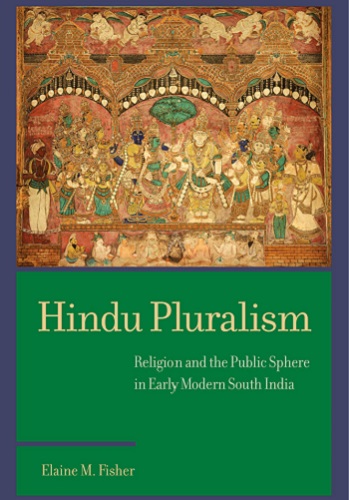
Hindu Pluralism: Religion and the Public Sphere in Early Modern South India
IRH Fellow: Elaine Fisher, 2014-2016 A.W. Mellon Postdoctoral Fellow Synopsis: In Hindu Pluralism, Elaine M. Fisher complicates the traditional scholarly narrative of the unification of Hinduism. By calling into question the colonial categories implicit in the term “sectarianism,” Fisher’s work excavates the pluralistic textures of precolonial Hinduism in the centuries prior to British intervention. Drawing on previously unpublished sources in Sanskrit, Tamil, and Telugu, Fisher argues that the performance of plural religious identities in public space in Indian early modernity paved the way for the emergence of a distinctively non-Western form of religious pluralism. This work provides a critical resource for understanding how Hinduism developed in the early modern period, a crucial era that set the tenor for religion’s role in public life in India through the present day.
On Not Defending Poetry: Defence and Indefensibility in Sidney’s “Defence of Poesy”
IRH Fellow: Catherine Bates, 2014-2015 Solmsen Fellow Synopsis: Sidney’s Defence of Poesy–the foundational text of English poetics–is generally taken to present a model of poetry as ideal: the poet depicts ideals of human conduct and readers are inspired to imitate them. Catherine Bates sets out to challenge this received view. Attending very closely to Sidney’s text, she identifies within it a model of poetry that is markedly at variance from the one presumed, and shows Sidney’s text to be feeling its way toward a quite different–indeed, a de-idealist–poetics. Following key theorists of the new economic criticism, On Not Defending Poetry shows how idealist poetics, like the idealist philosophy on which it draws, is complicit with the money form and with the specific ills that attend upon it: among them, commodification, fetishism, and the abuse of power. Against culturally approved models of poetry as profitable–as benefiting the individual and the state, as providing (in the form of intellectual, moral, and social capital) a quantifiable yield–the Defence reveals an unexpected counter-argument: one in which poetry is modelled, rather, as pure expenditure, a free gift, a net loss. Where a supposedly idealist Defence sits oddly with Sidney’s literary writings–which depict human behaviour that is very far from ideal–a de-idealist Defence does not. In its radical reading of the Defence, this book thus makes a decisive intervention in the field of early modern studies, while raising larger questions about a culture determined to quantify the ‘value’ of the humanities and to defend the arts on those grounds alone.
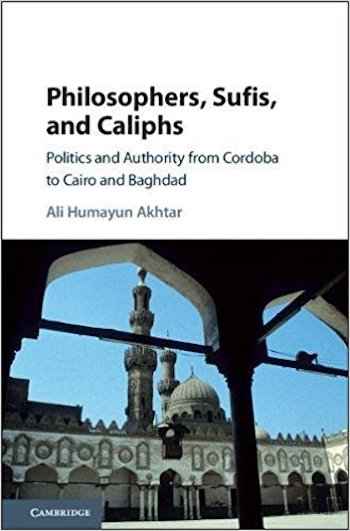
Philosophers, Sufis, and Caliphs: Politics and Authority from Cordoba to Cairo and Baghdad
IRH Fellow: Ali Humayun Akhtar, 2015-2016 Kingdon Fellow Synopsis: What was the relationship between government and religion in Middle Eastern history? In a world of caliphs, sultans, and judges, who exercised political and religious authority? In this book, Ali Humayun Akhtar investigates debates about leadership that involved ruling circles and scholars of jurisprudence and theology. At the heart of this story is a medieval rivalry between three caliphates: the Umayyads of Cordoba, the Fatimids of Cairo, and the Abbasids of Baghdad. In a fascinating revival of Late Antique Hellenism, Aristotelian and Platonic notions of wisdom became a key component of how these caliphs debated their authority as political leaders. By tracing how these political debates impacted the theological and jurisprudential scholars and their own conception of communal guidance, Akhtar offers a new picture of premodern political authority and the connections between Western and Islamic civilizations. It will be of use to students and specialists of the premodern and modern Middle East.
Singing the Resurrection: Body, Community, and Belief in Reformation Europe
IRH Fellow: Erin Lambert, 2011-2012 A.W. Mellon/ACLS Dissertation Fellow Synopsis: Singing the Resurrection brings music to the foreground of Reformation studies, as author Erin Lambert explores song as a primary mode for the expression of belief among ordinary Europeans in the sixteenth century, for the embodiment of individual piety, and the creation of new communities of belief. Together, resurrection and song reveal how sixteenth-century Christians–from learned theologians to ordinary artisans, and Anabaptist martyrs to Reformed Christians facing exile–defined belief not merely as an assertion or affirmation but as a continuous, living practice. Thus these voices, raised in song, tell a story of the Reformation that reaches far beyond the transformation from one community of faith to many. With case studies drawn from each of the major confessions of the Reformation–Lutheran, Anabaptist, Reformed, and Catholic–Singing the Resurrection reveals sixteenth-century belief in its full complexity.
State and Culture in Postcolonial Africa: Enchantings
Olaniyan, T. State and Culture in Postcolonial Africa: Enchantings. Indiana University Press, 2017.
IRH Fellowship and Year: Tejumola Olaniyan, 2011-2012 Interim Director, 2007-2013 Senior Fellow, 2005-2006 Resident Fellow Synopsis: How has the state impacted culture and cultural production in Africa? How has culture challenged and transformed the state and our understandings of its nature, functions, and legitimacy? Compelled by complex realities on the ground as well as interdisciplinary scholarly debates on the state-culture dynamic, senior scholars and emerging voices examine the intersections of the state, culture, and politics in postcolonial Africa in this lively and wide-ranging volume. The coverage here is continental and topics include literature, politics, philosophy, music, religion, theatre, film, television, sports, child trafficking, journalism, city planning, and architecture. Together, the essays provide an energetic and nuanced portrait of the cultural forms of politics and the political forms of culture in contemporary Africa.
Street Archives and City Life: Popular Intellectuals in Postcolonial Tanzania
IRH Fellow: Emily Callaci, 2015-2016 Resident Fellow Synopsis: In Street Archives and City Life Emily Callaci maps a new terrain of political and cultural production in mid- to late twentieth-century Tanzanian urban landscapes. While the postcolonial Tanzanian ruling party (TANU) adopted a policy of rural socialism known as Ujamaa between 1967 and 1985, an influx of youth migrants to the city of Dar es Salaam generated innovative forms of urbanism through the production and circulation of what Callaci calls street archives. These urban intellectuals neither supported nor contested the ruling party’s anti-city philosophy; rather, they navigated the complexities of inhabiting unplanned African cities during economic crisis and social transformation through various forms of popular texts that included women’s Christian advice literature, newspaper columns, self-published pulp fiction novellas, and song lyrics. Through these textual networks, Callaci shows how youth migrants and urban intellectuals in Dar es Salaam fashioned a collective ethos of postcolonial African citizenship. This spirit ushered in a revolution rooted in the city and its networks—an urban revolution that arose in spite of the nation-state’s pro-rural ideology.
The Essential Jewel of Holy Practice
IRH Fellow: Emily Webb McRae (Co-Translator), 2010-2011 Honorary Fellow Synopsis: The Essential Jewel of Holy Practice is a vibrant philosophical and ethical poem by one of Tibet’s great spiritual masters. Patrul Rinpoche presents a complete view of the path of liberation from the perspectives of the Madhyamaka understanding of emptiness and the Mahāyāna ideal of compassionate care refracted through the Dzogchen perspective on experience. This yields a sophisticated philosophical approach to practice focusing on the cultivation of clear, open, luminous, empty awareness and of liberation leading to the transformation of one’s moral capacity and sensitivity. Patrul Rinpoche’s verses speak intimately and directly to the reader and inspire one to develop one’s mind for the sake of ethical perfection and liberation. The translators’ introduction provides a foundation for reading the poem and their commentary to the verses assists the reader in understanding Patrul Rinpoche’s allusions and technical terms.
Action Reconceptualized: Human Agency and Its Sources
IRH Fellowship and Year: David K. Chan, 2008-2009 Honorary Fellow; 2004-2005 UW System Fellow Synopsis: In Action Reconceptualized: Human Agency and Its Sources, David K. Chan examines the sources of human agency that are proposed in causal theories of action—namely desire, intention, and trying—and distinguishes them from each other in terms of their roles in practical reasoning and motivation. He conceptualizes them in relation to each other in a way that is consistent and useful for answering a number of questions that are central to the philosophy of action. The action theory in this book addresses the need to understand human agency for its own sake, but it also serves another purpose. When the philosopher Elizabeth Anscombe stressed the need to do philosophy of action before doing ethical theory, what she meant was that moral philosophers should first work out a proper account of the relationship between the inner states of a person and the actions that she performs. This book provides such an account, and makes the case that it is desire, rather than intention, that is the basis for the ethical evaluation of an agent. Action Reconceptualized will be of particular interest to students and scholars doing research in action theory and ethics, as well as to those working outside of philosophy in psychology and cognitive science.
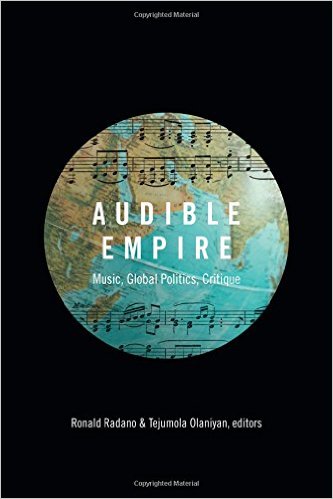
Audible Empire: Music, Global Politics, Critique
IRH Fellows: Ronald Radano, 2013-2017 Senior Fellow; and Tejumola Olaniyan, Senior Fellow (2007-2011; 2012-2013) Synopsis: Audible Empire rethinks the processes and mechanisms of empire and shows how musical practice has been crucial to its spread around the globe. Music is a means of comprehending empire as an audible formation, and the contributors highlight how it has been circulated, consumed, and understood through imperial logics. These fifteen interdisciplinary essays cover large swaths of genre, time, politics, and geography, and include topics such as the affective relationship between jazz and cigarettes in interwar China; the sonic landscape of the U.S.– Mexico border; the critiques of post-9/11 U.S. empire by desi rappers; and the role of tonality in the colonization of Africa. Whether focusing on Argentine tango, theorizing anticolonialist sound, or examining the music industry of postapartheid South Africa, the contributors show how the audible has been a central component in the creation of imperialist notions of reason, modernity, and culture. In doing so, they allow us to hear how empire is both made and challenged. Contributors: Kofi Agawu, Philip V. Bohlman. Michael Denning, Brent Hayes Edwards, Nan Enstad, Andrew Jones, Josh Kun, Morgan Luker, Jairo Moreno, Tejumola Olaniyan, Marc Perry, Ronald Radano, Nitasha Sharma, Micol Siegel, Gavin Steingo, Penny Von Eschen, Amanda Weidman.
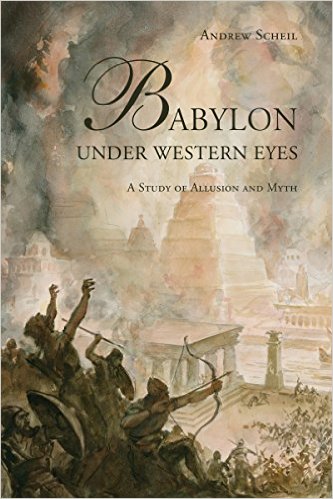
Babylon Under Western Eyes: A Study of Allusion and Myth
IRH Fellow: Andrew Scheil, 2008-2009 Solmsen Fellow Synopsis: Babylon under Western Eyes examines the mythic legacy of ancient Babylon, the Near Eastern city which has served western culture as a metaphor for power, luxury, and exotic magnificence for more than two thousand years. Sifting through the many references to Babylon in biblical, classical, medieval, and modern texts, Andrew Scheil uses Babylon’s remarkable literary ubiquity as the foundation for a thorough analysis of the dynamics of adaptation and allusion in western literature. Touching on everything from Old English poetry to the contemporary apocalyptic fiction of the “Left Behind” series, Scheil outlines how medieval Christian society and its cultural successors have adopted Babylon as a political metaphor, a degenerate archetype, and a place associated with the sublime. Combining remarkable erudition with a clear and accessible style, Babylon under Western Eyes is the first comprehensive examination of Babylon’s significance within the pantheon of western literature and a testimonial to the continuing influence of biblical, classical, and medieval paradigms in modern culture.
Black Natural Law
Lloyd, V. Black Natural Law. Oxford, UK: Oxford University Press, 2016.
IRH Fellow: Vincent Lloyd, 2015-2016 Kingdon Fellow Synopsis: Black Natural Law offers a new way of understanding the African American political tradition. Iconoclastically attacking left (including James Baldwin and Audre Lorde), right (including Clarence Thomas and Ben Carson), and center (Barack Obama), Vincent William Lloyd charges that many Black leaders today embrace secular, white modes of political engagement, abandoning the deep connections between religious, philosophical, and political ideas that once animated Black politics. By telling the stories of Frederick Douglass, Anna Julia Cooper, W. E. B. Du Bois, and Martin Luther King, Jr., Lloyd shows how appeals to a higher law, or God’s law, have long fueled Black political engagement. Such appeals do not seek to implement divine directives on earth; rather, they pose a challenge to the wisdom of the world, and they mobilize communities for collective action. Black natural law is deeply democratic: while charismatic leaders may provide the occasion for reflection and mobilization, all are capable of discerning the higher law using our human capacities for reason and emotion. At a time when continuing racial injustice poses a deep moral challenge, the most powerful intellectual resources in the struggle for justice have been abandoned. Black Natural Law recovers a rich tradition, and it examines just how this tradition was forgotten. A Black intellectual class emerged that was disconnected from social movement organizing and beholden to white interests. Appeals to higher law became politically impotent: overly rational or overly sentimental. Recovering the Black natural law tradition provides a powerful resource for confronting police violence, mass incarceration, and today’s gross racial inequities. Black Natural Law will change the way we understand natural law, a topic central to the Western ethical and political tradition. While drawing particularly on African American resources, Black Natural Law speaks to all who seek politics animated by justice.
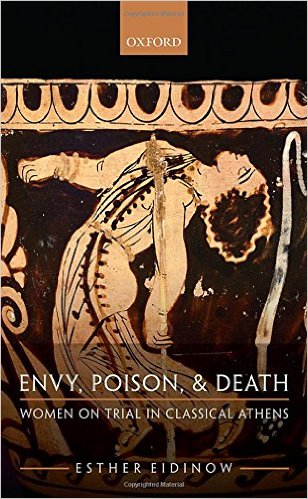
Envy, Poison, and Death: Women on Trial in Ancient Athens
IRH Fellow: Esther Eidinow, 2011-2012 Solmsen Fellow Synopsis: At the heart of this volume are three trials held in Athens in the fourth century BCE. The defendants were all women and in each case the charges involved a combination of ritual activities. Two were condemned to death. Because of the brevity of the ancient sources, and their lack of agreement, the precise charges are unclear, and the reasons for these women’s trials remain mysterious. Envy, Poison, and Death takes the complexity and confusion of the evidence not as a riddle to be solved, but as a revelation of social dynamics. It explores the changing factors–material, ideological, and psychological–that may have provoked these events. It focuses, in particular, on the dual role of envy (phthonos) and gossip as processes by which communities identified people and activities that were dangerous, and examines how and why those local, even individual, dynamics may have come to shape official civic decisions during a time of perceived hardship. At first sight so puzzling, these trials reveal a vivid picture of the socio-political environment of Athens during the early-mid fourth century BCE, including responses to changes in women’s status and behavior, and attitudes toward ritual activities within the city. The volume reveals some of the characters, events, and even emotions that would help to shape an emergent concept of magic: it suggests that the boundary of acceptable behavior was shifting, not only within the legal arena but also through the active involvement of society beyond the courts.
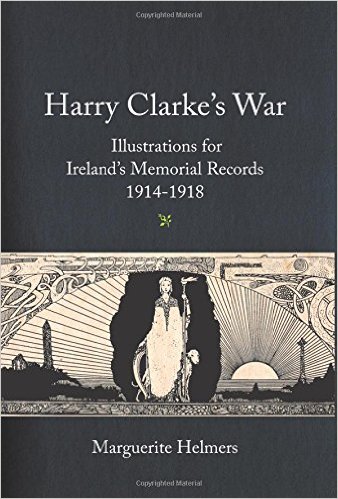
Harry Clarke’s War: Illustrations for Ireland’s Memorial Records, 1914-1918
IRH Fellow: Marguerite Helmers, 2013-2014 System Fellow Synopsis: Ireland’s Memorial Records, 1914-1918 contain the names of 49,435 enlisted men who were killed in World War I. Commissioned in 1919 by the Lord Lieutenant of Ireland and published in 100 eight-volume sets, the Records are notable for stunning and elaborate page decorations by celebrated Irish illustrator Harry Clarke. Drawing from published and unpublished sources, this ground-breaking study provides a fascinating insight into the work of Harry Clarke as an extraordinary war artist and examines the process that led to the Records being commissioned through to their eventual placement within the Irish National War Memorial at Islandbridge (Dublin). With Harry Clarke’s illustrations taking center stage in the story, the Records and their genesis are of vital importance to the understanding of how art and commemoration can come together in a powerful visual creation.
International Law and Japanese Sovereignty: The Emerging Global Order in the 19th Century
IRH Fellow: Douglas Howland, 2009-2010 UW System Fellow Synopsis: How does a nation become a great power? A global order was emerging in the nineteenth century, one in which all nations were included. This book explores the multiple legal grounds of Meiji Japan’s assertion of sovereign statehood within that order: natural law, treaty law, international administrative law, and the laws of war. Contrary to arguments that Japan was victimized by ‘unequal’ treaties, or that Japan was required to meet a ‘standard of civilization’ before it could participate in international society, Howland argues that the Westernizing Japanese state was a player from the start. In the midst of contradictions between law and imperialism, Japan expressed state will and legal acumen as an equal of the Western powers – international incidents in Japanese waters, disputes with foreign powers on Japanese territory, and the prosecution of interstate war. As a member of international administrative unions, Japan worked with fellow members to manage technical systems such as the telegraph and the post. As a member of organizations such as the International Law Association and as a leader at the Hague Peace Conferences, Japan helped to expand international law. By 1907, Japan was the first non-western state to join the ranks of the great powers.
Personification and the Feminine in Roman Philosophy
IRH Fellow: Alex Dressler, 2014-2015 Resident Fellow Synopsis: While the central ideal of Roman philosophy exemplified by Lucretius, Cicero and Seneca appears to be the masculine values of self-sufficiency and domination, this book argues, through close attention to metaphor and figures, that the Romans also recognized, as constitutive parts of human experience, what for them were feminine concepts such as embodiment, vulnerability and dependency. Expressed especially in the personification of grammatically feminine nouns such as Nature and Philosophy ‘herself’, the Roman’s recognition of this private ‘feminine’ part of himself presents a contrast with his acknowledged, public self and challenges the common philosophical narrative of the emergence of subjectivity and individuality with modernity. To meet this challenge, Alex Dressler offers both theoretical exposition and case studies, developing robust typologies of personification and personhood that will be useable for a variety of subjects beyond classics, including rhetoric, comparative literature, gender studies, political theory and the history of ideas.
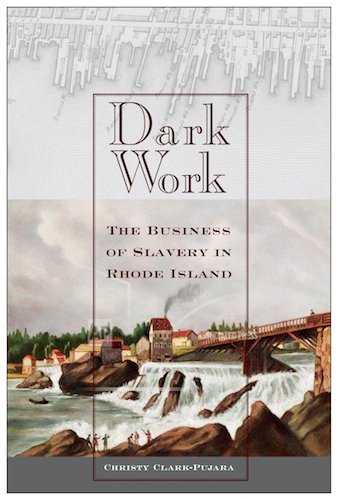
Dark Work: The Business of Slavery in Rhode Island
IRH Fellow: Christy Clark-Pujara, 2013-2014 Race, Ethnicity, and Indigeneity Fellow Synopsis: Historians have written expansively about the slave economy and its vital role in early American economic life. Like their northern neighbors, Rhode Islanders bought and sold slaves and supplies that sustained plantations throughout the Americas; however, nowhere else was this business so important. During the colonial period trade with West Indian planters provided Rhode Islanders with molasses, the key ingredient for their number one export: rum. More than 60 percent of all the slave ships that left North America left from Rhode Island. During the antebellum period Rhode Islanders were the leading producers of “negro cloth,” a coarse wool-cotton material made especially for enslaved blacks in the American South. Clark-Pujara draws on the documents of the state, the business, organizational, and personal records of their enslavers, and the few first-hand accounts left by enslaved and free black Rhode Islanders to reconstruct their lived experiences. The business of slavery encouraged slaveholding, slowed emancipation and led to circumscribed black freedom. Enslaved and free black people pushed back against their bondage and the restrictions placed on their freedom. It is convenient, especially for northerners, to think of slavery as southern institution. The erasure or marginalization of the northern black experience and the centrality of the business of slavery to the northern economy allows for a dangerous fiction—that North has no history of racism to overcome. But we cannot afford such a delusion if we are to truly reconcile with our past.
Angels of the Underground: The American Women who Resisted the Japanese in the Philippines in World War II
IRH Fellow: Theresa Kaminski, 2012-2013 UW System Fellow Synopsis: When the Japanese began their brutal occupation of the Philippines in January 1942, 76,000 ill and starving Filipino and American troops tried to hold out on Bataan and Corregidor. That spring, after having been forced to surrender, most of those men were thrown into Japanese POW camps while dozens of others slipped away to organize guerrilla forces. During the three violent years of occupation that followed, Allied sympathizers in Manila smuggled supplies and information to the guerrillas and the prisoners. Theresa Kaminski’s Angels of the Underground tells the story of four American women who were part of this little-known resistance movement: Gladys Savary, Claire Phillips, Yay Panlilio, and Peggy Utinsky – all incredibly adept at skirting occupation authorities to support the Allied war effort. The nature of their clandestine work meant that the truth behind their dangerous activities had to be obscured as long as the Japanese occupied the Philippines. If caught, they would be imprisoned, tortured, and executed. Throughout the Pacific War, these four women remained hidden behind a veil of deceit and subterfuge. An impressive work of scholarship grounded in archival research, FBI documents, and memoirs, Angels of the Underground illuminates the complex political dimensions of the occupied Philippines and its importance to the war effort in the Pacific. Kaminski’s narrative sheds light on the Japanese-occupied city of Manila; the Bataan Death March and subsequent incarceration of American military prisoners in camps O’Donnell and Cabanatuan; and the formation of guerrilla units in the mountains of Luzon. Angels of the Underground offers the compelling tale of four ordinary American women propelled by extraordinary circumstances into acts of heroism, and makes a significant contribution to the work on women’s wartime experiences. Through the lives of Gladys, Yay, Claire, and Peggy, who never wavered in their belief that it was their duty as patriotic American women to aid the Allied cause, Kaminski highlights how women have always been active participants in war, whether or not they wear a military uniform.
Democracy, Deliberation, and Education
IRH Fellow: Robert Asen, 2012-2013 Resident Fellow Synopsis: The local school board is one of America’s enduring venues of lay democracy at work. In Democracy, Deliberation, and Education, Robert Asen takes the pulse of this democratic exemplar through an in-depth study of three local school boards in Wisconsin. In so doing, Asen identifies the broader democratic ideal in the most parochial of American settings. Conducted over two years across racial, ethnic, and socioeconomic lines, Asen’s research reveals as much about the possibilities and pitfalls of local democracy as it does about educational policy. From issues as old as racial integration and as contemporary as the recognition of the Gay-Straight Alliance in high schools, Democracy, Deliberation, and Education illustrates how ordinary folks build and sustain their vision for a community and its future through consequential public decision making.For all the research on school boards conducted in recent years, no other project so directly addresses school boards as deliberative policymaking bodies. Democracy, Deliberation, and Education draws from 250 school-board meetings and 31 interviews with board members and administrators to offer insight into participants’ varied understandings of their roles in the complex mechanism of governance.
Dying for Ideas: The Dangerous Lives of the Philosophers
IRH Fellow: Costica Bradatan, 2009-2010 Solmsen Fellow Synopsis: What do Socrates, Hypatia, Giordano Bruno, Thomas More, and Jan Patocka have in common? First, they were all faced one day with the most difficult of choices: stay faithful to your ideas and die or renounce them and stay alive. Second, they all chose to die. Their spectacular deaths have become not only an integral part of their biographies, but are also inseparable from their work. A “death for ideas” is a piece of philosophical work in its own right; Socrates may have never written a line, but his death is one of the greatest philosophical best-sellers of all time. Dying for Ideas explores the limit-situation in which philosophers find themselves when the only means of persuasion they can use is their own dying bodies and the public spectacle of their death. The book tells the story of the philosopher’s encounter with death as seen from several angles: the tradition of philosophy as an art of living; the body as the site of self-transcending; death as a classical philosophical topic; taming death and self-fashioning; finally, the philosophers’ scapegoating and their live performance of a martyr’s death, followed by apotheosis and disappearance into myth. While rooted in the history of philosophy, Dying for Ideas is an exercise in breaking disciplinary boundaries. This is a book about Socrates and Heidegger, but also about Gandhi’s “fasting unto death” and self-immolation; about Girard and Passolini, and self-fashioning and the art of the essay.
Freedom’s Frontier: California and the Struggle over Unfree Labor, Emancipation, and Reconstruction
IRH Fellow: Stacey Smith, 2004-2005 Dana-Allen Dissertation Fellow Awards: 2014 David Montgomery Award, Organization of American Historians and Labor and Working-Class History Association Synopsis: Most histories of the Civil War era portray the struggle over slavery as a conflict that exclusively pitted North against South, free labor against slave labor, and black against white. In Freedom’s Frontier, Stacey L. Smith examines the battle over slavery as it unfolded on the multiracial Pacific Coast. Despite its antislavery constitution, California was home to a dizzying array of bound and semibound labor systems: African American slavery, American Indian indenture, Latino and Chinese contract labor, and a brutal sex traffic in bound Indian and Chinese women. Using untapped legislative and court records, Smith reconstructs the lives of California’s unfree workers and documents the political and legal struggles over their destiny as the nation moved through the Civil War, emancipation, and Reconstruction. Smith reveals that the state’s anti-Chinese movement, forged in its struggle over unfree labor, reached eastward to transform federal Reconstruction policy and national race relations for decades to come. Throughout, she illuminates the startling ways in which the contest over slavery’s fate included a western struggle that encompassed diverse labor systems and workers not easily classified as free or slave, black or white.
How Do I Know Thee?: Theatrical and Narrative Cognition in Seventeenth-Century France
IRH Fellow: Richard Goodkin, 2009-2014 Senior Fellow Synopsis: The classical period in France presents a particularly lively battleground for the transition between oral-visual culture, on the one hand, and print culture on the other. The former depended on learning from sources of knowledge directly, in their presence, in a manner analogous to theatrical experience. The latter became characterized by the distance and abstraction of reading. How Do I Know Thee? explores the ways in which literature, philosophy, and psychology approach social cognition, or how we come to know others. Richard E. Goodkin describes a central opposition between what he calls “theatrical cognition” and “narrative cognition,” drawing both on scholarship on literary genre and mode, and also on the work of a number of philosophers and psychologists, in particular Descartes’s theory of cognition, Freudian psychoanalysis, mid-twentieth-century behaviorism, and the field of cognitive science. The result is a study that will be of interest not only to students of the classical period but also to those in the corresponding disciplines.
In Search of an Alternative Biopolitics: Anti-Bullfighting, Animality, and the Environment in Contemporary Spain
IRH Fellow: Katarzyna Olga Beilin, 2011-2012 Resident Fellow Synopsis: In Search of an Alternative Biopolitics: Anti-Bullfighting, Animality, and the Environment in Contemporary Spain by Katarzyna Olga Beilin takes readers on a journey through the history of alternative thought that challenges mainstream understandings of the relations between the human and nonhuman realms. Weaving through the works of Mariano José de Larra, Eugenio Noel, Luis Buñuel, Luis Martín-Santos, Pedro Almodóvar, Pablo Bérguer, Juan Mayorga, and Rosa Montero, Beilin convincingly demonstrates that “the question of the animal” has long been of particular significance for Spanish culture. Analyses of the synergy of press debates on bullfighting and the War on Terror, as well as media debates on King Juan Carlos’s hunt in Botswana and his resignation, reveal how the concepts structuring human/animal relations condition national biopolitics. Beilin traces a main principle, where sacrifice of some lives is deemed necessary for the sake of others, from bullfighting, through environmental destruction and immigration policies, to bioeconomy. Ultimately, In Search of an Alternative Biopolitics argues that to address ever-increasing threats of global warming and future catastrophes, we urgently need to redefine concepts structuring the human and the nonhuman realms.
Planetary Modernisms: Provocations on Modernity Across Time
IRH Fellow: Susan Stanford Friedman, 2007-2017 IRH Director Synopsis: Drawing on a vast archive of world history, anthropology, geography, cultural theory, postcolonial studies, gender studies, literature, and art, Susan Stanford Friedman recasts modernity as a networked, circulating, and recurrent phenomenon producing multiple aesthetic innovations across millennia. Considering cosmopolitan as well as nomadic and oceanic worlds, she radically revises the scope of modernist critique and opens the practice to more integrated study. Friedman moves from large-scale instances of pre-1500 modernities, such as Tang Dynasty China and the Mongol Empire, to small-scale instances of modernisms, including the poetry of Du Fu and Kabir and Abbasid ceramic art. She maps the interconnected modernisms of the long twentieth century, pairing Joseph Conrad with Tayeb Salih, E. M. Forster with Arundhati Roy, Virginia Woolf with the Tagores, and Aimé Césaire with Theresa Hak Kyung Cha. She reads postcolonial works from Sudan and India and engages with the idea of Négritude. Rejecting the modernist concepts of marginality, othering, and major/minor, Friedman instead favors rupture, mobility, speed, networks, and divergence, elevating the agencies and creative capacities of all cultures not only in the past and present but also in the century to come.
Scenes of Projection: Recasting the Enlightenment Subject
IRH Fellow: Jill Casid, 2006-2007 Resident Fellow Synopsis: Theorizing vision and power at the intersections of the histories of psychoanalysis, media, scientific method, and colonization, Scenes of Projection poaches the prized instruments at the heart of the so-called scientific revolution: the projecting telescope, camera obscura, magic lantern, solar microscope, and prism. From the beginnings of what is retrospectively enshrined as the origins of the Enlightenment and in the wake of colonization, the scene of projection has functioned as a contraption for creating a fantasy subject of discarnate vision for the exercise of “reason.” Jill H. Casid demonstrates across a range of sites that the scene of projection is neither a static diagram of power nor a fixed architecture but rather a pedagogical setup that operates as an influencing machine of persistent training. Thinking with queer and feminist art projects that take up old devices for casting an image to reorient this apparatus of power that produces its subject, Scenes of Projection offers a set of theses on the possibilities for felt embodiment out of the damaged and difficult pasts that haunt our present.
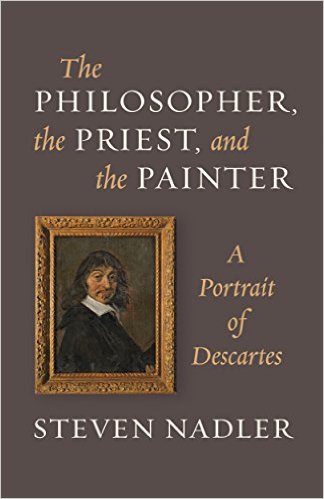
The Philosopher, the Priest, and the Painter: A Portrait of Descartes
IRH Fellow: Steven Nadler, 2013-2017 Senior Fellow Synopsis: In the Louvre museum hangs a portrait that is considered the iconic image of René Descartes, the great seventeenth-century French philosopher. And the painter of the work? The Dutch master Frans Hals–or so it was long believed, until the work was downgraded to a copy of an original. But where is the authentic version, and who painted it? Is the man in the painting–and in its original–really Descartes? A unique combination of philosophy, biography, and art history, The Philosopher, the Priest, and the Painter investigates the remarkable individuals and circumstances behind a small portrait. Through this image–and the intersecting lives of a brilliant philosopher, a Catholic priest, and a gifted painter–Steven Nadler opens a fascinating portal into Descartes’s life and times, skillfully presenting an accessible introduction to Descartes’s philosophical and scientific ideas, and an illuminating tour of the volatile political and religious environment of the Dutch Golden Age. As Nadler shows, Descartes’s innovative ideas about the world, about human nature and knowledge, and about philosophy itself, stirred great controversy. Philosophical and theological critics vigorously opposed his views, and civil and ecclesiastic authorities condemned his writings. Nevertheless, Descartes’s thought came to dominate the philosophical world of the period, and can rightly be called the philosophy of the seventeenth century. Shedding light on a well-known image, The Philosopher, the Priest, and the Painter offers an engaging exploration of a celebrated philosopher’s world and work.
The World the Game Theorists Made
Erickson, P. The World the Game Theorists Made. Chicago, IL: University of Chicago Press, 2015.
IRH Fellow: Paul Erickson, 2005-2006 William Coleman Dissertation Fellow Synopsis: In recent decades game theory—the mathematics of rational decision-making by interacting individuals—has assumed a central place in our understanding of capitalist markets, the evolution of social behavior in animals, and even the ethics of altruism and fairness in human beings. With game theory’s ubiquity, however, has come a great deal of misunderstanding. Critics of the contemporary social sciences view it as part of an unwelcome trend toward the marginalization of historicist and interpretive styles of inquiry, and many accuse its proponents of presenting a thin and empirically dubious view of human choice. The World the Game Theorists Made seeks to explain the ascendency of game theory, focusing on the poorly understood period between the publication of John von Neumann and Oscar Morgenstern’s seminal Theory of Games and Economic Behavior in 1944 and the theory’s revival in economics in the 1980s. Drawing on a diverse collection of institutional archives, personal correspondence, and papers, and interviews, Paul Erickson shows how game theory offered social scientists, biologists, military strategists, and others a common, flexible language that could facilitate wide-ranging thought and debate on some of the most critical issues of the day.
Valuing Health: Well-Being, Freedom, and Suffering
IRH Fellow: Daniel Hausman, 2006-2007 Resident Fellow Synopsis: In Valuing Health Daniel M. Hausman provides a philosophically sophisticated overview of generic health measurement that suggests improvements in standard methods and proposes a radical alternative. He shows how to avoid relying on surveys and instead evaluate health states directly. Hausman goes on to tackle the deep problems of evaluation, offering an account of fundamental evaluation that does not presuppose the assignment of values to the properties and consequences of alternatives. After discussing the purposes of generic health measurement, Hausman defends a naturalistic concept of health and its relations to measures such as quality-adjusted life-years (QALYs) and disability-adjusted life years (DALYs). In examining current health-measurement systems, Valuing Health clarifies their value commitments and the objections to relying on preference surveys to assign values to health states. Relying on an interpretation of liberal political philosophy, Hausman argues that the public value of health states should be understood in terms of the activity limits and suffering that health states impose. Hausman also addresses the moral conundrums that arise when policy-makers attempt to employ the values of health states to estimate the health benefits of alternative policies and to adopt the most cost-effective. He concludes with a general discussion of the difficulties of combining consequentialist and non-consequentialist moral considerations in policy-making.

We Gotta Get Out of This Place: The Soundtrack of the Vietnam War
IRH Fellow: Craig Werner, 2009-2013 Senior Fellow Awards: 2015 Rolling Stone 10 Best Music Books Synopsis: For a Kentucky rifleman who spent his tour trudging through Vietnam’s Central Highlands, it was Nancy Sinatra’s “These Boots Are Made for Walkin’.” For a “tunnel rat” who blew smoke into the Viet Cong’s underground tunnels, it was Jimi Hendrix’s “Purple Haze.” For a black marine distraught over the assassination of Martin Luther King Jr., it was Aretha Franklin’s “Chain of Fools.” And for countless other Vietnam vets, it was “I Feel Like I’m Fixin’ to Die,” “Who’ll Stop the Rain,” or the song that gives this book its title. In We Gotta Get Out of This Place, Doug Bradley and Craig Werner place popular music at the heart of the American experience in Vietnam. They explore how and why U.S. troops turned to music as a way of connecting to each other and the World back home and of coping with the complexities of the war they had been sent to fight. They also demonstrate that music was important for every group of Vietnam veterans―black and white, Latino and Native American, men and women, officers and “grunts”―whose personal reflections drive the book’s narrative. Many of the voices are those of ordinary soldiers, airmen, seamen, and marines. But there are also “solo” pieces by veterans whose writings have shaped our understanding of the war―Karl Marlantes, Alfredo Vea, Yusef Komunyakaa, Bill Ehrhart, Arthur Flowers―as well as songwriters and performers whose music influenced soldiers’ lives, including Eric Burdon, James Brown, Bruce Springsteen, Country Joe McDonald, and John Fogerty. Together their testimony taps into memories―individual and cultural―that capture a central if often overlooked component of the American war in Vietnam.
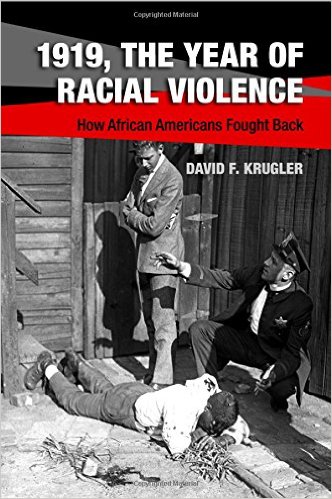
1919, The Year of Racial Violence: How African Americans Fought Back
IRH Fellow: David Krugler, 2010-2011 UW Systems Fellow Synopsis: 1919, The Year of Racial Violence recounts African Americans’ brave stand against a cascade of mob attacks in the United States after World War I. The emerging New Negro identity, which prized unflinching resistance to second-class citizenship, further inspired veterans and their fellow black citizens. In city after city – Washington, DC; Chicago; Charleston; and elsewhere – black men and women took up arms to repel mobs that used lynching, assaults, and other forms of violence to protect white supremacy; yet, authorities blamed blacks for the violence, leading to mass arrests and misleading news coverage. Refusing to yield, African Americans sought accuracy and fairness in the courts of public opinion and the law. This is the first account of this three-front fight – in the streets, in the press, and in the courts – against mob violence during one of the worst years of racial conflict in U.S. history.
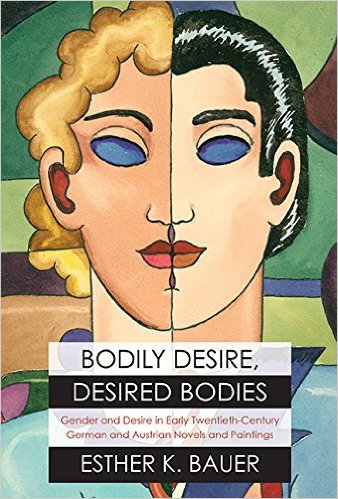
Bodily Desire, Desired Bodies: Gender and Desire in Early Twentieth-Century German and Austrian Novels and Paintings
IRH Fellow: Esther K. Bauer, 2008-2009 UW System Fellow Synopsis: Bodily Desire, Desired Bodies examines the diverse ways that literary works and paintings can be read as screens onto which new images of masculinity and femininity are cast. Esther Bauer focuses on German and Austrian writers and artists from the 1910s and 1920s —specifically authors Franz Kafka, Vicki Baum, and Thomas Mann, and painters Otto Dix, Christian Schad, and Egon Schiele—who gave spectacular expression to shifting trends in male and female social roles and the organization of physical desire and the sexual body. Bauer’s comparative approach reveals the ways in which artists and writers echoed one another in undermining the gender duality and highlighting sexuality and the body. As she points out, as sites of negotiation and innovation, these works reconfigured bodies of desire against prevailing notions of sexual difference and physical attraction and thus became instruments of social transformation.
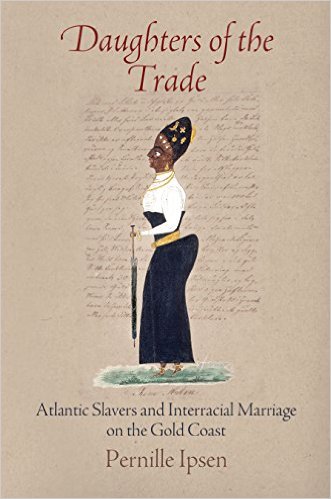
Daughters of the Trade: Atlantic Slavers and Interracial Marriage on the Gold Coast
IRH Fellow: Pernille Ipsen, 2012-2013 Race, Ethnicity, and Indigeneity Fellow Synopsis: Severine Brock’s first language was Ga, yet it was not surprising when, in 1842, she married Edward Carstensen. He was the last governor of Christiansborg, the fort that, in the eighteenth century, had been the center of Danish slave trading in West Africa. She was the descendant of Ga-speaking women who had married Danish merchants and traders. Their marriage would have been familiar to Gold Coast traders going back nearly 150 years. In Daughters of the Trade, Pernille Ipsen follows five generations of marriages between African women and Danish men, revealing how interracial marriage created a Euro-African hybrid culture specifically adapted to the Atlantic slave trade. Although interracial marriage was prohibited in European colonies throughout the Atlantic world, in Gold Coast slave-trading towns it became a recognized and respected custom. Cassare, or “keeping house,” gave European men the support of African women and their kin, which was essential for their survival and success, while African families made alliances with European traders and secured the legitimacy of their offspring by making the unions official. For many years, Euro-African families lived in close proximity to the violence of the slave trade. Sheltered by their Danish names and connections, they grew wealthy and influential. But their powerful position on the Gold Coast did not extend to the broader Atlantic world, where the link between blackness and slavery grew stronger, and where Euro-African descent did not guarantee privilege. By the time Severine Brock married Edward Carstensen, their world had changed. Daughters of the Trade uncovers the vital role interracial marriage played in the coastal slave trade, the production of racial difference, and the increasing stratification of the early modern Atlantic world.
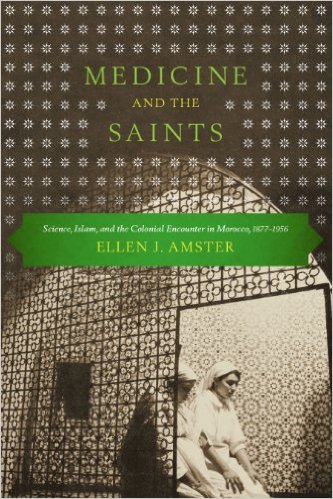
Medicine and the Saints: Science, Islam, and the Colonial Encounter in Morocco, 1877-1956
IRH Fellow: Ellen Amster, 2008-2009 UW System Fellow Synopsis: Exploring the colonial encounter between France and Morocco as a process of embodiment, and the Muslim body as the place of resistance to the state, this book provides the first history of medicine, health, disease, and the welfare state in Morocco. Because the body politic and the physical body are intimately linked, French efforts to colonize Morocco took place in and through the body. Starting from this original premise, Medicine and the Saints traces a history of colonial embodiment in Morocco through a series of medical encounters between the Islamic sultanate of Morocco and the Republic of France from 1877 to 1956. Drawing on an interdisciplinary wealth of archival, manuscript, and oral sources in French and Arabic, Ellen Amster investigates the positivist ambitions of French colonial doctors, sociologists, philologists, and historians to transform Morocco; the social history of the encounters occasioned by French medical interventions; and the ways in which Moroccan nationalists ultimately appropriated a French model of modernity to invent the independent nation-state. Each chapter of the book addresses a different problem in the history of medicine: international espionage and a doctor’s murder; disease and revolt in Moroccan cities; a battle for authority between doctors and Muslim midwives; and the search for national identity in the welfare state. This research reveals how Moroccans have ingested and digested French science and used it to create a nationalist movement and Islamist politics, and to understand disease and health. In the colonial encounter, the Muslim body became a seat of subjectivity, the place from which individuals contested and redefined the political.
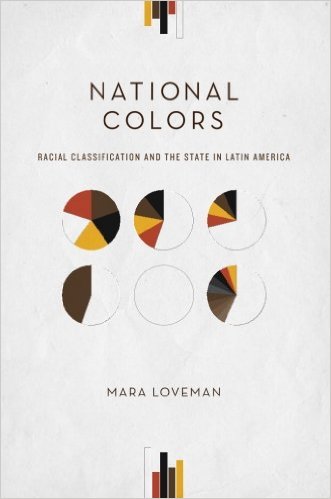
National Colors: Racial Classification and the State in Latin America
IRH Fellow: Mara Loveman, 2009-2010 Resident Fellow Awards: 2015 Allan Sharlin Memorial Award for Outstanding Book in Social Science History, Social Science History Association 2015 Oliver Cromwell Cox Book Award, Section on Racial and Ethnic Minorities, American Sociological Association 2015 Distinguished Contribution to Scholarship Award, Political Sociology Section of the American Sociological Association 2015 Best Scholarly Book Award, Section on Global and Transnational Sociology, American Sociological Association Synopsis: The era of official color-blindness in Latin America has come to an end. For the first time in decades, nearly every state in Latin America now asks their citizens to identify their race or ethnicity on the national census. Most observers approvingly highlight the historic novelty of these reforms, but National Colors shows that official racial classification of citizens has a long history in Latin America. Through a comprehensive analysis of the politics and practice of official ethnoracial classification in the censuses of nineteen Latin American states across nearly two centuries, this book explains why most Latin American states classified their citizens by race on early national censuses, why they stopped the practice of official racial classification around mid-twentieth century, and why they reintroduced ethnoracial classification on national censuses at the dawn of the twenty-first century. Beyond domestic political struggles, the analysis reveals that the ways that Latin American states classified their populations from the mid-nineteenth century onward responded to changes in international criteria for how to construct a modern nation and promote national development. As prevailing international understandings of what made a political and cultural community a modern nation changed, so too did the ways that Latin American census officials depicted diversity within national populations. The way census officials described populations in official statistics, in turn, shaped how policymakers viewed national populations and informed their prescriptions for national development–with consequences that still reverberate in contemporary political struggles for recognition, rights, and redress for ethnoracially marginalized populations in today’s Latin America.
Propaganda 1776: Secrets, Leaks, and Revolutionary Communications in Early America
IRH Fellow: Russ Castronovo, 2012-2013 Resident Fellow Synopsis: 1776 symbolizes a moment, both historical and mythic, of democracy in action. That year witnessed the release of a document, which Edward Bernays, the so-called father of public relations and spin, would later label as a masterstroke of propaganda. Although the Declaration of Independence relies heavily on the empiricism of self-evident truths, Bernays, who had authored the influential manifesto Propaganda in 1928, suggested that what made this iconic document so effective was not its sober rationalism but its inspiring message that ensured its dissemination throughout the American colonies. Propaganda 1776 reframes the culture of the U.S. Revolution and early Republic, revealing it to be rooted in a vast network of propaganda. Drawing on a wide range of resources, Russ Castronovo considers how the dispersal and circulation-indeed, the propagation-of information and opinion across the various media of the eighteenth century helped speed the flow of revolution. This book challenges conventional wisdom about propaganda as manipulation or lies by examining how popular consent and public opinion in early America relied on the spirited dissemination of rumor, forgery, and invective. While declarations about self-evident truths were important to liberty, the path toward American independence required above all else the spread of unreliable intelligence that traveled at such a pace that it could be neither confirmed nor refuted. By tracking the movements of stolen documents and leaked confidential letters, this book argues that media dissemination created a vital but seldom acknowledged connection between propaganda and democracy. The spread of revolutionary material in the form of newspapers, pamphlets, broadsides, letters, songs, and poems across British North America created multiple networks that spawned new and often radical ideas about political communication. Communication itself became revolutionary in ways that revealed circulation to be propaganda’s most vital content. By examining the kinetic aspects of print culture, Propaganda 1776 shows how the mobility of letters, pamphlets, and other texts amounts to political activity par excellence. With original examinations of Ben Franklin, Mercy Otis Warren, Tom Paine, and Philip Freneau among a crowd of other notorious propagandists, this book examines how colonial men and women popularized and spread the patriot cause across America.
Roomscape: Women Writers in the British Museum from George Eliot to Virginia Woolf
IRH Fellow: Susan David Bernstein, 2009-2010 Resident Fellow Synopsis: Drawing on archival materials around this national library reading room, Roomscape is the first study that integrates documentary, theoretical, historical, and literary sources to examine the significance of this public interior space for women writers and their treatment of reading and writing spaces in literary texts. This book challenges an assessment of the Reading Room of the British Museum as a bastion of class and gender privilege, an image firmly established by Virginia Woolf’s 1929 A Room of One’s Own and the legions of feminist scholarship that upholds this spatial conceit. Susan David Bernstein argues not only that the British Museum Reading Room facilitated various practices of women’s literary traditions, she also questions the overdetermined value of privacy and autonomy in constructions of female authorship, a principle generated from Woolf’s feminist manifesto. Rather than viewing reading and writing as solitary, individual events, Roomscape considers the meaning of exteriority and the public and social and gendered dimensions of literary production.
The Ethics of Witnessing: The Holocaust in Polish Writers’ Diaries from Warsaw, 1939-1945
IRH Fellow: Rachel Feldhay Brenner, 2008-2013 Senior Fellow Awards: 2015 USC Book Award in Literary and Cultural Studies Synopsis: The Ethics of Witnessing investigates the reactions of five important Polish diarists-writers—Jaroslaw Iwaszkiewicz, Maria Dabrowska, Aurelia Wylezynska, Zofia Nalkowska, and Stanislaw Rembek—during the period when the Nazis persecuted and murdered Warsaw’s Jewish population. The responses to the Holocaust of these prominent prewar authors extended from insistence on empathic interaction with victims to resentful detachment from Jewish suffering. Whereas some defied the dehumanization of the Jews and endeavored to maintain intersubjective relationships with the victims they attempted to rescue, others sell deceptively evaded the Jewish plight. The Ethics of Witnessing examines the extent to which ideologies of humanism and nationalism informed the diarists’ perceptions, proposing that the reality of the Final Solution exposed the limits of both orientations and ultimately destroyed the ethical landscape shaped by the Enlightenment tradition, which promised the equality and fellowship of all human beings.
Beyond the Metropolis: Second Cities and Modern Life in Interwar Japan
IRH Fellow: Louise Young, 2008-2009 Resident Fellow Synopsis: In Beyond the Metropolis, Louise Young looks at the emergence of urbanism in the interwar period, a global moment when the material and ideological structures that constitute “the city” took their characteristic modern shape. In Japan, as elsewhere, cities became the staging ground for wide-ranging social, cultural, economic, and political transformations. The rise of social problems, the formation of a consumer marketplace, the proliferation of streetcars and streetcar suburbs, and the cascade of investments in urban development reinvented the city as both socio-spatial form and set of ideas. Young tells this story through the optic of the provincial city, examining four second-tier cities: Sapporo, Kanazawa, Niigata, and Okayama. As prefectural capitals, these cities constituted centers of their respective regions. All four grew at an enormous rate in the interwar decades, much as the metropolitan giants did. In spite of their commonalities, local conditions meant that policies of national development and the vagaries of the business cycle affected individual cities in diverse ways. As their differences reveal, there is no single master narrative of twentieth-century modernization. By engaging urban culture beyond the metropolis, this study shows that Japanese modernity was not made in Tokyo and exported to the provinces, but rather co-constituted through the circulation and exchange of people and ideas throughout the country and beyond.
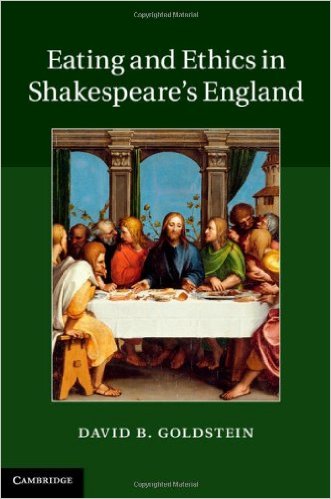
Eating and Ethics in Shakespeare’s England
IRH Fellow: David Goldstein, 2009-2010 Solmsen Fellow Awards: Shakespeare’s Globe Book Award Synopsis: David B. Goldstein argues for a new understanding of Renaissance England from the perspective of communal eating. Rather than focus on traditional models of interiority, choice and consumption, Goldstein demonstrates that eating offered a central paradigm for the ethics of community formation. The book examines how sharing food helps build, demarcate and destroy relationships – between eater and eaten, between self and other, and among different groups. Tracing these eating relations from 1547 to 1680 – through Shakespeare, Milton, religious writers and recipe book authors – Goldstein shows that to think about eating was to engage in complex reflections about the body’s role in society. In the process, he radically rethinks the communal importance of the Protestant Eucharist. Combining historicist literary analysis with insights from social science and philosophy, the book’s arguments reverberate well beyond the Renaissance. Ultimately, Eating and Ethics in Shakespeare’s England forces us to rethink our own relationship to food.
Les magnifiques mensonges de Madeleine Béjart
IRH Fellow: Richard Goodkin, 2009-2014 Senior Fellow Synopsis: Would Molière be the great playwright we know today had he not met Madeleine de Béjart, the beautiful, intelligent, and gifted actress who was his collaborator, mistress, and sister-in-law–or perhaps mother-in-law? Richard Goodkin’s well-documented novel adopts the form of historical fiction. When details are missing from the historical record, the author fills in the gaps to give meaning to the story, yet with cheerful malice, he also takes the conventions of the historical novel with a grain of salt. The story of a life, the novel is also the tale of Madeleine’s gradual discovery of the “art of lying,” which in Goodkin’s vision can also be one of the purest forms of love.
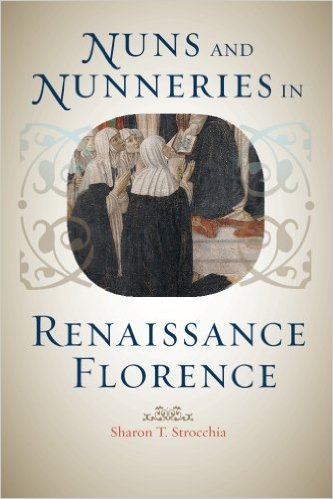
Nuns and Nunneries in Renaissance Florence
Strocchia, S. Nuns and Nunneries in Renaissance Florence. Baltimore, MD: Johns Hopkins University Press, 2013.
IRH Fellow: Sharon Strocchia, 2010-2011 Solmsen Fellow Synopsis: The 15th century was a time of dramatic and decisive change for nuns and nunneries in Florence. In the course of that century, the city’s convents evolved from small, semiautonomous communities to large civic institutions. By 1552, roughly one in eight Florentine women lived in a religious community. Historian Sharon T. Strocchia analyzes this stunning growth of female monasticism, revealing the important roles these women and institutions played in the social, economic, and political history of Renaissance Florence. It became common practice during this time for unmarried women in elite society to enter convents. This unprecedented concentration of highly educated and well-connected women transformed convents into sites of great patronage and social and political influence. As their economic influence also grew, convents found new ways of supporting themselves; they established schools, produced manuscripts, and manufactured textiles. Strocchia has mined previously untapped archival materials to uncover how convents shaped one of the principal cities of Renaissance Europe. She demonstrates the importance of nuns and nunneries to the booming Florentine textile industry and shows the contributions that ordinary nuns made to Florentine life in their roles as scribes, stewards, artisans, teachers, and community leaders. In doing so, Strocchia argues that the ideals and institutions that defined Florence were influenced in great part by the city’s powerful female monastics. Nuns and Nunneries in Renaissance Florence shows for the first time how religious women effected broad historical change and helped write the grand narrative of medieval and Renaissance Europe. The book is a valuable text for students and scholars in early modern European history, religion, women’s studies, and economic history.
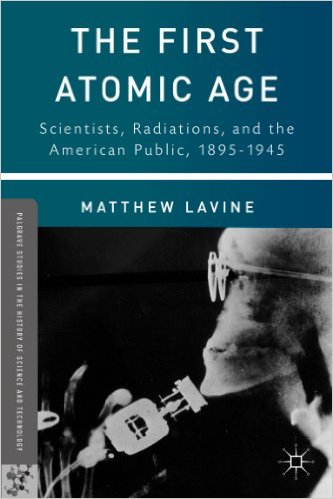
The First Atomic Age: Scientists, Radiations, and the American Public, 1895-1945
IRH Fellow: Matthew Lavine, 2007-2008 William Coleman Dissertation Fellow Synopsis: At the close of the nineteenth century, the discovery of strange new forms of energy arrested the American public’s attention in ways that no scientific discovery ever had before. The fascination with X-rays and radioactivity that was kindled in those early years evolved to affect the course of industry, public policy, and the cultural authority of scientists and physicians. Americans exposed themselves to radiation in ways that seem shocking now, even as knowledge about radiation, its risks, and its applications percolated through the public discourse. This groundbreaking cultural history demonstrates how the busy exchange of perspectives between researchers, popularizers, entrepreneurs, and the general public gave rise to the first nuclear culture, one whose lasting effects would later be seen in the familiar “atomic age” of the post-war twentieth century.
What Soldiers Do: Sex and the American GI in World War II France
IRH Fellow: Mary Louise Roberts, 2010-2014 Senior Fellow Awards: American Historical Association: AHA-George Louis Beer Prize Society for French Historical Studies: Gilbert Chinard Prize Synopsis: How do you convince men to charge across heavily mined beaches into deadly machine-gun fire? Do you appeal to their bonds with their fellow soldiers, their patriotism, their desire to end tyranny and mass murder? Certainly—but if you’re the US Army in 1944, you also try another tack: you dangle the lure of beautiful French women, waiting just on the other side of the wire, ready to reward their liberators in oh so many ways. That’s not the picture of the Greatest Generation that we’ve been given, but it’s the one Mary Louise Roberts paints to devastating effect in What Soldiers Do. Drawing on an incredible range of sources, including news reports, propaganda and training materials, official planning documents, wartime diaries, and memoirs, Roberts tells the fascinating and troubling story of how the US military command systematically spread—and then exploited—the myth of French women as sexually experienced and available. The resulting chaos—ranging from flagrant public sex with prostitutes to outright rape and rampant venereal disease—horrified the war-weary and demoralized French population. The sexual predation, and the blithe response of the American military leadership, also caused serious friction between the two nations just as they were attempting to settle questions of long-term control over the liberated territories and the restoration of French sovereignty. While never denying the achievement of D-Day, or the bravery of the soldiers who took part, What Soldiers Do reminds us that history is always more useful—and more interesting—when it is most honest, and when it goes beyond the burnished beauty of nostalgia to grapple with the real lives and real mistakes of the people who lived it.
Clandestine Marriage: Botany and Romantic Culture
IRH Fellow: Theresa M. Kelley, 2003-2004 Resident Fellow Awards: Winner, 2012 British Society for Literature and Science Book Prize Synopsis: Romanticism was a cultural and intellectual movement characterized by discovery, revolution, and the poetic as well as by the philosophical relationship between people and nature. Botany sits at the intersection where romantic scientific and literary discourses meet. Clandestine Marriage explores the meaning and methods of how plants were represented and reproduced in scientific, literary, artistic, and material cultures of the period. Theresa M. Kelley synthesizes romantic debates about taxonomy and morphology, the contemporary interest in books and magazines devoted to plant study and images, and writings by such authors as Mary Wollstonecraft and Anna Letitia Barbauld. Period botanical paintings of flowers are reproduced in vibrant color, bringing her argument and the romantics’ passion for plants to life. In addition to exploring botanic thought and practice in the context of British romanticism, Kelley also looks to the German philosophical traditions of Kant, Hegel, and Goethe and to Charles Darwin’s reflections on orchids and plant pollination. Her interdisciplinary approach allows a deeper understanding of a time when exploration of the natural world was a culture-wide enchantment.
Cosmopolitan Style: Modernism Beyond the Nation
IRH Fellow: Rebecca Walkowitz, 2002-2003 Resident Fellow Synopsis: In this broad-ranging and ambitious intervention in the debates over the politics, ethics, and aesthetics of cosmopolitanism, Rebecca L. Walkowitz argues that modernist literary style has been crucial to new ways of thinking and acting beyond the nation. While she focuses on modernist narrative, Walkowitz suggests that style conceived expansively as attitude, stance, posture, and consciousness helps to explain many other, nonliterary formations of cosmopolitanism in history, anthropology, sociology, transcultural studies, and media studies. Walkowitz shows that James Joyce, Joseph Conrad, Virginia Woolf, Salman Rushdie, Kazuo Ishiguro, and W. G. Sebald use the salient features of literary modernism in their novels to explore different versions of transnational thought, question moral and political norms, and renovate the meanings of national culture and international attachment. By deploying literary tactics of naturalness, triviality, evasion, mix-up, treason, and vertigo, these six authors promote ideas of democratic individualism on the one hand and collective projects of antifascism or anti-imperialism on the other. Joyce, Conrad, and Woolf made their most significant contribution to this “critical cosmopolitanism” in their reflection on the relationships between narrative and political ideas of progress, aesthetic and social demands for literalism, and sexual and conceptual decorousness. Specifically, Walkowitz considers Joyce’s critique of British imperialism and Irish nativism; Conrad’s understanding of the classification of foreigners; and Woolf’s exploration of how colonizing policies rely on ideas of honor and masculinity. Rushdie, Ishiguro, and Sebald have revived efforts to question the definitions and uses of naturalness, argument, utility, attentiveness, reasonableness, and explicitness, but their novels also address a range of “new ethnicities” in late-twentieth-century Britain and the different internationalisms of contemporary life. They use modernist strategies to articulate dynamic conceptions of local and global affiliation, with Rushdie in particular adding playfulness and confusion to the politics of antiracism. In this unique and engaging study, Walkowitz shows how Joyce, Conrad, and Woolf developed a repertoire of narrative strategies at the beginning of the twentieth century that were transformed by Rushdie, Ishiguro, and Sebald at the end. Her book brings to the forefront the artful idiosyncrasies and political ambiguities of twentieth-century modernist fiction.
Diego Velázquez’s Early Paintings and the Culture of Seventeenth-Century Seville
IRH Fellow: Tanya Tiffany, 2008-2009 UW System Fellow Synopsis: Diego Velázquez spent his formative years at the center of artistic life in seventeenth-century Seville, a gateway to the New World characterized by intellectual debate, religious fervor, and mounting ethnic tensions. Yet critics have often divorced the painter’s novel style and subject matter from the city’s unique pictorial and cultural traditions. In Diego Velázquez’s Early Paintings and the Culture of Seventeenth-Century Seville, Tanya J. Tiffany demonstrates that Velázquez’s works not only engaged Seville’s social practices but also raised issues of vital importance to seventeenth-century Sevillians. As a young artist, Velázquez contended with such essential questions as women’s place in society, the nature of artistic creativity, the role of religion in everyday life, and the incorporation of racial minorities into Christianity. This study offers close readings of individual paintings with regard to their historical framework, critical context, and early reception. Through this approach, Tiffany illuminates well-known masterpieces and also highlights the fluid boundaries between high art and popular forms of visual expression.
Morality and the Emotions
Bagnoli (Editor), C. Morality and the Emotions. Oxford, UK: Oxford University Press, 2012.
IRH Fellow: Carla Bagnoli, 2002-2003 UW System Fellow Synopsis: Emotions shape our mental and social lives. Their relation to morality is, however, problematic. Since ancient times, philosophers have disagreed about the place of emotions in morality. One the one hand, some hold that emotions are disorderly and unpredictable animal drives, which undermine our autonomy and interfere with our reasoning. For them, emotions represent a persistent source of obstacles to morality, as in the case of self-love. Some virtues, such as prudence, temperance, and fortitude, require or simply consist in the capacity to counteract the disruptive effect of emotions. On the other hand, venerable traditions of thought place emotions such as respect, love, and compassion at the very heart of morality. Emotions are sources of moral knowledge, modes of moral recognition, discernment, valuing, and understanding. Emotions such as blame, guilt, and shame are the voice of moral conscience, and are central to the functioning of our social lives and normative practices. New scientific findings about the pervasiveness of emotions posit new challenges to ethical theory. Are we responsible for emotions? What is their relation to practical rationality? Are they roots of our identity or threats to our autonomy? This volume is born out of the conviction that philosophy provides a distinctive approach to these problems. Fourteen original articles, by prominent scholars in moral psychology and philosophy of mind, offer new arguments about the relation between emotions and practical rationality, value, autonomy, and moral identity.
Women and Aristocratic Culture in the Carolingian World
IRH Fellow: Valerie Garver, 2008-2009 Solmsen Fellow Synopsis: Despite the wealth of scholarship in recent decades on medieval women, we still know much less about the experiences of women in the early Middle Ages than we do about those in later centuries. In Women and Aristocratic Culture in the Carolingian World, Valerie L. Garver offers a fresh appraisal of the cultural and social history of eighth- and ninth-century women. Examining changes in women’s lives and in the ways others perceived women during the early Middle Ages, she shows that lay and religious women, despite their legal and social constrictions, played integral roles in Carolingian society. Garver’s innovative book employs an especially wide range of sources, both textual and material, which she uses to construct a more complex and nuanced impression of aristocratic women than we’ve seen before. She looks at the importance of female beauty and adornment; the family and the construction of identities and collective memory; education and moral exemplarity; wealth, hospitality and domestic management; textile work, and the lifecycle of elite Carolingian women. Her interdisciplinary approach makes deft use of canons of church councils, chronicles, charters, polyptychs, capitularies, letters, poetry, exegesis, liturgy, inventories, hagiography, memorial books, artworks, archaeological remains, and textiles. Ultimately, Women and Aristocratic Culture in the Carolingian World underlines the centrality of the Carolingian era to the reshaping of antique ideas and the development of lasting social norms.
A History of Trust in Ancient Greece
Johnstone, S. A History of Trust in Ancient Greece. Chicago, IL: University of Chicago Press, 2011.
IRH Fellow: Steven Johnstone, 2004-2005 Solmsen Fellow Synopsis: An enormous amount of literature exists on Greek law, economics, and political philosophy. Yet no one has written a history of trust, one of the most fundamental aspects of social and economic interaction in the ancient world. In this fresh look at antiquity, Steven Johnstone explores the way democracy and markets flourished in ancient Greece not so much through personal relationships as through trust in abstract systems—including money, standardized measurement, rhetoric, and haggling. Focusing on markets and democratic politics, Johnstone draws on speeches given in Athenian courts, histories of Athenian democracy, comic writings, and laws inscribed on stone to examine how these systems worked. He analyzes their potentials and limitations and how the Greeks understood and critiqued them. In providing the first comprehensive account of these pervasive and crucial systems, A History of Trust in Ancient Greece links Greek political, economic, social, and intellectual history in new ways and challenges contemporary analyses of trust and civil society.
The Lettered Mountain: A Peruvian Village’s Way with Writing
IRH Fellow: Frank Salomon, 2004-2009 Senior Fellow Synopsis: Andean peoples joined the world of alphabetic literacy nearly 500 years ago, yet the history of their literacy has remained hidden until now. In The Lettered Mountain, Frank Salomon and Mercedes Niño-Murcia expand notions of literacy and challenge stereotypes of Andean “orality” by analyzing the writings of mountain villagers from Inka times to the Internet era. Their historical ethnography is based on extensive research in the village of Tupicocha, in the central Peruvian province of Huarochirí. The region has a special place in the history of Latin American letters as the home of the unique early-seventeenth-century Quechua-language book explaining Peru’s ancient gods and priesthoods. Granted access to Tupicocha’s surprisingly rich internal archives, Salomon and Niño-Murcia found that legacy reflected in a distinctive version of lettered life developed prior to the arrival of state schools. In their detailed ethnography, writing emerges as a vital practice underlying specifically Andean sacred culture and self-governance. At the same time, the authors find that Andean relations with the nation-state have been disadvantaged by state writing standards developed in dialogue with European academies but not with the rural literate tradition.
The Protestant Ethic Revisited
Gorski, P. S. The Protestant Ethic Revisited. Philadelphia, PA: Temple University Press, 2011.
IRH Fellow: Philip S. Gorski, 1998-1999 Resident Fellow Synopsis: In The Protestant Ethic Revisited, the historical sociologist Philip Gorski returns to the overarching theme that animated Max Weber’s life work—namely, how the Christian West was reshaped by world-changing energies of the Calvinist movement. Gorski not only considers the perennial debate about religion and capitalism; he also devotes particular attention to the influence of Calvinism on the political development of the West—that is, the formation of strong states, the crystallization of national identities, the ignition of revolutions, and the advent of secularized politics. The Protestant Ethic Revisited is a masterful new collection of Gorski’s essays on religion and comparative historical sociology that includes both classic works and previously unpublished materials. Reflecting the aim of much of Gorski’s work, this anthology reveals what we think of as fixed ideas about nationalism, secularism, politics, and religion in public life as either older-or less stable-concepts than previously thought.
The Reformation: Towards a New History
IRH Fellow: Lee Palmer Wandel, 2005-2009 Senior Fellow Synopsis: This book brings together two histories, of the Encounter between Europe and the western hemisphere that began in 1492 and the fragmentation of European Christendom in the sixteenth century, to recast the story of the Reformation. It restores to the polemics-“idolatry,” “true Christian,” “barbarian”-their deeply divisive force, even as it helps us to see past those polemics to divergent understandings of divinity, matter, and human nature. Every aspect of human life, from marriage and family through politics to conceptualizations of space and time was called into question. Debates on human nature and conversion forged new understandings of religious identity. Divergent understandings of human nature and its relationship to the material world divided Europeans on the nature and function of images and ritual. By the end of the century, there was not one “Christian religion,” but multiple understandings of person, matter, space, time-and of “religion” itself.
Divine Sophia: The Wisdom Writings of Vladimir Solovyov
IRH Fellow: Judith Kornblatt, 2004-2005 Resident Fellow Synopsis: The founder of modern Russian philosophy, Vladimir Solovyov (1853-1900) is widely considered its greatest practitioner. Together with Dostoevsky and Tolstoy, he is one of the towering intellectual figures in late-nineteenth-century Russia, and his diverse writings influenced much of the non-Marxist tradition of twentieth-century Russian thought. Philosopher, journalist, poet, and playwright, Solovyov was also a mystic who claimed to have had three visions of Divine Sophia. This personification of wisdom with golden hair and a radiant aura echoes both the eternal feminine and the world soul. Rooted in Christian and Jewish mysticism, Eastern Orthodox iconography, Greek philosophy, and European romanticism, the Sophiology that suffuses Solovyov’s philosophical and artistic works is both intellectually sophisticated and profoundly inspiring. Judith Deutsch Kornblatt brings together key texts from Solovyov’s writings about Sophia: poetry, fiction, drama, and philosophy, all extensively annotated and some available in English for the first time (with assistance from the translators Boris Jakim and Laury Magnus). In the comprehensive introductory essay that encompasses the book’s first half, Kornblatt establishes the historical, philosophical, religious, and literary context of Solovyov’s Sophiology, emphasizing its connection to contemporaneous religious and philosophical thought as well as other social and cultural trends in Europe and the United States―for example, Solovyov’s reactions to his changing world ran parallel to and sometimes intersected with those of Darwin, Nietzsche, and William James. Sophiology is once again finding enthusiasts both in Russia and among seekers around the world. The definitive introduction to Solovyov’s wisdom and its profound impact on Russian thought and culture, Divine Sophia makes Solovyov’s mystical visions and literary “re-visions” of Sophia accessible to scholars and lay readers alike. Solovyov’s wisdom writings captivated several generations of poets and philosophers during the pre- and postrevolutionary periods in Russia and abroad. In particular, his Sophiology had a profound influence on such major figures of Russia’s Silver Age as Alexander Blok, Andrei Belyi, Pavel Florensky, and Sergei Bulgakov.
Main Street Public Library Community Places and Reading Spaces in the Rural Heartland, 1876-1956
Wiegand, W. A. Main Street Public Library Community Places and Reading Spaces in the Rural Heartland, 1876-1956. Iowa City, IA: University of Iowa Press, 2011.
IRH Fellow: Wayne A. Wiegand, 1997-1998 Resident Fellow Synopsis: By any measure, the American public library is a heavily used and ubiquitous institution. Popular thinking identifies the public library as a neutral agency that protects democratic ideals by guarding against censorship as it makes information available to people from all walks of life. Among librarians this idea is known as the “library faith.” But is the American public library as democratic as it appears to be? In Main Street Public Library, eminent library historian Wayne Wiegand studies four emblematic small-town libraries in the Midwest from the late nineteenth century through the federal Library Service Act of 1956, and shows that these institutions served a much different purpose than is so often perceived. Rather than acting as neutral institutions that are vital to democracy, the libraries of Sauk Centre, Minnesota; Osage, Iowa; Rhinelander, Wisconsin; and Lexington, Michigan, were actually mediating community literary values and providing a public space for the construction of social harmony. These libraries, and the librarians who ran them, were often just as susceptible to the political and social pressures of their time as any other public institution. By analyzing the collections of all four libraries and revealing what was being read and why certain acquisitions were passed over, Wiegand challenges both traditional perceptions and professional rhetoric about the role of libraries in our small-town communities. While the American public library has become essential to its local community, it is for reasons significantly different than those articulated by the “library faith.”
Artisans and Narrative Craft in Late Medieval England
IRH Fellow: Lisa Cooper, Resident Fellow (2007-2008) Synopsis: Lisa H. Cooper offers new insight into the relationship of material practice and literary production in the Middle Ages by exploring the representation of craft labor in England from c.1000-1483. She examines genres as diverse as the school-text, comic poem, spiritual allegory, and mirror for princes, and works by authors both well-known (Chaucer, Lydgate, Caxton) and far less so. Whether they represent craft as profitable endeavor, learned skill, or degrading toil, the texts she reviews not only depict artisans as increasingly legitimate members of the body politic, but also deploy images of craft labor and its products to confront other complex issues, including the nature of authorship, the purpose of community, the structure of the household, the fate of the soul, and the scope of princely power.
Becoming Imperial Citizens: Indians in the Late-Victorian Empire
IRH Fellow: Sukanya Banerjee, 2005-2006 UW System Fellow Synopsis: In this remarkable account of imperial citizenship, Sukanya Banerjee investigates the ways that Indians formulated notions of citizenship in the British Empire from the late nineteenth century through the early twentieth. Tracing the affective, thematic, and imaginative tropes that underwrote Indian claims to formal equality prior to decolonization, she emphasizes the extralegal life of citizenship: the modes of self-representation it generates even before it is codified and the political claims it triggers because it is deferred. Banerjee theorizes modes of citizenship decoupled from the rights-conferring nation-state; in so doing, she provides a new frame for understanding the colonial subject, who is usually excluded from critical discussions of citizenship. Interpreting autobiography, fiction, election speeches, economic analyses, parliamentary documents, and government correspondence, Banerjee foregrounds the narrative logic sustaining the unprecedented claims to citizenship advanced by racialized colonial subjects. She focuses on the writings of figures such as Dadabhai Naoroji, known as the first Asian to be elected to the British Parliament; Surendranath Banerjea, among the earliest Indians admitted into the Indian Civil Service; Cornelia Sorabji, the first woman to study law in Oxford and the first woman lawyer in India; and Mohandas K. Gandhi, who lived in South Africa for nearly twenty-one years prior to his involvement in Indian nationalist politics. In her analysis of the unexpected registers through which they carved out a language of formal equality, Banerjee draws extensively from discussions in both late-colonial India and Victorian Britain on political economy, indentured labor, female professionalism, and bureaucratic modernity. Signaling the centrality of these discussions to the formulations of citizenship, Becoming Imperial Citizens discloses a vibrant transnational space of political action and subjecthood, and it sheds new light on the complex mutations of the category of citizenship.
Beyond the Royal Gaze: Clanship and Public Healing in Buganda
Kodesh, N. Beyond the Royal Gaze: Clanship and Public Healing in Buganda. Charlottesville, VA: University of Virginia Press, 2010.
IRH Fellow: Neil Kodesh, 2007-2008 Resident Fellow Awards: 2011 African Studies Association Herskovits Award Synopsis: Beyond the Royal Gaze shifts the perspective from which we view early African politics by asking what Buganda, a kingdom located on the northwest shores of Lake Victoria in present-day Uganda, looked like to people who were not of the center but nevertheless became central to its functioning. Drawing on insights from a variety of disciplines―history, historical linguistics, archaeology, and anthropology―Neil Kodesh argues that the domains of politics and public healing were intimately entwined in Buganda from the sixteenth through the early nineteenth centuries. Drawing on extensive fieldwork conducted throughout Buganda, Kodesh demonstrates how efforts to ensure collective prosperity and perpetuity―usually expressed in the language of health and healing―lay at the heart of community-building processes in Buganda. Kodesh’s work offers a novel approach to the use of oral sources and opens up new possibilities for researching and writing histories of more distant periods in Africa’s past. Beyond the Royal Gaze will appeal to students and scholars of health and healing, political complexity, and the production of knowledge in places where limited documentary evidence exists.
Caesar in Gaul and Rome: War in Words
Riggsby, A. M. Caesar in Gaul and Rome: War in Words. Austin, TX: University of Texas Press, 2010.
IRH Fellow: Andrew Riggsby, 1997-1998 Solmsen Fellow Synopsis: Anyone who has even a passing acquaintance with Latin knows “Gallia est omnis divisa in partes tres” (“All Gaul is divided into three parts”), the opening line of De Bello Gallico, Julius Caesar’s famous commentary on his campaigns against the Gauls in the 50s BC. But what did Caesar intend to accomplish by writing and publishing his commentaries, how did he go about it, and what potentially unforeseen consequences did his writing have? These are the questions that Andrew Riggsby pursues in this fresh interpretation of one of the masterworks of Latin prose. Riggsby uses contemporary literary methods to examine the historical impact that the commentaries had on the Roman reading public. In the first part of his study, Riggsby considers how Caesar defined Roman identity and its relationship to non-Roman others. He shows how Caesar opens up a possible vision of the political future in which the distinction between Roman and non-Roman becomes less important because of their joint submission to a Caesar-like leader. In the second part, Riggsby analyzes Caesar’s political self-fashioning and the potential effects of his writing and publishing the Gallic War. He reveals how Caesar presents himself as a subtly new kind of Roman general who deserves credit not only for his own virtues, but for those of his soldiers as well. Riggsby uses case studies of key topics (spatial representation, ethnography, virtus and technology, genre, and the just war), augmented by more synthetic discussions that bring in evidence from other Roman and Greek texts, to offer a broad picture of the themes of national identity and Caesar’s self-presentation.
Confronting Evils: Terrorism, Torture, Genocide
IRH Fellow: Claudia Card, 2003-2008 Senior Fellow Synopsis: In this new contribution to philosophical ethics, Claudia Card revisits the theory of evil developed in her earlier book The Atrocity Paradigm (2002), and expands it to consider collectively perpetrated and collectively suffered atrocities. Redefining evil as a secular concept and focusing on the inexcusability – rather than the culpability – of atrocities, Card examines the tension between responding to evils and preserving humanitarian values. This stimulating and often provocative book contends that understanding the evils in terrorism, torture and genocide enables us to recognise similar evils in everyday life: daily life under oppressive regimes and in racist environments; violence against women, including in the home; violence and executions in prisons; hate crimes; and violence against animals. Card analyses torture, terrorism and genocide in the light of recent atrocities, considering whether there can be moral justifications for terrorism and torture, and providing conceptual tools to distinguish genocide from non-genocidal mass slaughter.
Forgetful Memory: Representation and Remembrance in the Wake of the Holocaust
IRH Fellow: Michael Bernard-Donals, 2008-2009 Resident Fellow Synopsis: Much of the discussion surrounding the Holocaust and how it can be depicted sixty years later has focused on memory. In Forgetful Memory, Michael Bernard-Donals focuses on the relation between memory and forgetfulness, arguing that memory and forgetfulness cannot be separated but must be examined as they complicate our understanding of the Shoah. Drawing on the work of Josef Yerushalmi, Maurice Blanchot, David Roskies, and especially Emmanuel Levinas, Bernard-Donals explores contemporary representations of the Holocaust in memoirs, novels, and poetry; films and photographs; in museums; and in our contemporary political discourse concerning the Middle East. Ultimately, Forgetful Memory makes the case that we should give up on the idea of memory as a kind of representation, and that we should see it instead as an intersection of remembrance and oblivion, as a kind of writing, where what remains at its margins—what is left unwritten—is at least as important as what is given voice.
From Utopia to Apocalypse: Science Fiction and the Politics of Catastrophe
IRH Fellow: Peter Y. Paik, 2004-2005 UW System Fellow Synopsis: In From Utopia to Apocalypse, Peter Y. Paik shows how science fiction generates intriguing and profound insights into politics. He reveals that the fantasy of putting annihilating omnipotence to beneficial effect underlies the revolutionary projects that have defined the collective upheavals of the modern age. Paik traces how this political theology is expressed, and indeed literalized, in popular superhero fiction, examining works including Alan Moore and Dave Gibbons’s graphic novel Watchmen, the science fiction cinema of Jang Joon-Hwan, the manga of Hayao Miyazaki, Alan Moore’s V for Vendetta, and the Matrix trilogy. Superhero fantasies are usually seen as compensations for individual feelings of weakness, victimization, and vulnerability. But Paik presents these fantasies as social constructions concerned with questions of political will and the disintegration of democracy rather than with the psychology of the personal. What is urgently at stake, Paik argues, is a critique of the limitations and deadlocks of the political imagination. The utopias dreamed of by totalitarianism, which must be imposed through torture, oppression, and mass imprisonment, nevertheless persist in liberal political systems. With this reality looming throughout, Paik demonstrates the uneasy juxtaposition of saintliness and cynically manipulative realpolitik, of torture and the assertion of human dignity, of cruelty and benevolence.
Milton among the Puritans: The Case for Historical Revisionism
IRH Fellow: Catherine Martin, 2008-2009 Solmsen Fellow Synopsis: Solidly grounded in Milton’s prose works and the long history of Milton scholarship, Milton among the Puritans: The Case for Historical Revisionism challenges many received ideas about Milton’s brand of Christianity, philosophy, and poetry. It does so chiefly by retracing his history as a great “Puritan poet” and reexamining the surprisingly tenuous Whig paradigm upon which this history has been built. Catherine Martin not only questions the current habit of “lumping” Milton with the religious Puritans but agrees with a long line of literary scholars who find his values and lifestyle markedly inconsistent with their beliefs and practices. Pursuing this argument, Martin carefully reexamines the whole spectrum of seventeenth-century English Puritanism from the standpoint of the most recent and respected scholarship on the subject. Martin also explores other, more secular sources of Milton’s thought, including his Baconianism, his Christian Stoic ethics, and his classical republicanism; she establishes the importance of these influences through numerous direct references, silent but clear citations, and typical tropes. All in all, Milton among the Puritans presents a radical reassessment of Milton’s religious identity; it shows that many received ideas about the “Puritan Milton” are neither as long-established as most scholars believe nor as historically defensible as most literary critics still assume, and resituates Milton’s great poems in the period when they were written, the Restoration.
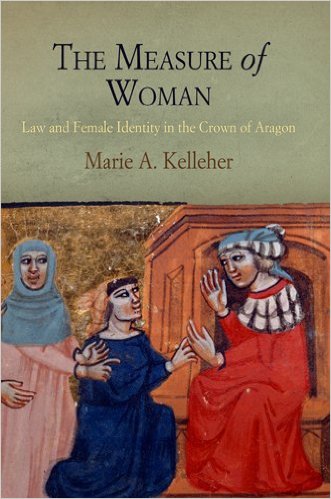
The Measure of Woman: Law and Female Identity in the Crown of Aragon
IRH Fellow: Marie A. Kelleher, 2007-2008 Solmsen Fellow Synopsis: By the end of the Middle Ages, the ius commune—the combination of canon and Roman law—had formed the basis for all law in continental Europe, along with its patriarchal system of categorizing women. Throughout medieval Europe, women regularly found themselves in court, suing or being sued, defending themselves against criminal accusations, or prosecuting others for crimes committed against them or their families. Yet choosing to litigate entailed accepting the conceptual vocabulary of the learned law, thereby reinforcing the very legal and social notions that often subordinated them. In The Measure of Woman Marie A. Kelleher explores the complex relationship between women and legal culture in Spain’s Crown of Aragon during the late medieval period. Aragonese courts measured women according to three factors: their status in relation to men, their relative sexual respectability, and their conformity to ideas about the female sex as a whole. Yet in spite of this situation, Kelleher argues, women were able to play a crucial role in shaping their own legal identities while working within the parameters of the written law. The Measure of Woman reveals that women were not passive recipients—or even victims—of the legal system. Rather, medieval women actively used the conceptual vocabulary of the law, engaging with patriarchal legal assumptions as part of their litigation strategies. In the process, they played an important role in the formation of a gendered legal culture that would shape the lives of women throughout Western Europe and beyond for centuries to come.
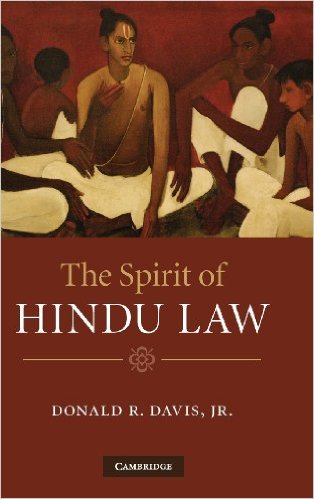
The Spirit of Hindu Law
Davis Jr., D. R. The Spirit of Hindu Law. Cambridge, UK: Cambridge University Press, 2010.
IRH Fellow: Donald R. Davis Jr., 2006-2007 Resident Fellow Synopsis: Law is too often perceived solely as state-based rules and institutions that provide a rational alternative to religious rites and ancestral customs. The Spirit of Hindu Law uses the Hindu legal tradition as a heuristic tool to question this view and reveal the close linkage between law and religion. Emphasizing the household, the family, and everyday relationships as additional social locations of law, it contends that law itself can be understood as a theology of ordinary life. An introduction to traditional Hindu law and jurisprudence, this book is structured around key legal concepts such as the sources of law and authority, the laws of persons and things, procedure, punishment and legal practice. It combines investigation of key themes from Sanskrit legal texts with discussion of Hindu theology and ethics, as well as thorough examination of broader comparative issues in law and religion.
Theology and the Soul of the Liberal State
IRH Fellow: Leonard v. Kaplan, Honorary Fellow (2008-2011), and Charles L. Cohen, Resident Fellow (1986-1987) Synopsis: Rising calls in both the United States and abroad for theologizing national agendas have renewed examinations about whether liberal states can accommodate such programs without either endangering citizens’ rights or trivializing religious concerns. Conventional wisdom suggests that theology is necessarily unfriendly to the liberal state, but neither philosophical analysis nor empirical argument has convincingly established that conclusion. Examining the problem from a variety of perspectives including law, philosophy, history, political theory, and religious studies, the essays in Theology and the Soul of the Liberal State suggest the possibilities for and limits on what theological reflection might contribute to liberal polities across the globe. Theology and the Soul of the Liberal State develops these issues under five headings. Part One explores “The Nature of Religious Argument” as it can inflect discussions of public policy, political theory, jurisprudence, and education. Part Two, “Theologies of the Marketplace,” notes that theology can by turns be highly critical, neutral, or even inordinately supportive of market operations. Part Three, “European Perspectives,” reviews and develops arguments from Abraham Kuyper, Karl Barth, and French post-modernists concerning how one might integrate theological discourse into the public sphere. Part Four offers Israel, Pakistan and Tibet as “Asian Perspectives” on how theology may comport with liberalism in recently created states (or, in the last case, a diasporic government-in-exile) where powerful religious constituencies make “secular” civil action extremely problematic. Finally, Part V, “Religion and Terror,” probes the vexed relationship between conceptions of divine and human justice, where the imperatives of theology and state confront each other most nakedly. Collectively, Theology and the Soul of the Liberal State suggests that the liberal state cannot keep theology out of public discourse and may even benefit from its intervention.
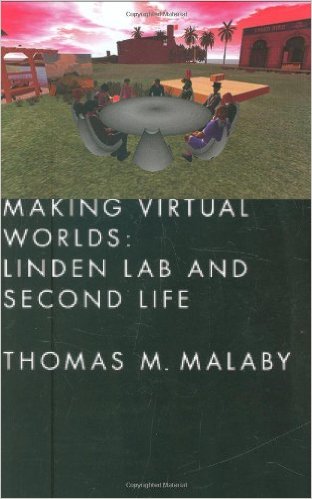
Making Virtual Worlds: Linden Lab and Second Life
IRH Fellow: Thomas Malaby, 2007-2008 UW System Fellow Synopsis: The past decade has seen phenomenal growth in the development and use of virtual worlds. In one of the most notable, Second Life, millions of people have created online avatars in order to play games, take classes, socialize, and conduct business transactions. Second Life offers a gathering point and the tools for people to create a new world online. Too often neglected in popular and scholarly accounts of such groundbreaking new environments is the simple truth that, of necessity, such virtual worlds emerge from physical workplaces marked by negotiation, creation, and constant change. Thomas Malaby spent a year at Linden Lab, the real-world home of Second Life, observing those who develop and profit from the sprawling, self-generating system they have created. Some of the challenges created by Second Life for its developers were of a very traditional nature, such as how to cope with a business that is growing more quickly than existing staff can handle. Others are seemingly new: How, for instance, does one regulate something that is supposed to run on its own? Is it possible simply to create a space for people to use and then not govern its use? Can one apply these same free-range/free-market principles to the office environment in which the game is produced? “Lindens”―as the Linden Lab employees call themselves―found that their efforts to prompt user behavior of one sort or another were fraught with complexities, as a number of ongoing processes collided with their own interventions. In Making Virtual Worlds, Malaby thoughtfully describes the world of Linden Lab and the challenges faced while he was conducting his in-depth ethnographic research there. He shows how the workers of a very young but quickly growing company were themselves caught up in ideas about technology, games, and organizations, and struggled to manage not only their virtual world but also themselves in a nonhierarchical fashion. In exploring the practices the Lindens employed, he questions what was at stake in their virtual world, what a game really is (and how people participate), and the role of the unexpected in a product like Second Life and an organization like Linden Lab.
Why America Fights: Patriotism and War Propaganda from the Philippines to Iraq
IRH Fellow: Susan Brewer, 2014-2015 System Fellow Synopsis: On the evening of September 11, 2002, with the Statue of Liberty shimmering in the background, television cameras captured President George W. Bush as he advocated the charge for war against Iraq. This carefully staged performance, writes Susan Brewer, was the culmination of a long tradition of sophisticated wartime propaganda in America. In Why America Fights, Brewer offers a fascinating history of how successive presidents have conducted what Donald Rumsfeld calls “perception management,” from McKinley’s war in the Philippines to Operation Iraqi Freedom. Her intriguing account ranges from analyses of wartime messages to descriptions of the actual operations, from the dissemination of patriotic ads and posters to the management of newspaper, radio, and TV media. When Woodrow Wilson carried the nation into World War I, he created the Committee on Public Information, led by George Creel, who called his job “the world’s greatest adventure in advertising.” In World War II, Roosevelt’s Office of War Information avowed a “strategy of truth,” though government propaganda still depicted Japanese soldiers as buck-toothed savages. After examining the ultimately failed struggle to cast the Vietnam War in a favorable light, Brewer shows how the Bush White House drew explicit lessons from that history as it engaged in an unprecedented effort to sell a preemptive war in Iraq. Yet the thrust of its message was not much different from McKinley’s pronouncements about America’s civilizing mission. Impressively researched and argued, filled with surprising details, Why America Fights shows how presidents have consistently drummed up support for foreign wars by appealing to what Americans want to believe about themselves.
Becoming Hebrew: The Creation of a Jewish National Culture in Ottoman Palestine
IRH Fellow: Arieh Bruce Sapasnik, 2003-2004 UW System Fellow Synopsis: “If the Jews wish to become a nation of ‘Jewish Culture,'” Eliezer Ben-Yehuda wrote in 1904, “they must first become truly a nation.” Throughout the subsequent decade, Ben-Yehuda and other Zionist activists in Palestine attempted to transform the small, divided, economically depressed, and demographically declining Yishuv — the pre-state Jewish community — into the foundation of a modern nation. In this book, Arieh Bruce Saposnik tells the story of this transformation. As Saposnik shows, these activists did not attempt to rewrite Jewish culture simply by uprooting and transplanting themselves, but sought to affect a dramatic revolution in all aspects of Jewish life. They endeavored not only to revise Judaism, but to revise the very definition of culture, and the expanse with which they viewed the word was, in part, what made this group so revolutionary. The new “Hebrew” culture they sought to create encompassed everything from the way in which Yishuv Zionists dressed to the art they created and the literature they read, to the holidays they celebrated, to the language they spoke and the accent with which they spoke it. Politics, economics, and even medicine were mobilized to become dynamic parts of a new Jewish identity. Saposnik attempts to recapture their comprehensive view of culture and to show how these activists translated images and ideas into concrete cultural institutions, new art, rituals, and language. But, he also argues that this new culture, while expansive, was highly precarious and intensely contested. The Zionists struggled to maintain a complex relationship with traditional Jewish discourses, practices, and liturgy and to forge a delicate balance between the traditional and the novel, “occident” and “orient,” and shifting national centers and peripheries. Through his examination of the Zionist cultural project, Saposnik sheds new light on the origins of Israel and Israeli culture, and on the fundamental building blocks from which modern nations and nationalisms are erected.
Immigration and Politics in the Caribbean: Japanese and Other Immigrants in the Dominican Republic
Peguero, V. Immigration and Politics in the Caribbean: Japanese and Other Immigrants in the Dominican Republic. Pompano Beach, FL: Caribbean Studies Press, 2008.
IRH Fellow: Valentina Peguero, 2000-2001 UW System Fellow Synopsis: A revealing study of 20th-century immigration and racial politics in the Dominican Republic. The little-known settlements of Japanese immigrants in the Dominican Republic are the basis for this richly informed history of 20th-century migration to the Caribbean and Latin America. Yet the connection of Japan to the region is strong, with a considerable volume of trade and approximately 1.5 million individuals of Japanese descent in the area, with an estimated 60% of them in Brazil. Dr. Peguero conducted extensive fieldwork in the Japanese settlements and interviewed the immigrants and their descendants as well as Dominicans in the larger community. The author weaves the history of racism and eugenics, war, colonialism, power, money, population, religion, food, language, and culture in a detailed study of immigration to the Caribbean
Mount Karol and Other Poems
Sharma, R. L. Mount Karol and Other Poems. Chandigarh, India: Graphit India, 2008.
IRH Fellow: Roshan Lal Sharma, 2007-2008 Honorary Fellow Synopsis: Mount Karel and Other Poems redefines the parameters of English poetry in India today. It maintains a delicate balance between the realistic stand and the imaginative strain. The language is lucid and charmingly readable. The reader is constantly surprised by the versatility and innovativeness of expression. The forte of the poems is the wide range of emotions that the reader can easily identify with.
Voice in Motion: Staging Gender, Shaping Sound in Early Modern England
IRH Fellow: Gina Bloom, 2004-2005 Solmsen Fellow Awards: 2008 Society for the Study of Early Modern Women Book Award Synopsis: Voice in Motion explores the human voice as a literary, historical, and performative motif in early modern English drama and culture, where the voice was frequently represented as struggling, even failing, to work. In a compelling and original argument, Gina Bloom demonstrates that early modern ideas about the efficacy of spoken communication spring from an understanding of the voice’s materiality. Voices can be cracked by the bodies that produce them, scattered by winds when transmitted as breath through their acoustic environment, stopped by clogged ears meant to receive them, and displaced by echoic resonances. The early modern theater underscored the voice’s volatility through the use of pubescent boy actors, whose vocal organs were especially vulnerable to malfunction. Reading plays by Shakespeare, Marston, and their contemporaries alongside a wide range of late sixteenth- and early seventeenth-century texts—including anatomy books, acoustic science treatises, Protestant sermons, music manuals, and even translations of Ovid—Bloom maintains that cultural representations and theatrical enactments of the voice as “unruly matter” undermined early modern hierarchies of gender. The uncontrollable physical voice creates anxiety for men, whose masculinity is contingent on their capacity to discipline their voices and the voices of their subordinates. By contrast, for women the voice is most effective not when it is owned and mastered but when it is relinquished to the environment beyond. There, the voice’s fragile material form assumes its full destabilizing potential and becomes a surprising source of female power. Indeed, Bloom goes further to query the boundary between the production and reception of vocal sound, suggesting provocatively that it is through active listening, not just speaking, that women on and off the stage reshape their world. Bringing together performance theory, theater history, theories of embodiment, and sound studies, this book makes a significant contribution to gender studies and feminist theory by challenging traditional conceptions of the links among voice, body, and self.
Angels on the Edge of the World: Geography, Literature, and English Community, 1000-1534
IRH Fellow: Kathy Lavezzo, 2002-2003 Solmsen Fellow Synopsis: “The various and contradictory signs of English otherworldliness offered medieval writers a remarkably elastic medium with which to construct national identity. . . . Above all, the wonderful aspects of geographic otherness made it possible for English writers to see their homeland as not only barbarously divided but also blessed and united. Even as they acknowledged England as a barbarous wasteland . . . or as a site of brutal disorder . . . , the English also imagined England as a holy wilderness or as a blessed isle.”―from the book’s introduction In a view that sweeps from the tenth century to the mid-sixteenth century, Kathy Lavezzo shows how the English people’s concern with their island’s relative isolation on the global map contributed to the emergence of a distinctive English national consciousness in which marginality came to be seen as a virtue. Lavezzo examines the many world maps and textual geographies produced by the English during these years. In a beautifully illustrated book, she argues that the English looked to the globe only to emphasize and, in time, to exalt their own exceptional geographic status. The author charts this process by examining a series of wondrous maps and canonical texts. Demonstrating how medieval geographic notions conditioned English attitudes toward Rome, clarifying the complicated religious history leading up to Henry the Eighth’s divorce and the Reformation, Angels on the Edge of the World straddles the subjects―and methods―of literature, history, and cultural geography. It will be of special interest to those readers who use cartography as a way to map cultural identities.
Religion, Politics and Thomas Hobbes
Wright, G. Religion, Politics and Thomas Hobbes. Netherlands: Springer, 2006.
IRH Fellow: George Wright, 1997-1999 Honorary Fellow; 1996-1997 UW System Fellow Synopsis: This collection develops insight into the relation which Hobbes describes between his theory of government and the three-part division he draws with respect to religion. Pursuing the chain of causes that proves God’s existence as first cause, Hobbes identifies and defines both “true religion” and such superstition as he found in the theology and practices of the Roman Catholic Church of his era. He then emphasizes the difference between natural religion and revealed religion in order to extinguish the claim of contemporary theologians to an authority in the state greater than that of the political sovereign. Although, according to the author, Hobbes falters in carrying out his politico/theological project, his careful, radical and innovative attempt to describe the relationship of religion and politics, church and state, has special relevance for us today, as forms of religious fundamentalism in many countries are increasingly claiming and, in some cases, winning control of political institutions.
The Epic of America: An Introduction to Rafael Landívar and the Rusticatio Mexicana
IRH Fellow: Andrew Laird, 2003-2004 Solmsen Fellow Synopsis: Rafael Landívar is the best known of all the poets from the Americas to write in Latin. In the 15 books of his Rusticatio Mexicana (1782), he described — in vivid epic verse — the lakes, volcanoes, and wildlife of Mexico and his native Guatemala, as well as the livelihoods and recreations of the people of the region. This panorama of nature, culture and production in colonial New Spain took classical didactic poetry into a new world of political conflict. But Landívar also writes with a strongly personal voice: elegiac and pastoral modes convey the pathos of displacement and the poet’s overwhelming nostalgia for his American homeland. Andrew Laird’s introduction provides information about Landívar’s life and exile to Italy, explains his diverse intellectual heritage, and collects his shorter works (translated into English here for the first time). A 1948 text of the Rusticatio Mexicana, with a translation by Graydon W. Regenos, is included in this volume. This accessible and stimulating account of ‘the American Virgil’ highlights the astonishing quality and complexity of the Latin literature of Latin America.
Language, Authority, and Indigenous History in the “Comentarios reales de los Incas”
IRH Fellow: Margarita Zamora, 2001-2002 Resident Fellow Synopsis: The Comentarios reales de los Incas, a classic of Spanish Renaissance prose narrative, was written by Garcilaso Inca de la Vega, the son of an Inca princess and a Spanish conquistador. It is filled with ideological tensions and apparent contradictions as Garcilaso attempts to reconcile a pagan New World culture with the fervent Christian evangelism of the period of the discovery and conquest of America. This study of the Commentarios, is original both in adopting the perspective of discourse analysis and in its interdisciplinary approach. Margarita Zamora examines the rhetorical complexities of the Comentarios, and shows how Garcilaso turned to the linguistic strategies of humanist philology and hermeneutics rather than traditional historiography in order to present Inca civilization to the Europeans. Zamora’s book reveals how Garcilaso’s views of the Incas were shaped by his dual background, his commitment to humanism and Christianity, by the expectations he had of his readers, and by the disruptive practices of his time.
The Goddess Lives in Upstate New York: Breaking Convention and Making Home at a North American Hindu Temple
IRH Fellow: Corinne Dempsey, 2002-2003 UW System Fellow Synopsis: The Goddess Lives in Upstate New York is a profile of a flourishing Hindu temple in the town of Rush, New York. The temple, established by a charismatic nonbrahman Sri Lankan Tamil known as Aiya, stands out for its combination of orthodox ritual meticulousness and socioreligious iconoclasm. The vitality with which devotees participate in ritual themselves and their ready access to the deities contrasts sharply with ritual activities at most North American Hindu temples, where (following the usual Indian custom) ritual is performed only by priests and access to the highly sanctified divine images is closely guarded. Drawing on several years of fieldwork, Dempsey weaves traditional South Asian tales, temple miracle accounts, and devotional testimonials into an analysis of the distinctive dynamics of diaspora Hinduism. She explores the ways in which the goddess, the guru, and temple members reside at cultural and religious intersections, noting how distinctions between miraculous and mundane, convention and non-convention, and domestic and foreign are more often intertwined and interdependent than in tidy opposition. This lively and accessible work is a unique and important contribution to diaspora Hindu Studies.
Wandering in Ancient Greek Culture
Montiglio, S. Wandering in Ancient Greek Culture. Chicago, IL: University of Chicago Press, 2005.
IRH Fellow: Silvia Montiglio, 2000-2001 Resident Fellow Synopsis: From the Archaic period to the Greco-Roman age, the figure of the wanderer held great significance in ancient Greece. In the first comprehensive study devoted to this theme, Wandering in Ancient Greek Culture unearths the many meanings attached to this practice over the centuries. Employing a broad range of literary and philosophical texts, Silvia Montiglio demonstrates how wandering has been conceptualized from Homer’s Odysseus—the hero “who wandered much”—in the eighth century BCE to pagan sages of the early Roman Empire such as Saint John the Baptist in the first century AD. Attitudes toward wandering have evolved in accordance with cultural perspectives, causing some characterizations to persist while others have faded. For instance, the status of wanderers in Greek societies varied from outcasts and madmen to sages, who were recognized as mystical, even divine. Examining the act of wandering through many lenses, Wandering in Ancient Greek Culture shows how the transformation of the wanderer coincided with new perceptions of the world and of travel and invites us to consider its definition and import today.
Conspiracy Narratives in Roman History
Pagan, V. E. Conspiracy Narratives in Roman History. Austin, TX: University of Texas Press, 2004.
IRH Fellow: Victoria E. Pagán, 2001-2002 Resident Fellow Synopsis: Conspiracy and Roman history go hand-in-hand although Roman writers were required to assure citizens that they were rare occurrences and that conspiracies were always revealed and the perpetrators punished. In this study, Victoria Pagan examines the narrative strategies of five prominent Roman historians who recorded conspiracies: Sallust, Livy, Tacitus, Josephus, and Appian. Through five incidences of Intrigue and secrecy, including the assassinations of Julius Caesar and Caligula, she explores how writers dealt with this sensitive subject which brought fear and suspicion into the lives of Roman citizens.
Material Virtue: Ethics And The Body In Early China
IRH Fellow: Mark Csikszentmihalyi, 2002-2003 Resident Fellow Synopsis: This book reconstructs a neglected episode in the development of Confucianism, one that considerably influenced later Chinese religious thought. “Material Virtue” examines a set of four through first century B.C.E. Chinese texts that argue virtue has a physical correlate in the body. Based on both transmitted (e.g., the Mengzi or Mencius) and recently excavated (e.g., the Wuxing or Five Kinds of Action) texts, “Material Virtue” describes how the argument addresses challenges to early Chinese religious ethics in part by relying on emerging notions such as the balance of qi (pneumas) also found in natural philosophy.
The Unfinished Bombing: Oklahoma City in American Memory
IRH Fellow: Edward T. Linenthal, 1998-1999 UW System Fellow Synopsis: On April 19, 1995, the bombing of the Alfred P. Murrah Federal Building in Oklahoma City shook the nation, destroying our complacent sense of safety and sending a community into a tailspin of shock, grief, and bewilderment. Almost as difficult as the bombing itself has been the aftermath, its legacy for Oklahoma City and for the nation, and the struggle to recover from this unprecedented attack. In The Unfinished Bombing, Edward T. Linenthal explores the many ways Oklahomans and other Americans have tried to grapple with this catastrophe. Working with exclusive access to materials gathered by the Oklahoma City National Memorial Archive and drawing from over 150 personal interviews with family members of those murdered, survivors, rescuers, and many others. Linenthal looks at how the bombing threatened cherished ideas about American innocence, sparked national debate on how to respond to terrorism at home and abroad, and engendered a new “bereaved community” in Oklahoma City itself. Linenthal examines how different stories about the bombing were told through positive narratives of civic renewal and of religious redemption and more negative narratives of toxicity and trauma. He writes about the extraordinary bonds of affection that were created in the wake of the bombing, acts of kindness, empathy, and compassion that existed alongside the toxic legacy of the event. The Unfinished Bombing offers a compelling look at both the individual and the larger cultural consequences of one of the most searing events in recent American history.
German Travel Cultures
Koshar, R. German Travel Cultures. London and New York: Bloomsbury Academic, 2000.
IRH Fellowship and Year: Rudy Koshar, 1996-1997 Resident Fellow Synopsis: Travel guidebooks are an important part of contemporary culture, but we know relatively little about their history and importance to the evolution of tourism. Germany not only produced the first international standard for travel handbooks, the Baedeker, but also became a major tourist destination early in the twentieth century. This is the first comprehensive discussion of the history of tourist guidebooks for any modern nation. Selecting representative texts – the first Baedeker to unified Germany, guides to Berlin sex life and sites of Nazi martyrdom, a tour guide for the German worker and American tourbooks to West Germany – this fascinating study relates the history of tourist literature to the formation of distinct ‘travel cultures’ oriented to specific audiences, tastes and ideologies.
Mappings: Feminism and the Cultural Geographies of Encounter
IRH Fellow: Susan Stanford Friedman, 1994-1999 Senior Fellow Awards: 1999 Barbara Perkins and Geroge Perkins Award, Society for the Study of Narrative Literature One of Choice’s Outstanding Academic Titles for 1999 Synopsis: In this powerful work, Susan Friedman moves feminist theory out of paralyzing debates about us and them, white and other, first and third world, and victimizers and victims. Throughout, Friedman adapts current cultural theory from global and transnational studies, anthropology, and geography to challenge modes of thought that exaggerate the boundaries of gender, race, ethnicity, sexuality, class, and national origin. The author promotes a transnational and heterogeneous feminism, which, she maintains, can replace the proliferation of feminisms based on difference. She argues for a feminist geopolitical literacy that goes beyond fundamentalist identity politics and absolutist poststructuralist theory, and she continually focuses the reader’s attention on those locations where differences are negotiated and transformed. Pervading the book is a concern with narrative: the way stories and cultural narratives serve as a primary mode of thinking about the politically explosive question of identity. Drawing freely on modernist novels, contemporary film, popular fiction, poetry, and mass media, the work features narratives of such writers and filmmakers as Gish Jen, Julie Dash, June Jordon, James Joyce, Gloria Anzaldúa, Neil Jordon, Virginia Woolf, Mira Nair, Zora Neale Hurston, E. M. Forster, and Irena Klepfisz. Defending the pioneering role of academic feminists in the knowledge revolution, this work draws on a wide variety of twentieth-century cultural expressions to address theoretical issues in postmodern feminism.
Penelope’s Web: Gender, Modernity, H. D.’s Fiction
IRH Fellow: Susan Stanford Friedman, 1986-1987 Resident Fellow Synopsis: Penelope’s Web should appeal to a wide spectrum of readers interested in twentieth-century modernism, women’s writing, feminist criticism, post-structuralist theory, psychoanalysis, autobiography, and women’s studies. It is the first book to examine fully the brilliantly innovative prose writings of H.D., the pen-name for Hilda Doolittle (1886-1961), who has been known primarily as a poet. Her prose, more personal, experimental, and postmodern than her poetry, raises central questions about the relation of women writers to language, desire, and history. She suppressed in her lifetime many of these texts because of their daring exploration of her bisexuality and their radical critique of the social order. H.D.’s prose writings contribute importantly to the many histories and theories of modernism that are redrawing boundaries to include the achievement of women writers.