
Wounded Identities: The Pressure of the Empire and the Limits of Meaning
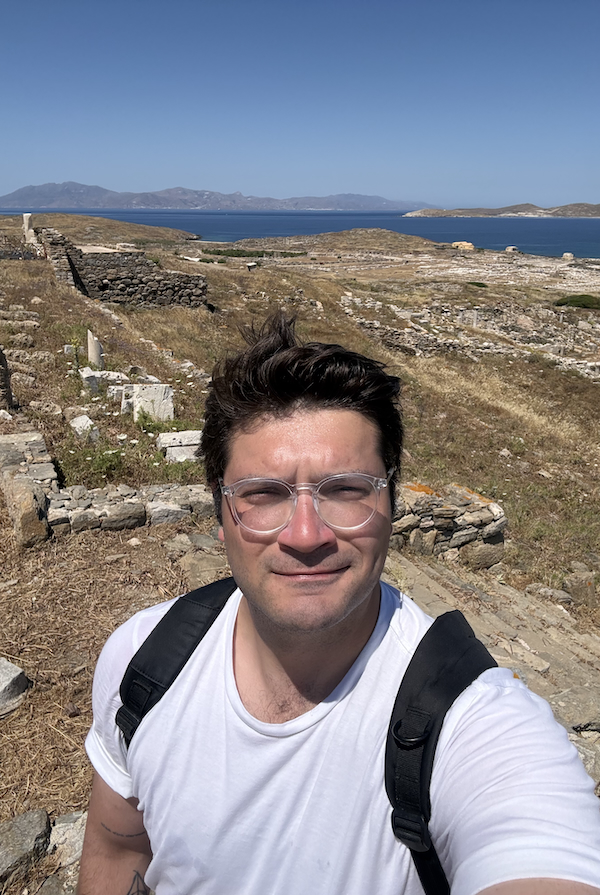
Hakan Özlen
Reinhold Dissertation Fellow (2026–2027)
PhD Candidate, Classical and Near Eastern Studies, UW–Madison
Wounded Identities: The Pressure of the Empire and the Limits of Meaning studies how Josephus, Paul, and Seneca make sense of selfhood, religious identity, and time. Although they occupied different social and intellectual positions within the first-century Mediterranean world, their texts show similar moments in which inherited frameworks no longer hold experience together. These moments raise a question: can historians explain imperial effects without a division that puts agency on one side and passivity on the other, a division inherited from the field’s founders?
Roman historiography took shape during European colonial expansion, when scholars modeled the Roman Empire on the imperial orders of their own age, and vice versa. This origin organized the field around binaries, such as imperial center and provincial periphery, or active ruler and passive subject. Later scholarship, time to time, moved agency from one side of these divisions to the other, yet the divisions themselves remained in place. I distinguish the Roman Empire, a historical formation with borders, armies, and institutions, from the empire. Following Althusser, and behind him Spinoza, I treat the empire as an “absent cause,” a cause that exists nowhere except in its effects.
I call the places where the effects of the empire become visible “wound sites.” They appear when religious traditions, institutions, and narrative forms lose their power to connect experience with a stable past and an open future. Through close readings, I trace four recurring patterns: accelerated frameworks, patchwork structures, porous identity boundaries, and compressed temporal horizons. These patterns show how subjects try to rebuild coherence after inherited forms begin to fail. The dissertation therefore asks what ancient texts preserve when selfhood becomes unstable and the structures that once sustained meaning across generations can no longer organize experience.
Hakan Özlen is a doctoral candidate in the Department of Classical and Ancient Near Eastern Studies at the University of Wisconsin–Madison. He studies Roman imperial history, early Christianity, and the philosophy of history, with particular attention to how Greek and Latin texts respond when established forms of identity, time, and historical meaning begin to fail. His dissertation, Wounded Identities: The Pressure of the Empire and the Limits of Meaning, reads Josephus, Paul, and Seneca together and argues that empire becomes visible through breaks within the structures by which people make sense of themselves and their world. His other work includes research on late antique religious time, Roman social history, and inscriptions from Asia Minor. He teaches courses on Roman history, Latin, ancient religion, and the lives of people often left outside traditional political histories.
*Events currently open only to 2026-27 fellows due to space concerns; please contact IRH at info@irh.wisc.edu to be added to a cancellation list for in-person events.*