
Inside the Center for Humanistic Inquiry into AI and Uncertainty: A Conversation with Grant Nelsestuen
It’s no secret that funding for the humanities is currently hard to come by. But for a team of interdisciplinary humanists at UW–Madison, the scarcity of opportunities only meant that they’d have to work that much harder to make their dream of building a humanistically-oriented, artificial intelligence research center a reality. And a reality it has become—the Uncertainty and AI Group (Un-AI) was awarded an unprecedented $500,000 in funding from the National Endowment for the Humanities this past summer to open the new Center for Humanistic Inquiry into AI and Uncertainty (CHIAIU). An initiative co-led by Associate Dean for Arts and Humanities Grant Nelsestuen and IRH Director Steven Nadler, the Center—which is set to open in 2026—will house one faculty director, four UW–Madison faculty fellows, and one external fellow, each of whom will conduct innovative research on the Center’s first annual theme: Knowledge and AI. To determine how Un-AI was so successful in an era of pessimism surrounding the future of the humanities, IRH Project Assistant Jojo Lovejoy sat down with Nelsestuen to discuss everything from tips and tricks for grant applications to whether or not AI is overhyped.
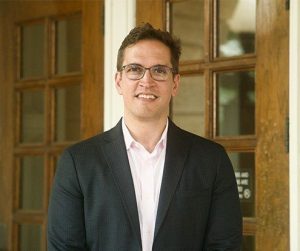
“A lot of the unglamorous stuff.” This is how Nelsestuen described his role as Un-AI’s co-lead throughout the grant application process. But sometimes the “unglamorous” work is the most critical. Nelsestuen took on roles big—managing the eleven other members of the team and building incipient partnerships with other campus units—and small—editing CVs and writing selection criteria for fellowship competitions. As for the “intellectual meat” of the grant proposal, Nelsestuen left this to Un-AI’s steering committee, which consists of CHIAIU Director Jeremy Morris (Communication Arts), Alan Rubel (iSchool), Annette Zimmermann (Philosophy), Devin Kennedy (History), Jamie Goodrich (Philosophy), and Clinton Castro (iSchool). “They’re the ones who really […] outlined the issues that the Center could address, and the methodology it would take,” Nelsestuen explained.
Un-AI was clearly equipped with a brilliant lineup of scholars and strong leadership. But so are many other research groups that, try as they might, fail to get their own grant proposals accepted. What made Un-AI special? Though he remains humble, it’s not hard to see that Nelsestuen’s behind-the-scenes efforts were likely a deciding factor. To give the proposal the extra boost it needed to dazzle the review committee, Nelsestuen was proactive: He attended information sessions for the grant competitions—all of them. “I didn’t always have a question,” he admitted. “But it was immensely helpful for other people to ask questions, and then I would hear an answer, and then I would ask [my own] question.” But what really seems to have sealed the deal was the jaw-dropping $1.2 million in additional funding from various campus partners that Nelsestuen, along with Un-AI’s advisory board, secured to sustain the Center. Indeed, the CHIAIU will be the first humanities partner of UW–Madison’s Data Science Institute, a partnership that, Nelsestuen predicts, will provide the Center’s fellows with “new and ready audiences.”
Unfortunately, such broad institutional support is not always possible for scholars who are applying for smaller grants and fellowships. Yet much of the wisdom that Nelsestuen picked up throughout this process remains applicable to smaller-scale projects. Apart from getting examples of successful grant applications, Nelsestuen recommends getting feedback on drafts—from the NEH, but also from colleagues, especially those outside of your discipline who can help check for jargon and accessibility. Finally, as obvious as it sounds, Nelsestuen urges applicants to read the instructions. “[The NEH] has extensive documentation of what they need and what they’re looking for,” he commented. “Some of it is just persistence and reading the instructions, providing what they ask for, taking very seriously that [when] they ask for X, we need to provide X.”
Of course, it’s one thing to be awarded grant money, and another thing to know how to transform it into a bustling, productive research center. So, where does one start? First, Nelsestuen looked to humanities centers like the IRH as a model for the CHIAIU: “What has made the IRH such an enduring important feature on our campus? We thought about what’s best there and we took inspiration from that.” From there, he worked on governance. This again involved looking at examples from across the University, but also undergoing a review process by the L&S Academic Planning Committee, and then by the University Academic Planning Committee. In going through this process, Nelsestuen has always tried to stay optimistic, even at stages where all the pieces of the puzzle hadn’t quite fallen into place. “I tried to be very collaborative throughout this,” he mentioned. “Doing that up front builds goodwill for those dicier moments later on.”
In its first three years, the Center will tackle three topics as they relate to AI: knowledge, power, and creativity. And in each of these years, the Center’s fellows will conduct individual research projects as well as collaborate on a whitepaper—an 8–10 page summary of issues that emerge in their research—which will be circulated across the University in conjunction with the Data Science Institute. And then there’s a third primary activity of the Center, which will take place every two years: A public forum, which will bring together national-level speakers, industry partners, and community organizations. While the forum will showcase the Center’s own research, it will also bring its various attendees into dialogue, an opportunity that Nelsestuen eagerly awaits. “To my mind, there’s a lot of potential for humanists working on ethical questions related to AI in particular [to] contribut[e] to community organizations—thinking about anything from algorithmic justice and fairness to how or whether or in what way they should incorporate these technologies which are rapidly becoming more and more accessible into their own day-to-day operations.”
With all the hype surrounding AI, one might express doubts about the longevity of the CHIAIU. Is a Center focused entirely on artificial intelligence sustainable? Nelsestuen is not particularly worried. “At this time I don’t know if it [the hype] will collapse per se, but I think it’ll become more nuanced.” In fact, sensitivity to potential shifts in these technologies are built into the Center’s iterative design. “While we have the broad themes, current fellows in conjunction with members of the steering committee will create the new calls [for applications], and will help participate in the selection process. So, it is supposed to be a ground-up Center in its approach. And we would like to see it as having an anticipatory aspect in its mission as well.”
But as Nelsestuen also pointed out, fear that the “AI bubble” will soon burst underestimates just how much of a desire there is for key ethical, epistemological, and cultural questions about AI to be answered. We see this in the classroom, where anxious professors are suddenly returning to Blue Book-style exams. “We don’t all on our own have time to be thinking about, ‘how should I structure my classroom so that students may optimally engage with AI, but they’re still also learning the course material?’ It’s hard. So, I want people to be thinking about that.”
But ordinary people are also hungry for information about how to best interface with AI—even Nelsestuen. As the treasurer of his Parent-Teacher Organization, he’s often wondered: “Can we just do all this with AI?” He remains unsure. But perhaps the CHIAIU will have the answer.