
Place and Space, from Monuments to Bodies: An Interview with Louise Zamparutti
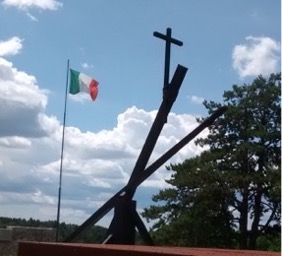
In the outskirts of Trieste, approximately 1.6 miles from the Italian-Slovenian border, lies the Foiba di Basovizza. The memorial commemorates Fascist officials and collaborators who were victims of summary executions conducted by the Yugoslavian antifascist partisans during World War II. Marketed by the far right as a site for commemorating the innocent Italians massacred by Slavic invaders in 1945, this once-controversial memorial has achieved widespread bipartisan acceptance. How did an originally niche memorial of Italy’s far-right become a national monument with mass public appeal? This is one of the questions that Louise Zamparutti (Universities of Wisconsin Fellow, 2025–2026) aims to answer in her book project, Monument in Motu: The Positionality of Place.
As a rhetorician, Louise has long found monuments and memorials to be rich objects of study, particularly for the way they both shape, and are shaped by, space. But the Foiba di Basovizza offers a deeply personal case study for Louise, who not only comes from a family of anti-fascist partisans, but also grew up in the small town of San Pietro al Natisone, approximately 54 miles from the Foiba. She recalls it as a “place of stark contrasts: beautiful mountains and fields, wonderful food, and military bunkers, people you couldn’t trust, and barbed wire fences.” Though some might see Louise’s personal connection to her case study as an impediment to objectivity, Louise tends to see it as a virtue. Her identity has allowed her to conduct personal interviews, but also positions her as both an insider and an outsider in a field of research that is characterized by polarized side-taking.
“When I first embarked on an academic journey, I thought of it as a brand-new path. But as I delved into theories about objects, agency, relationship, and positionality, I found myself recalling my dance experiences working with shape and form and the relationship between human bodies and ’empty’ spaces.”
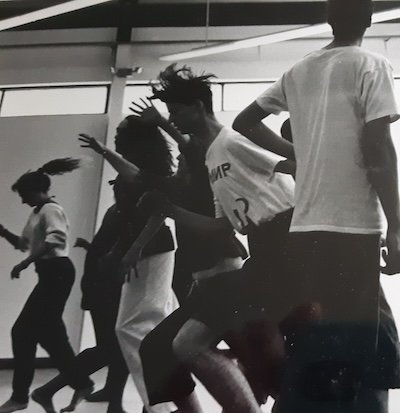
Another identity that has informed Louise’s understanding of positionality and space is her background as a dancer and choreographer. Though her artistic practice has shifted from performance to writing, there’s a sense in which these two passions ultimately blended into one. “When I first embarked on an academic journey, I thought of it as a brand-new path,” Louise recalls. “But as I delved into theories about objects, agency, relationship, and positionality, I found myself recalling my dance experiences working with shape and form and the relationship between human bodies and “empty” spaces.” In fact, the Japanese concept of Ma—or empty space—that has shaped much of Louise’s work was first introduced to her while she was dancing with a Japanese Butoh company. “I’m curious about how we—as dancers, as people moving or sitting or standing still, as spectators—organize space and time into boundaries and meaningful units of seemingly discrete ‘things’ and/or ‘space between things,'” Louise told us.

Many faculty at the Universities of Wisconsin campuses have dealt with increased teaching loads in recent years—Louise included. This made her all the more determined to make the most of her fellowship semester. With the support of an ACLS Project Development Grant, Louise was able to move to Madison for the spring and fully immerse herself in IRH’s intellectual community. “It [was] incredibly valuable to be able to talk about my and others’ work, not only in seminars and Humani-Teas but in unscheduled conversations while we’re getting our lunches or coffee. I’d never experienced that before,” she reflected.
Louise has been a wonderful community member, and the IRH invites her to take the trip down from La Crosse to visit at any time.