
Introducing IRH’s New Project Assistant: Kate Lohnes
IRH is excited to announce that Kate Lohnes (PhD Candidate, Department of Philosophy, UW–Madison) will begin as Project Assistant in fall 2026. In this article, Kate tells about her own research, how she fell in love with philosophy, and why she’s looking forward to joining the Institute.
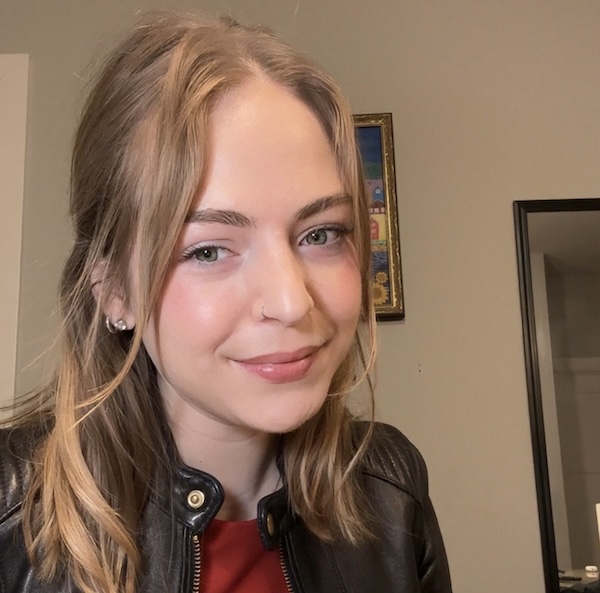
Can two distinct material objects occupy exactly the same space at the very same time? Can a single object have parts that are located thousands of miles away from each other? To each of these questions, the obvious answer is “no.” Kate thinks that we ought to reconsider the obvious. In her view, there are far more objects in the world than it may appear. In addition to ordinary objects, like cars and the Eiffel Tower, there are also a plethora of “extraordinary” objects. For instance, there are cars that exist only when inside of garages. Likewise, there is an object that has as its parts Kate’s nose and the Eiffel Tower. These bizarre objects are just as real as the ordinary objects that we are more familiar with. We only fail to recognize them because we do not have words or concepts for them—or so Kate argues.
Kate’s dissertation, “How to Want Everything: Stabilizing a Maximalist Ontology,” offers a sustained defense of philosophical views which hold that far more exists in the world than meets the eye. She is especially interested in the interaction between two views: Material Plenitude—roughly, the view that every material object coincides with an abundance of other material objects—and Mereological Universalism—roughly, the view that any set of disjoint material objects automatically compose another object. Maximalist views such as these have been notoriously unstable; Kate aims to stabilize them.
Kate’s research is situated in an area of philosophy called metaphysics. A branch of philosophy that gets its name from a fourteen-book series by Aristotle, metaphysics is principally concerned with the questions of what exists in the world, and how it exists. Kate is mainly engaged with so-called “ontological” questions of the former sort. But metaphysicians are interested in a variety of other questions, too: How could the world have been different, and in what ways must it stay the same? Does time really pass, or do humans simply represent time as passing? How do objects persist through change? And many more.
How does one begin to start thinking about such questions? At least in Kate’s case, it was a long and unexpected journey. Up until her junior year at the University of Iowa, philosophy was not even on her radar—she was studying creative writing and beginning to toy with the idea of pursuing an MFA. Then it came time to satisfy a General Education requirement, and Philosophy 101 fit the bill. That’s where everything changed. Unsurprisingly, it was a classic thought experiment from metaphysics—The Ship of Theseus—that sold her on philosophy. “That puzzle was keeping me up until two in the morning when I was in that class, and I couldn’t stop thinking about it,” Kate recalls. “So I started taking more philosophy classes, and then I was like, okay, I actually really, really enjoy this.”
“That puzzle [The Ship of Theseus] was keeping me up until two in the morning when I was in that class, and I couldn’t stop thinking about it. So I started taking more philosophy classes and then I was like, okay, I actually really, really enjoy this.”
From that point on, Kate worked diligently to complete her new major requirements and prepare her materials for graduate school. After having spent four years at Iowa, accepting her offer at UW–Madison was a no-brainer. In addition to its stellar academic reputation, it was also the University’s size as well as intellectual and demographic diversity that drew Kate to apply. “It was the perfect convergence of all the things I wanted in terms of being academically rigorous, big, and a state school,” she explained. Factors like these were especially important when Kate was considering the type of environment she’d be teaching in. While she is happy to talk philosophy with majors, graduate students, and faculty, she finds a special joy in teaching the array of undergraduates that take UW–Madison’s introductory philosophy courses. “I find that I learn way more when I have a classroom of 200 students who are totally different from one another,” Kate told us. “They challenge each other, and in doing that, they challenge me.”
It was precisely her appreciation for disciplinary diversity that led Kate to apply for the Project Assistant position at IRH. As a dissertator, she has spent the majority of her last few years doing philosophy, and talking to philosophers, 24/7. And as much as she enjoys doing so, she is also looking forward to expanding her academic community. “I miss things like English and literature and art and all of the other things in the humanities that I really loved when I was an undergrad,” Kate said. “And so I think it’s going to be a really cool opportunity to just be around other people who are doing research in other areas and think about my research in a non-philosophy context.”
The Institute has been lucky to have a series of qualified Project Assistants over the past ten years, with each just as passionate about the humanities as the rest. Kate is no different. She comes to the Institute with a wealth of experience that will help keep things running smoothly. In 2024–2025, she was the Director of Diversity, Equity, and Inclusion for the Philosophy Department, where she planned gatherings for graduate students and helped coordinate Prospective Students Weekend. She is looking forward to transferring the community-building and event-planning skills she learned in these positions to her role at the IRH and is always looking for recommendations for IRH field trips! Prior to graduate school, Kate also worked for Encyclopaedia Britannica, where she wrote short-form content on topics from Stoker’s Dracula to the question, “How does Wi-Fi work?” This experience made her well-equipped to take over the IRH Newsletter, a project begun by 2024–2026 IRH Project Assistant Jojo Lovejoy.
IRH staff and continuing fellows are just as excited to welcome Kate as she is to join the Institute. But be warned: If you ask her how many chairs are in the seminar room, be prepared for a long answer.