French Revolutions in Keyboard Pedagogy, 1768–1804
This event has passed.
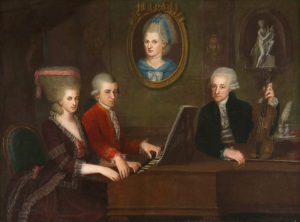
Johann Nepomuk della Croce (1736–1819). “Wolfgang Amadeus Mozart with his Sister Maria Anna and Father Leopold, with a Portrait of the Deceased Mother Anna Maria”, ca. 1780. Oil on canvas. Mozarteum Foundation, Salzburg, Austria.
Michael Weinstein-Reiman
UW–Madison open-topic Resident Fellow (2025–2026)
Assistant Professor, Mead-Witter School of Music, UW–Madison
French Revolutions in Keyboard Pedagogy, 1768–1804Before the storming of the Bastille, another kind of revolution was brewing. In the spring of 1768, the piano made its French debut—a relatively late arrival that nonetheless transformed how keyboard performers conceived of touch. Historians have often celebrated the piano as more tactile than its predecessor, the harpsichord. Put simply: while harpsichords could not vary their volume, pianos responded to the pressure of a keystroke, allowing for expressive nuance. Between 1768 and 1789, enterprising pedagogues began publishing manuals aimed at cultivating this new kind of touch. They introduced exercises—repetitive physical maneuvers designed to familiarize students with the piano’s mechanism. In treating touch as an educable sense, these pedagogues echoed the epistemologies of John Locke and the Abbé Condillac, whose philosophies also underpinned contemporaneous calls for nationalized education. These efforts culminated in the founding of the Paris Conservatory in 1795. This talk tracks how, by 1804, with the adoption of a formal piano curriculum at the Conservatory—an institution born from the merger of a military school and the Royal Academy of Singing, a remnant of the Ancien Régime—the piano had become not just a musical instrument, but a symbol of revolutionary pedagogy.Michael Weinstein-Reiman is a historian of music theory whose work examines how musical thought intersects with broader intellectual, cultural, and pedagogical traditions. His research spans eighteenth- and nineteenth-century European philosophy, music education, literature, gender and sexuality, and disability studies. He earned his Ph.D. in Music Theory from Columbia University in 2021, where his work was supported by Columbia’s Dean’s Fellowship, the Georges Lurcy Foundation, and the French Embassy’s Chateaubriand Fellowship.
*Events currently open only to 2025-26 fellows due to space concerns; please contact IRH at info@irh.wisc.edu to be added to a cancellation list for in-person events.*