Self-Representation and Burlesque Portraiture in Golden Age Spanish Poetry

This event has passed.

@ 3:30 pm - 5:00 pm

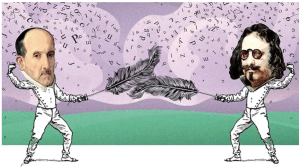
The image, by illustrator Mabel Rodríguez, shows Spanish writers Góngora and Quevedo fighting. Instead of swords, they use quills.
Illustration by Mabel Rodríguez featured in the article “De Góngora y Quevedo a Pardo Bazán y Murguía: las enemistades literarias más sonadas de la historia” (10 May 2024). Courtesy of La Voz de Galicia.

Ignacio Arellano-Torres

Birutė Ciplijauskaitė Fellow in Peninsular Spanish Literature and Culture (2025–2026)

Assistant Professor, Department of Languages, Literatures, and Cultures, Adelphi University

Self-Representation and Burlesque Portraiture in Golden Age Spanish Poetry
This seminar examines a cluster of burlesque self-portraits in Spanish Golden Age poetry, focusing on texts by Góngora and several other seventeenth-century writers. In these poems, the speaking subject offers an intentionally unflattering description of his own body: ugliness, disproportions, defects, and physical shortcomings are foregrounded rather than concealed. The effect is comic, but it is also structurally revealing. When the poet assumes the role of his own satirist, the dynamics of insult shift. Because the description originates in the subject itself, language loses much of its offensive force and becomes instead a vehicle for irony and generic play. These self-portraits engage prosopographical and ethopoetic techniques while simultaneously parodying established poetic models, particularly idealizing traditions that elevate beauty and harmony. Rather than reading these texts as mere self-deprecation, I approach them as deliberate acts of self-positioning within the literary culture of the period. The burlesque self-portrait allows the poet to control his public image, to anticipate ridicule, and to transform vulnerability into a form of rhetorical authority. In doing so, these poems invite us to reconsider how humor, distortion, and exaggeration function within early modern Spanish poetics—not as marginal curiosities, but as central strategies of representation.

Ignacio D. Arellano-Torres is an Assistant Professor of Spanish at Adelphi University and the 2025–2026 Biruté Ciplijauskaité Fellow in Peninsular Spanish Literature and Culture. He specializes in early modern Spanish literature and is the author of Realismo, fantasía y alegoría: Viaje y espacio en la literatura del Siglo de Oro (2025). He has also edited volumes on literary adaptation, burlesque comedies, and autos sacramentales. His scholarship, published in journals including HispaniaBulletin hispanique, Romance NotesHispanófila, and Anales Cervantinos, examines topics ranging from literary space and soundscapes to cultural encounters across early modern Spain and the Americas. He has received several fellowships and awards, including the John H. Daniels Fellowship, the Harry Ransom Center Fellowship, the L.M. McKneely Endowed Professorship in Humanities at the University of Louisiana–Monroe (where he previously taught), and the Luis Murillo Award from the Cervantes Society of America, alongside multiple recognitions for teaching excellence. At Adelphi, he teaches courses on Spanish language, literature, translation, and intercultural competence. He is also, in lower-case letters, an amateur artist.

*Events currently open only to 2025-26 fellows due to space concerns; please contact IRH at info@irh.wisc.edu to be added to a cancellation list for in-person events.*