The Labor of Images: Work and Its Discontents in Brazilian Cinema
This event has passed.
University Club, Room 212
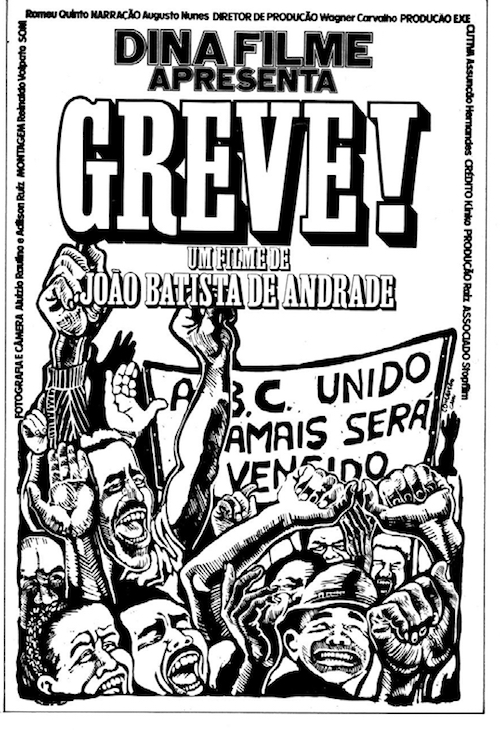
Image: Poster for the film “Greve! (Strike!),” João Batista de Andrade, Brazil, 1979.
Monday Seminar:
Sarah Ann Wells
Resident Fellow (2019-2020)
English, UW–Madison
What is the relationship between labor and cinema? Focusing on a pivotal moment for modern labor — the 1970s — this project analyzes the emergence of two opposing approaches to work in Brazilian cinema: on one hand, its legitimation and elevation; on the other, its disorganization and devaluation via an aesthetics of anti-work. As a lens into the shifting status and forms of labor, Brazilian cinema of the ‘70s also poses a question that has haunted this art form since its origins, one that has only become more pressing in the present: how might film capture the uneven experiences of labor on a global scale?
Sarah Ann Wells is Associate Professor in the Department of English at UW–Madison. She is the author of the book Media Laboratories: Late Modernist Literature in South America (Northwestern, FlashPoints, 2017; winner of the Southern Cone Section of the Latin American Studies Association’s Best Book in the Humanities Prize) and co-editor of Simultaneous Worlds: Global Science Fiction Cinema (Minnesota, 2015). Her scholarship has appeared in Modernism/Modernity, The Global South, Luso-Brazilian Review, Revista Iberoamericana, A Contracorriente, and the volumes Cosmopolitan Film Cultures in Latin America (Indiana, 2017) and Comintern Aesthetics (Toronto, 2019). She is currently writing a book entitled The Labor of Images: Work and its Discontents in Brazilian Cinema, 1975 to the Present (recipient of an ACLS Fellowship for 2017-2018).