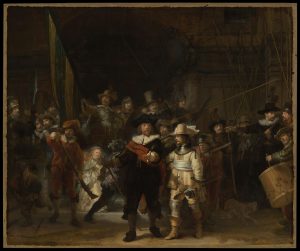
Rembrandt van Rijn, The Night Watch Militia Company of District II under the Command of Captain Frans Banninck Cocq [The Night Watch], 1642, oil on canvas, 379.5 × 453.5 cm, on permanent loan from the City of Amsterdam (1808), image courtesy of the Rijksmuseum Collection.
Solmsen Fellow (2024–2025)
PhD, Philosophy, Université Paris 8
The Martial Virtue of States in Spinoza’s Political Treatise
Spinoza’s (1632–1677) posthumously published
Political Treatise—not to be confused with the
Theological-Political Treatise from 1670—gives us Spinoza’s final considerations in political philosophy. Spinoza’s chief aim is to design long-lasting states that empower their citizens. The central place of the war powers of the state in Spinoza’s thinking about states remains largely unnoticed by scholars: for Spinoza, the power for war belongs to the essence of the state. Model states are designed to succeed at war and best take advantage of the power for war. To that end, model states cultivate martial virtue in citizen armies. For this seminar presentation, I examine two strands of Spinoza’s reasoning. The first concerns Spinoza’s argument for the claim that the power for war belongs to the essence of the state, which sits in an uneasy tension with Spinoza’s presentation of the origin of the state in the
Political Treatise. The second concerns Spinoza’s conception of the martial virtue of model states and their citizen armies, and the influence on Spinoza of Machiavelli’s theory that having arms of one’s own is a form of
virtù.
Jack Stetter (PhD, Université Paris 8) works primarily on early modern philosophy with a special focus on Spinoza. His publications include articles for the
Journal of Modern Philosophy,
Modern Judaism,
Crisis and Critique, the
Revista Seiscentos, the
Blackwell Companion to Spinoza, and the
Springer Encyclopedia of Early Modern Philosophy and the Sciences. With Charles Ramond, he is co-editor of
Spinoza in Twenty-First Century American and French Philosophy (Bloomsbury, 2019). With Stephen Howard, he is co-editor of
The Edinburgh Critical Guide to Early Modern and Enlightenment Philosophy (forthcoming).
*Events currently open only to 2024–25 fellows due to space concerns; please contact IRH at info@irh.wisc.edu to be added to a cancellation list for in-person events.*
