
Debunking the Divide between Art and Scholarship: An Interview with Andrea Harris
Earlier this summer, outgoing IRH Director Steven Nadler presented Andrea Harris (Open-topic Senior Fellow, 2023–2027) with an award for Perfect Monday Seminar Attendance. The certificate, which came with a coveted IRH-branded tote bag, was given in a somewhat humorous spirit—more emblematic of the collegial bond that Steve and Andrea had formed over several years than any actual competition. But on a more serious note, the award reflects only a fragment of the time and care that Andrea puts into both the Institute and the University.
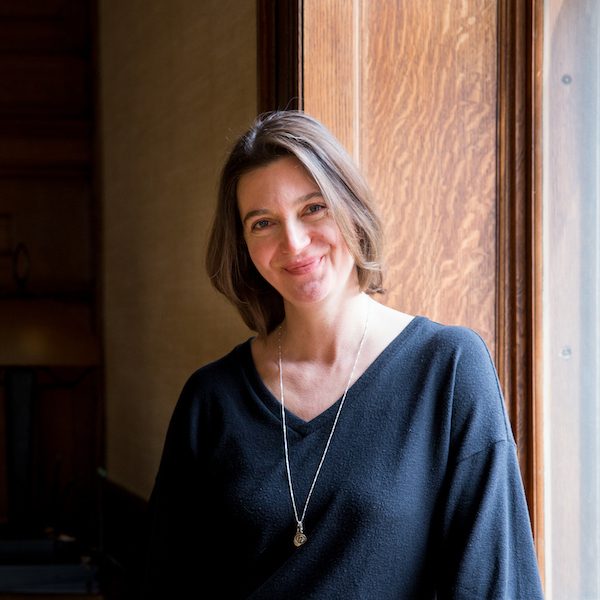
Twice an IRH fellow, Andrea first became affiliated with the Institute in 2019–2020 as a Resident Fellow. It was there that the book project she is now working on as a Senior Fellow—The Body Is an Instrument: Science, Therapeutics, and the Beginning of Modern Dance—really began to take shape. Originally a history of the field of dance/movement therapy, the project has since expanded to become a more ambitious and significant history of the therapeutic origins of modern dance as a whole. Andrea credits much of the book’s broadened scope to the IRH community. “It’s hard to overstate how much the intellectual community and camaraderie at the IRH has expanded my thinking, pushed the interdisciplinary boundaries, and bolstered my confidence in my project,” she told us.
Andrea is currently Professor of Dance in UW–Madison’s School of Education, where she has taught courses in dance history, dance studies, and movement analysis since 2009. But her affiliation with the University began well before that. It was 1999, and Andrea was teaching Dance at the University of Oklahoma after earning her MFA. There, she became aware of a severe need for trained dance historians in university dance departments. Pursuing a PhD had already been on Andrea’s mind, but it was this awareness that finally catapulted her back into graduate school. And, as one may have guessed, that graduate school was UW–Madison.
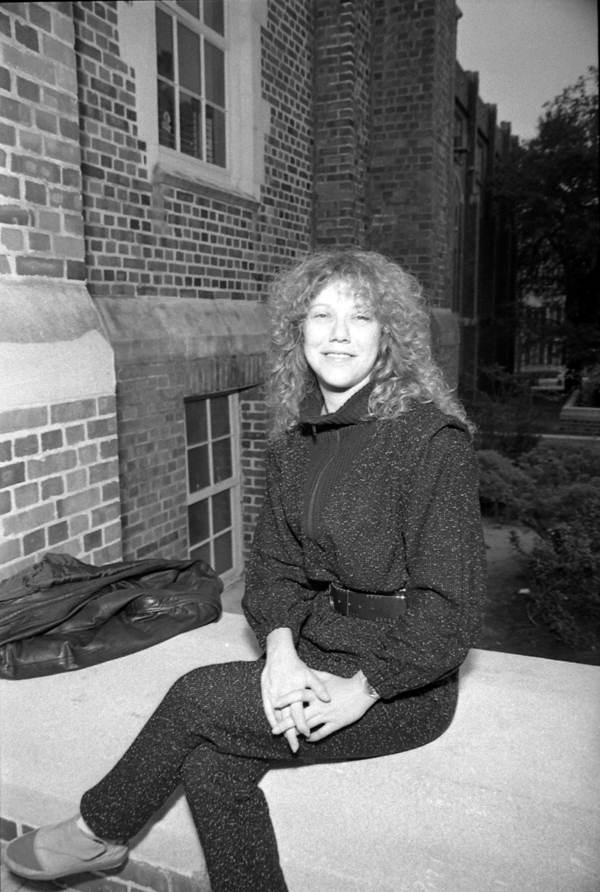
Andrea chose UW–Madison to study with the renowned performer and historian Sally Banes, who is also a former IRH Director (2001–2002). “I was reading Banes’s Dancing Women: Female Bodies Onstage, and that book was pivotal for me in envisioning a scholarly way of seeing and studying dance,” Andrea recalled. “It played a big part in motivating me to become a dance historian.” Sadly, Andrea’s advising relationship with Banes was cut all too short—Banes suffered a debilitating stroke in 2002, just as Andrea was wrapping up PhD coursework and preparing to start her dissertation with Banes.
Andrea remained close to Banes nevertheless. At the request of Banes’s husband—eminent philosopher Noël Carroll—Andrea helped Banes finish an anthology that she was editing: Reinventing Dance in the 1960s: Everything Was Possible (2003). She continued to spend time with Banes as well, sorting through and re-reading her writings to try to help her recovery. The result of this process was a lasting collection of Banes’s work: Before, Between, and Beyond: Three Decades of Dance Writing (2007), which Andrea edited. “It was definitely a loss, as a graduate student, to not have Sally when I wrote my dissertation,” Andrea explained. “But through both of those editions, I spent many, many hours with her work, which became like a sort of mentoring in itself, through her writing.”
“I feel the dance world is generally not divided between the academics and the creative practitioners, and there is a sense of mutual respect, value, and interdependence, no matter what the research focus.”
Banes was a pioneer in the field of dance studies—the humanities-based field focusing on historical, ethnographic, and theoretical studies of dance within which Andrea’s research and teaching is most squarely situated. One might expect that her position as a scholarly researcher would put her at odds with the artists and performers in her home department. But this perceived divide is far from the truth. “The majority of the dancers I have known are passionate about dance studies, because they care about its history and about the impact dance makes in and on its social and political surroundings,” Andrea said. “So I feel the dance world is generally not divided between the academics and the creative practitioners, and there is a sense of mutual respect, value, and interdependence, no matter what the research focus.”
It’s impossible to quantify the incredible amount of service that Andrea has done for the Dance Department. For the past year, she has been conducting research in the UW Archives on Margaret H’Doubler, the basketball coach-turned-dance pedagogue who started the nation’s first degree in dance at UW–Madison in 1926. Though some of this research is for her next book, she is currently using it to write an introduction for the fourth edition of H’Doubler’s Dance: A Creative Art Experience (1940), which will be republished by UW Press in 2026 as part of the centennial celebration of the nation’s first dance degree.
This past year, Andrea also collaborated with her colleagues to establish an MFA program in Dance, which will welcome its first students in the fall. The program has two tracks: Creative Research, Culture, and Practice; and Screendance, the latter of which is the first program of its kind in the country. “More and more artists are creating screendance works and more departments want to add screendance courses and positions,” Andrea told us. “With this growing demand for screendance, our MFA will fill a need for terminal degree credentials in the field.”
In April of 2027, the official centennial celebration for the Dance Department will take place. As part of the celebration, Andrea will participate in a panel on H’Doubler’s legacy with other dance scholars. Attendees can also look forward to a keynote address by phenomenologist and Dance Department alumna Maxine Sheets-Johnstone, as well as performances and classes throughout the weekend.